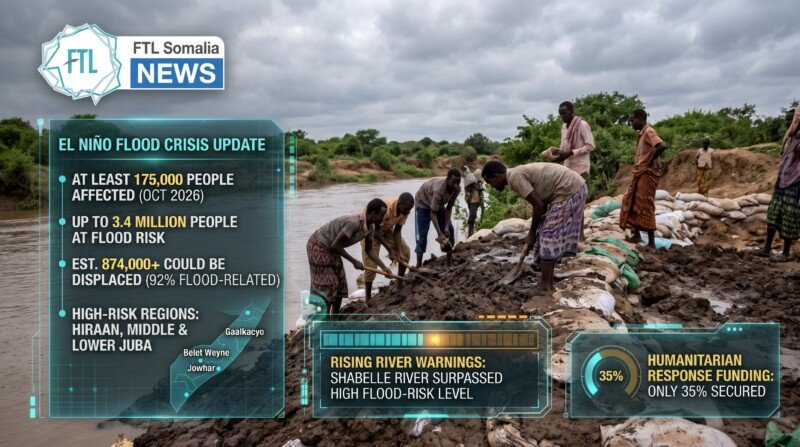
MOGADISHU, At least 175,000 people have been affected by El Niño-linked heavy rains and flash floods across several regions of Somalia in October, with shelters, latrines, and water points damaged or flooded, according to the latest humanitarian update from the United Nations Office for the Coordination of Humanitarian Affairs.
Projections show that up to 3.4 million people could face flood risks between October and December, with Hiraan, Middle Juba, and Lower Juba regions most exposed. The International Organization for Migration and the Danish Refugee Council estimate that more than 874,000 people may be displaced, with flooding accounting for 92 percent of the projected displacement.
The most affected areas so far are Gaalkacyo, Abudwaq, and Baidoa. Area-based coordination teams reported 1,515 shelters or houses destroyed and 4,498 damaged during October. Also damaged or flooded were 2,110 latrines, 137 water points, 72 schools, and 55 health facilities.
Anticipatory Action, But Not Enough
Ahead of the projected El Niño rains, humanitarian agencies activated a Floods Anticipatory Action Implementation Plan, backed by $7 million from the Central Emergency Response Fund and a further $1 million from the Somalia Humanitarian Fund. The plan links early warning and flood forecasting to pre-arranged financing, enabling partners to act when predefined risk thresholds are reached.
The trigger mechanism draws on forecasting and monitoring systems tracking rainfall, river discharge, and water levels in the Juba and Shabelle rivers. The plan focuses on 14 high-risk districts, with interventions including early warning, cash and voucher assistance, displacement risk mapping, livelihood protection, and the pre-positioning of essential supplies.
But the scale of the response remains far below what is needed. The 2026 humanitarian response plan has received only 35 percent of its required funding, leaving large gaps in a crisis that is both foreseeable and recurring. As IOM warned in late October, the agency had secured only about 14.4 percent of the $16.62 million it needs to prepare for and respond to the floods, with the shortfall already constraining efforts to establish safe relocation areas and provide essential shelter, clean water, sanitation, and healthcare.
The Rivers Are Already Rising
The warnings are not theoretical. In early October, the Shabelle River at Jowhar rose from 2.48 metres to 4.70 metres in a single week, approaching the moderate flood-risk threshold. By mid-October, the river had surpassed its high flood-risk level and was forecast to reach bankfull, with a new rise moving downstream from Belet Weyne.
The FAO’s Somalia Water and Land Information Management programme has identified 388 sites along the Shabelle River with flood-related conditions, including breaches, openings, and blockages. In late October, the Shabelle river level rose significantly, approaching moderate flood-risk thresholds in Belet Weyne district in Hiraan region. Partners are concerned that further rainfall could trigger displacement, disrupt road access, and constrain the movement of humanitarian and commercial supplies along key corridors.
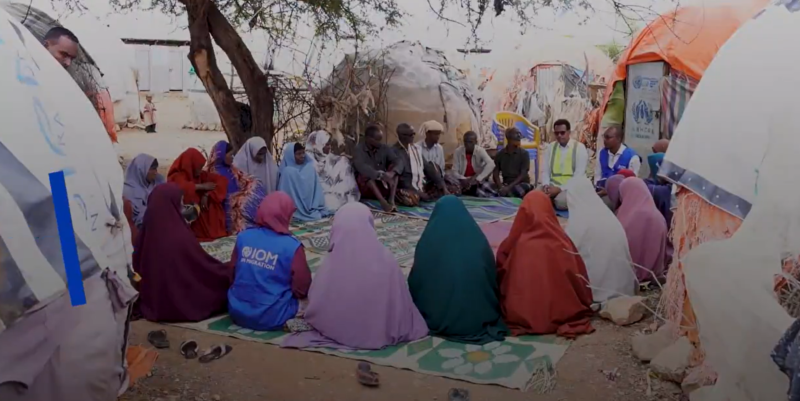
Flooding has already displaced families in Puntland. In Godob-yar village in the Nugaal region, heavy rainfall inundated homes, cut off roads, and forced families to flee to the outskirts of the village. The collapse of toilets and the mixing of sewage with floodwater created a serious health risk, with concerns about waterborne diseases such as cholera.
Lessons from 2023
The current anticipatory action plan is explicitly designed to apply the lessons of the 2023 floods, which affected approximately 2 million people and displaced 1.2 million. An estimated 691 water sources and 17,900 latrines were damaged, severely disrupting access to safe water and sanitation. Twenty-eight health facilities were also severely affected.
The Somali Disaster Management Agency has placed 29 districts across 14 regions on high alert for riverine and flash flooding, including Jowhar, Beledweyne, and Gaalkacyo. The agency has urged communities to clear drainage channels and prepare for possible displacement. SoDMA Commissioner Mohamud Moallim Abdulle also led an emergency mission to Beledweyne in September to accelerate preparedness efforts in one of the most flood-vulnerable cities in the country.
Conflict Complicates the Response
The floods are not the only crisis. Renewed conflict and insecurity in Bay Region, South West State, are causing new displacement and further complicating humanitarian operations. Significant numbers of humanitarian workers have temporarily relocated from Burhakaba district since mid-October, alongside civilians who have fled to safer areas.
Burhakaba was already hosting people displaced by drought and previous rounds of fighting, and a risk of famine was identified there earlier this year. The flooding risk is further complicating the operating environment, though frontline responders remain on the ground with support continuing in several humanitarian sites.
Critical Note
Somalia’s humanitarian system is being tested on multiple fronts at once. The floods are unfolding in regions that are still recovering from the 2023 disaster, and in some cases, in areas where conflict is actively displacing people. The anticipatory action plan is a genuine improvement on the reactive model of the past, and the $7 million from CERF shows that early warning can trigger early money. But 35 percent funding for the response plan is not a gap. It is a failure.
The rivers have already risen. Families in Godob-yar have already fled their homes. The Shabelle has already surpassed its high-risk threshold at Jowhar. The early warning systems that the humanitarian system has built are working. The question is whether the money will follow the warnings, or whether Somalia will repeat the pattern of 2023, when the world was told what was coming and failed to act until it was too late.
The international community has grown accustomed to Somalia’s crises, and the money follows the headlines rather than the forecasts. The 2023 floods were a warning. The current rains are testing whether the lessons of that disaster were actually learned, or merely written into plans that cannot be financed. The answer will be determined not in Mogadishu’s conference rooms but in Belet Weyne and Gaalkacyo, where families are watching the water rise.
Recommended Reading On ftlsomalia.com
- IOM Warns 874,000 Could Be Displaced as Floods Threaten Somalia
- Shabelle River Nears Flood Alert Level at Jowhar as El Niño Rains Intensify
- Flooding Displaces Residents in Godob-yar Village as El Niño Rains Begin in Puntland
- SoDMA Urges 29 Districts Across 14 Regions to Prepare for Super El Niño Flooding
- SoDMA Chief Leads Emergency Mission to Beledweyne as El Niño Flood Fears Mount