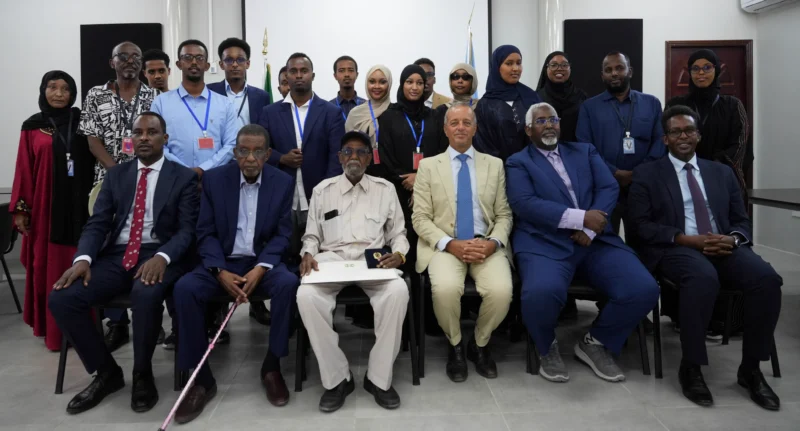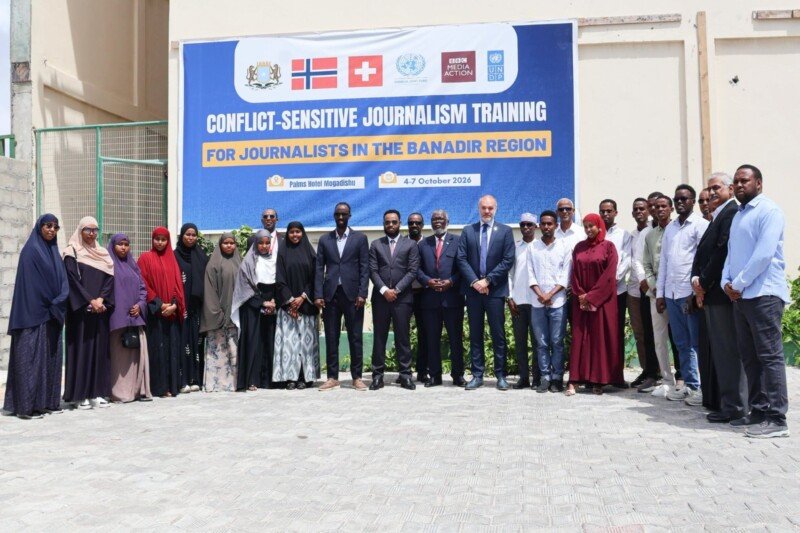
MOGADISHU — The Director General of Somalia’s Ministry of Information, Culture and Tourism, Abdullahi Hayir Duale, has launched a joint training programme with UNDP Somalia and BBC Media Action aimed at strengthening conflict-sensitive journalism in the country.
The programme supports Somali journalists in producing accurate, responsible and public-interest reporting, with a focus on understanding conflicts, verifying information, countering disinformation and misinformation, media ethics, and the role of media in peacebuilding.
The first training session, lasting four days, brings together 20 journalists from the Banadir region. A second cohort of 20 journalists from Hirshabelle will follow, with their training scheduled for 11-14 October 2026. Participants are also being trained in the use of the UNDP Somalia Conflict Navigator, a tool designed to help journalists understand conflict situations and prepare responsible reports.
Government and UNDP Emphasise Responsible Reporting
Duale emphasised the importance of media providing accurate and responsible information to the public, particularly during conflicts and sensitive situations.
The Director General of the Ministry of Interior, Federal Affairs and Reconciliation, Abdulqadir Ali, highlighted that the information journalists share with the public affects how events are understood and how communities respond.
Christophoros Politis, UNDP Somalia’s Resident Representative, said at the event that independent, accurate and responsible media plays a critical role in building public trust.
Critical Note
The launch of a conflict-sensitive journalism training programme is a welcome initiative in a country where media freedom remains deeply constrained. Somalia ranks 126th out of 180 countries in the 2026 RSF World Press Freedom Index, and journalists face harassment, arrest, violence and impunity for crimes committed against them. The National Union of Somali Journalists documented 72 press freedom violations in 2025 alone, including the killing of one journalist. Most violations were committed by police forces in full impunity.
Training journalists to report responsibly on conflict is valuable. But the most serious threats to Somali journalism do not come from a lack of skills or ethics among reporters. They come from the state itself. Journalists are arrested by security forces, tortured in military detention, and killed by police officers at checkpoints. The government that is now sponsoring this training programme is the same government whose security forces are responsible for a majority of documented violations.
The UNDP Somalia Conflict Navigator and the training sessions may help journalists navigate complex conflict dynamics and improve their professional standards. But unless the government addresses impunity for attacks on journalists, implements legal reforms to protect media freedom, and respects the independence of the press, these initiatives risk being undermined by the very conditions they are meant to address. A journalism training programme is not a substitute for an environment where journalists can work without fear.
Recommended Reading On ftlsomalia.com
- Journalists Arrested, Beaten in Mogadishu Amid Press Freedom Crackdown
- Journalist Mascuud Warsame Released After 40 Days of Unlawful Detention in Mogadishu
- Somali Media Association Condemns Violations Against Journalists
- RSF Calls on Somali Authorities to End Impunity for Violence Against Journalists