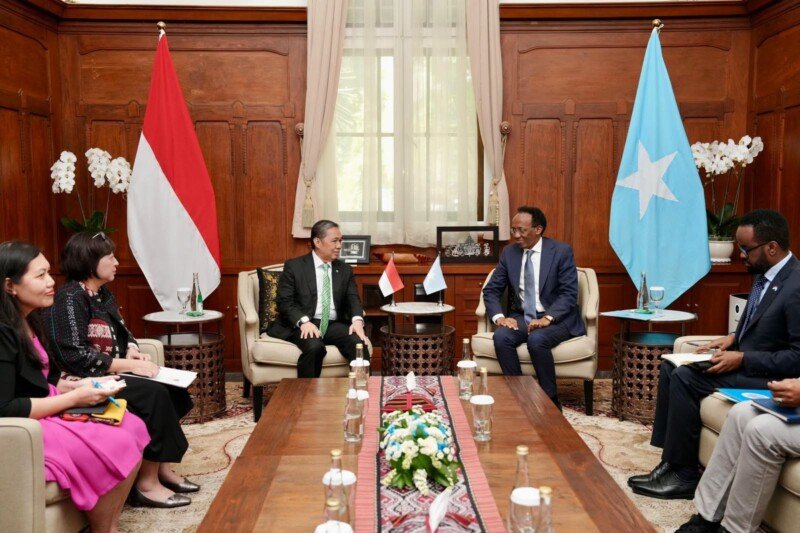
JAKARTA, Somalia’s Deputy Minister of Foreign Affairs and International Cooperation, Hassan Mohamed Ali, held formal bilateral talks with his Indonesian counterpart, Anis Matta, at the Indonesian Foreign Ministry in Jakarta on Thursday, focusing on expanding cooperation in trade, agriculture, fisheries, and maritime security.
The meeting covered a broad agenda, including investment opportunities, livestock, the blue economy, education, healthcare, infrastructure, and energy. The two sides also exchanged views on regional political developments, institutional capacity-building, and coordination of their positions at the United Nations and the Organisation of Islamic Cooperation (OIC).
Both officials reaffirmed their commitment to strengthening friendly relations and expanding practical cooperation based on mutual respect and shared interests. The Somali foreign ministry statement did not announce specific agreements, investment commitments, or timelines for implementing the proposed initiatives.
A Relationship With Momentum
The Jakarta talks build on a diplomatic push that has accelerated since Somalia’s Foreign Minister, Abdisalam Abdi Ali, made his first official visit to Indonesia in July 2025. As FTL Somalia reported on the Jakarta meeting, that visit produced agreements to deepen cooperation in trade, agriculture, maritime affairs, and education, and included the signing of a visa waiver agreement for holders of diplomatic and official passports.
The engagement has continued at multiple levels. In August 2026, Deputy Prime Minister Salah Ahmed Jama hosted Indonesia’s Ambassador to Somalia, T.B.H. Witjaksono Adji, for talks focused on education, fisheries, the blue economy, and expanding opportunities for mutual collaboration. As FTL Somalia reported on the Deputy PM’s meeting, the engagement builds on a series of high-level exchanges, including the Cabinet’s approval of the visa exemption agreement in July 2025.
Indonesia has positioned itself as a partner with technical expertise relevant to Somalia’s economic priorities. One concrete project already underway is Indonesia’s contribution to developing an Intensive Care Unit at East Africa University Hospital in Bosaso, carried out in partnership with Indonesian Aid and the Islamic Development Bank. In education, Indonesia has encouraged Somali students to use scholarship programs including KNB, Darmasiswa, and TIAS, and has expressed willingness to collaborate on diplomat training.
The relationship also has a maritime dimension that matters to both countries. Indonesia, an archipelagic state with significant experience in maritime industries, has committed to assisting Somalia in building naval capacity, including training for coast guard units focused on combating illegal fishing and piracy. For Somalia, whose coastline remains largely unguarded, that technical support addresses a critical gap. As FTL Somalia reported on the piracy resurgence, the international naval presence that once kept piracy in check has been drawn away by the Red Sea crisis, creating a security vacuum along Somalia’s coastline that local forces are struggling to fill.
The OIC and the Sovereignty Question
The OIC coordination discussed in Jakarta is not abstract. In January 2026, Anis Matta, the same Indonesian deputy foreign minister who met Hassan on Thursday, used an OIC extraordinary ministerial meeting in Jeddah to reaffirm Indonesia’s full support for Somalia’s sovereignty and territorial integrity, explicitly including Somaliland as an inseparable part of the country. As FTL Somalia reported on the OIC conference, Somalia and Egypt used the same meeting to coordinate their diplomatic opposition to Israel’s recognition of Somaliland.
Indonesia condemned Israel’s recognition of Somaliland as a violation of international law and the UN Charter, and proposed reactivating the OIC Contact Group on Somalia to safeguard the country’s territorial integrity. That position aligns Jakarta with Mogadishu on the most sensitive diplomatic issue Somalia faces, and it gives the bilateral relationship a political weight that goes beyond trade and technical cooperation. The OIC has consistently defended Somalia’s territorial integrity, as FTL Somalia reported when the organization condemned Somaliland’s Jerusalem embassy plan.
Critical Note
The meeting between Hassan Mohamed Ali and Anis Matta is a routine diplomatic engagement, and it should be reported as such. The agenda is broad, the language is warm, and the commitment to cooperation is genuine. But the absence of specific agreements, investment figures, or implementation timelines is telling. Somalia has held many such meetings with many partners. The question is not whether the intentions are good. It is whether the intentions translate into outcomes.
Indonesia is a potentially valuable partner. It has expertise in exactly the sectors Somalia needs to develop, from fisheries to agriculture to maritime security. It has demonstrated political solidarity on Somaliland. And it has a track record of concrete technical assistance, such as the intensive care unit in Bosaso. But the scale of Indonesia’s engagement remains modest compared to Somalia’s traditional partners. A few scholarships and a hospital unit are welcome. They are not a transformation.
The most significant dimension of the relationship may be the maritime one. Somalia’s waters are more dangerous than they have been in a decade, and the international patrols that once kept piracy in check have thinned. If Indonesia can help build the Somali coast guard’s capacity to patrol its own waters, that would be a contribution with lasting value. But training programs take time, and Somalia’s security transition is unfolding now. The question is whether Indonesia’s assistance will arrive in time to make a difference, or whether it will be another well-intentioned initiative that arrives after the crisis has already deepened.
Recommended Reading On ftlsomalia.com
- Deputy PM Hosts Indonesian Envoy as Mogadishu and Jakarta Expand Strategic Partnership
- Somalia, Indonesia Forge Closer Ties in High-Level Jakarta Meeting
- Somalia, Egypt Unite Against Somaliland Recognition
- OIC Condemns Somaliland’s Jerusalem Embassy Plan
- Puntland Forces Free Sibu 1 After 48-Hour Operation, Rescue 20 Crew Members