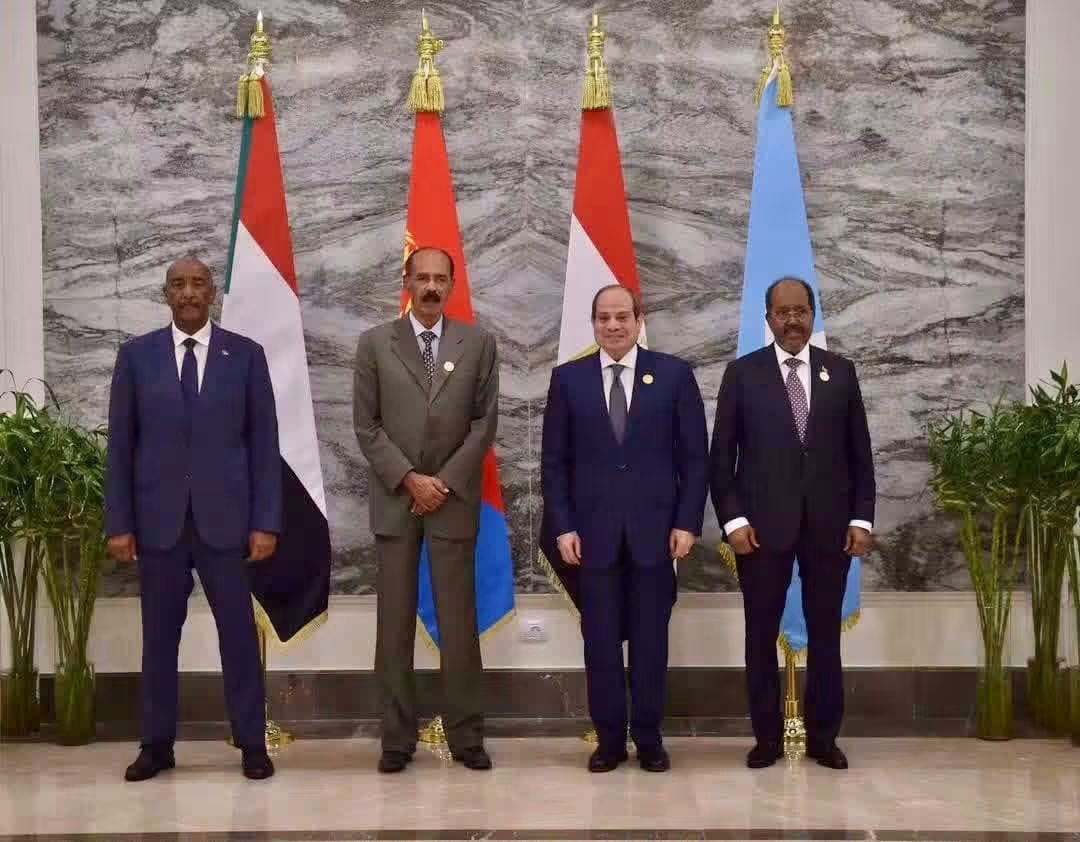
NEW ALAMEIN — The leaders of Egypt, Eritrea, Sudan and Somalia issued a joint declaration on Sunday formalizing their coordination on regional security, economic cooperation and shared political positions, following a four-way summit in the Egyptian city of New Alamein.
The declaration, released after the meeting between Egyptian President Abdel Fattah El-Sisi, Eritrean President Isaias Afwerki, Somali President Hassan Sheikh Mohamud and Sudanese Sovereign Council Chairman General Abdel Fattah al-Burhan, outlines a framework for cooperation that touches on the Nile River dispute, Red Sea security and the war in Sudan.
The four leaders stated that the summit addressed the need to preserve the fundamental principles and pillars of international law that underpin regional stability and cooperation, particularly respect for the sovereignty, stability and territorial integrity of regional states, the principles of good neighbourliness, and the rejection of interference in the internal affairs of regional countries under any pretext.
Somalia’s Sovereignty and Rejection of ‘Somaliland’ Recognition
The declaration explicitly affirmed support for the unity and sovereignty of the Federal Republic of Somalia and rejected any interference that undermines that unity, specifically referencing the recognition of what it called “Somaliland.” This position aligns with the Arab League, African Union and Organisation of Islamic Cooperation, all of which have rejected Israel’s December 2025 recognition of Somaliland. As reported in FTL Somalia’s coverage of the diplomatic dispute, President Mohamud recently stated that Somalia would not accept an Israeli presence “under any circumstances,” alleging that Israel plans to establish a naval base in Berbera and use its airport.
The leaders also expressed support for Somalia’s counterterrorism efforts and called on regional and international partners to provide adequate, sustainable and predictable funding for the African Union Support and Stabilization Mission in Somalia (AUSSOM) to fulfil its mandate. This comes as Ethiopia plans to withdraw more than 3,000 troops from Somalia’s South West State, where they have been operating under AUSSOM’s Sector 3 command, as detailed in FTL Somalia’s coverage of the withdrawal.
Sudan, the Nile and Red Sea Governance
On Sudan, the declaration affirmed support for the unity, sovereignty and territorial integrity of the Republic of Sudan and its national institutions, rejecting the establishment of parallel bodies. It called for the resumption of a Sudanese-led political process and the complete rejection of support for mercenaries.
On the Nile, the leaders emphasized the importance of respecting international law governing transboundary rivers, including the principle of no harm and the obligation to cooperate through prior notification, consultation and agreement. The declaration rejected any unilateral measures that negatively affect current water use in the downstream countries of the Nile. This language reflects Egypt and Sudan’s longstanding opposition to Ethiopia’s Grand Ethiopian Renaissance Dam, which they view as a threat to their water security.
On the Red Sea, the declaration affirmed the principle of freedom of navigation and stated that the management of the Red Sea is a responsibility exclusive to the littoral states. This position aligns with Egypt’s repeated calls for Red Sea governance to be restricted to bordering countries, as detailed in FTL Somalia’s coverage of Egypt’s Red Sea policy.
The leaders also agreed to continue strengthening consultation and coordination among the four countries.
Context of the Summit
The four-way summit was held on the sidelines of the Alamein Africa Forum, which brought together about 1,500 African business leaders, heads of state and government, and representatives of continental financial institutions. The forum, co-organized by the Egyptian government, the African Export-Import Bank and the African Union Development Agency, focused on investment, trade and economic cooperation.
The summit comes amid escalating regional tensions. Ethiopia is facing renewed fighting in Tigray, Amhara and Afar against a rebel alliance that includes the Tigray People’s Liberation Front (TPLF) and six other armed groups, as detailed in FTL Somalia’s coverage of the alliance. Tigrayan forces seized airports in Mekelle, Axum and Shire in late September, prompting Ethiopian Airlines to suspend flights to those cities. As reported in FTL Somalia’s coverage of the IGAD response, the regional bloc called for immediate de-escalation and respect for the Pretoria Agreement.
Ethiopia’s army chief, Field Marshal Birhanu Jula, publicly accused Eritrea, Sudan and Egypt of supporting the TPLF-led rebel alliance, allegations that all three countries denied. The accusations reflect a broader deterioration in Ethiopia’s relations with its neighbours, driven by the Nile dam dispute, Ethiopia’s pursuit of Red Sea access, and the conflict in Sudan.
Ethiopia has deepened its ties with the UAE, which has provided military support and facilitated Ethiopia’s maritime access strategy. The UAE’s involvement in the Sudan war, where it is widely alleged to have backed the Rapid Support Forces (RSF), has further complicated regional dynamics.
Critical Note
The Alamein Declaration formalizes an alignment that has been taking shape for months. Egypt, Eritrea, Sudan and Somalia now have a written framework for cooperation that explicitly addresses the Nile, Red Sea governance, Sudan’s civil war and Somalia’s territorial integrity. For Somalia, the declaration provides diplomatic backing at a time when its sovereignty is being challenged by Israel’s recognition of Somaliland and Ethiopia’s pursuit of separate deals with Hargeisa.
But the alignment carries significant risks. Somalia is now formally associated with a bloc that is openly opposed to Ethiopia, its largest neighbour and a fellow contributor to the African Union mission on Somali soil. Ethiopia’s withdrawal of 3,000 troops from South West State creates a security gap that Somalia may struggle to fill, and the loss of Ethiopian forces could be exploited by Al-Shabaab. The declaration’s call for sustainable AUSSOM funding is welcome, but it does not resolve the immediate problem of who will defend Baidoa if Ethiopian troops leave.
Egypt and Eritrea have their own agendas. Cairo’s primary concern is the Nile dam, not Somalia’s security. Asmara’s focus is its border dispute with Ethiopia and its opposition to Addis Ababa’s Red Sea ambitions. Somalia risks becoming a proxy in a wider confrontation that it cannot control. The declaration is a diplomatic success for President Mohamud, but the gap between the principles it enshrines and the security realities on the ground in Somalia remains wide.
Recommended Reading On ftlsomalia.com
- Somaliland Rejects Mogadishu’s Criticism, Offers Ethiopia Sea Access as Somalia Proposes UNCLOS Alternative
- ONLF Joins Seven-Group Ethiopian Alliance Against Abiy Government
- IGAD Calls for Immediate De-escalation as Tigray Forces Seize Airports
- Ethiopia to Withdraw 3,000 Troops from Somalia to Fight Rebels at Home
- Egypt Pushes for Red Sea Governance Restricted to Bordering Countries