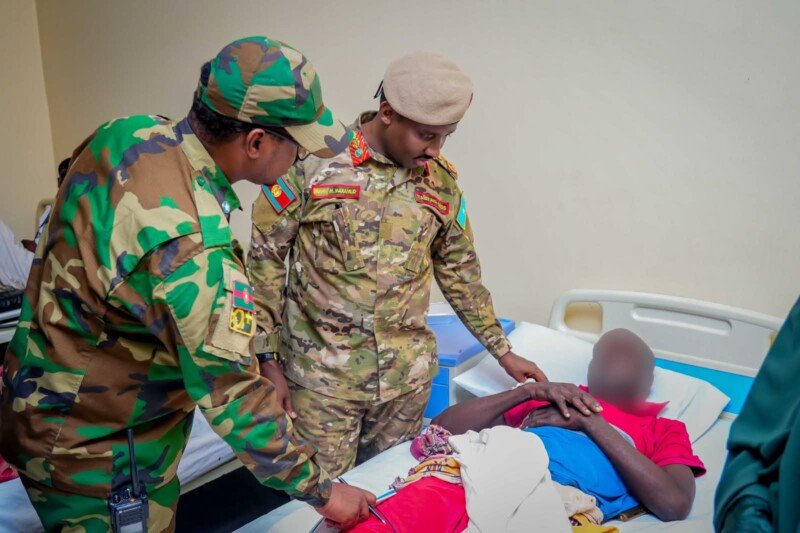
MOGADISHU, The commander of the Somali National Army, Brigadier General Ibrahim Mohamed Mohamud, visited soldiers wounded in operations against the Khawaarij Al-Shabaab at the army hospital in Mogadishu, according to a statement from the military.
The commander met each wounded soldier individually, inquiring about their medical condition and recovery, and offered support and encouragement. He also received a briefing from the hospital’s medical officers on the soldiers’ health and the treatment being provided.
The visit comes days after heavy fighting between government forces and Al-Shabaab militants in the Bay region, where the military says it killed dozens of fighters but has disclosed limited information about its own casualties. The engagement near Leego and Jameeca on October 26 was the most significant battle of the ongoing Operation Banooda, which the military launched to degrade the group’s capabilities in South West State.
The Battle Behind the Hospital Visit
The wounded soldiers were evacuated following clashes near Jameeca village in Burhakaba district. The Defence Ministry claimed its forces killed 75 Al-Shabaab militants and wounded 56 others during hours of fighting after militants attacked a military convoy, though those figures could not be independently verified. The ministry acknowledged that Al-Shabaab used explosives-laden vehicles against army vehicles and that some government transport was damaged, but did not provide a detailed account of its own dead, wounded, or missing.
Accounts from soldiers who survived the battle diverged sharply from the official narrative. Two soldiers speaking to Reuters on condition of anonymity described a far heavier toll, with one saying he helped transport 40 dead soldiers and more than 100 wounded to Mogadishu. Garowe Online reported that 36 military vehicles were lost, including six Turkish-made Kirpi armoured vehicles, and that several officers were reported missing. As FTL Somalia reported, the government convened an emergency cabinet meeting to discuss “heavy casualties,” according to local media, suggesting the losses were significant even if the exact figures remain contested.
Al-Shabaab claimed responsibility for the attack and asserted far higher government casualties, claiming it killed 321 soldiers and captured prisoners and equipment, claims that also could not be independently confirmed.
Casualty Transparency and Military Morale
The visit by the army chief is a standard morale-building measure, but it unfolds amid broader questions about how the military documents and communicates losses. A senior general subsequently revised the militant death toll slightly downward to 70, while acknowledging that the discrepancy between official claims and soldiers’ accounts is a gap that transparency would help close.
Military authorities have not publicly clarified the status of personnel reported missing after the clashes, nor have they provided a breakdown distinguishing confirmed deaths from wounded soldiers and those whose whereabouts remain unestablished. Such gaps complicate public understanding of the human cost of operations and can affect trust between the military and the communities it draws recruits from.
The Broader Campaign
The Leego engagement is part of a wider military push against Al-Shabaab, conducted under Operation Banooda and supported by international partners including the African Union Support and Stabilization Mission in Somalia. The operation has involved multiple axes of advance in the Bay and Lower Shabelle regions, with the military describing its objective as disrupting the group’s ability to regroup and rearm.
The fighting also intersects with a separate political dispute in South West State, where federal forces have been engaged in operations tied to efforts to consolidate authority over the regional administration. The political dispute with former regional leader Abdiaziz Laftagareen has diverted resources and attention from the counterterrorism campaign, creating openings for Al-Shabaab to exploit. As FTL Somalia noted in its coverage of the Jameeca battle, until the federal government and the regional opposition resolve their differences, the army will be fighting on two fronts.
The Leego area itself has been contested for years. In 2020, Al-Shabaab recaptured the town from government troops shortly after the army had briefly taken it, underscoring the difficulty of holding territory in the region even after tactical gains.
Critical Note
The army chief’s hospital visit serves a legitimate purpose, showing attention to wounded personnel whose care and recovery are a basic obligation of any military. But it should not substitute for the transparency that the public and the ranks themselves are owed. The government has been quick to publicize militant casualties while remaining largely silent on its own. That asymmetry is understandable in wartime, but it is also unsustainable if it persists.
Soldiers who are wounded, killed, or missing are not abstractions. Their families need clear answers, and the military’s credibility depends on its willingness to provide them, even when the numbers are painful. The accounts of soldiers who spoke to Reuters, describing dozens of dead and over a hundred wounded, deserve a fuller public accounting than the Defence Ministry has so far offered. The emergency cabinet meeting on “heavy casualties” confirms that the government itself understood the scale of the loss, even as its public statements remained vague.
The campaign against the Khawaarij is necessary, but it will be judged not only by territory recaptured or fighters killed. It will also be judged by how the state treats those who bear the cost, and by whether the institutions sending them into battle are capable of honesty about what happens when they return, or do not.
Recommended Reading On ftlsomalia.com
- Somali Army Kills 75 Al-Shabaab Militants in Major Operation Near Buurhakaba
- National Security Office Denies Turkish Aircraft Struck Somali Troops, But Questions Remain
- Federal Government Deploys Senior Military Commanders to South West Frontlines as Fighting Intensifies
- Somalia’s Danab Commandos Launch Operation Banooda, Kill Seven Al-Shabaab Militants
- Al-Shabaab Recapture Leego Town from Government Troops