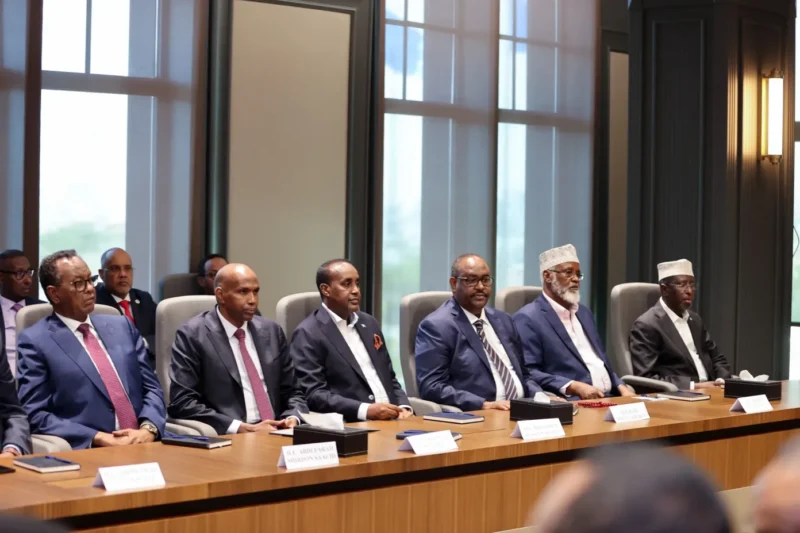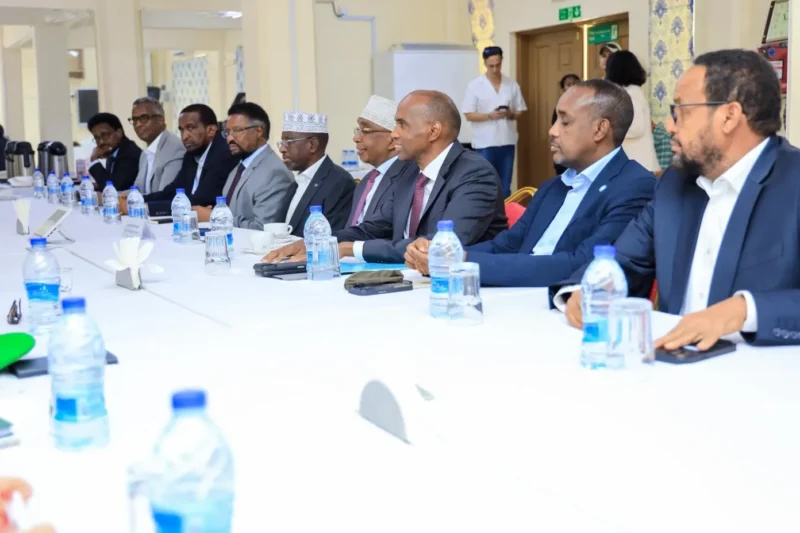
MOGADISHU, Somalia’s State Attorney General has formally requested that both houses of the Federal Parliament and the Ministry of Justice and Constitutional Affairs submit all documentation related to the constitutional review and amendment process, as the government prepares its defense in a Supreme Court case brought by former President Sharif Sheikh Ahmed.
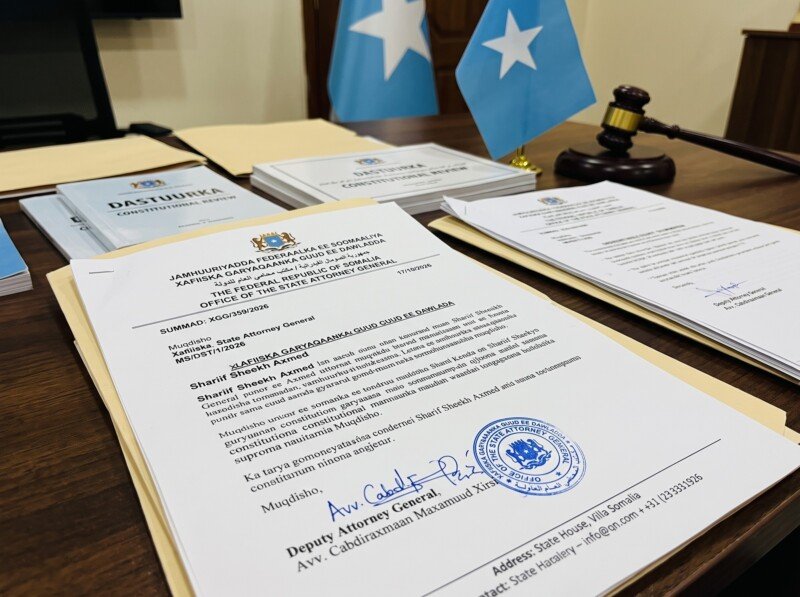
In a letter dated October 17, 2026, and addressed to the Speakers of the House of the People and the Upper House, the State Attorney General’s Office cited a Supreme Court summons issued on October 14 in case number MS/DST/1/2026. The office demanded that the relevant institutions provide reports and procedural records concerning the constitutional review by October 20, ahead of the government’s scheduled response to the court on October 22.
The Legal Challenge
Former President Sharif Sheikh Ahmed filed his petition with the Supreme Court on October 11, 2026, seeking to invalidate the constitutional amendments approved by Parliament in March 2026 and all decisions arising from them. The court admitted the petition the following day, as reported in FTL Somalia’s coverage of the filing. Sharif has argued that the amendments violated Chapter 15 of the Provisional Constitution, which sets out the procedures for constitutional review and safeguards the independence of the review bodies.
The amendments, adopted on March 4, 2026, extended presidential and parliamentary terms from four to five years, a change the opposition contends cannot retroactively apply to the current institutions. President Hassan Sheikh Mohamud signed them into law on March 8, formally ending Somalia’s provisional constitutional phase.
The legal challenge is unfolding against a backdrop of deepening political fracture. The Somali Salvation Forum, an opposition alliance that includes Puntland, Jubaland, and several former presidents and prime ministers, has rejected the election timetable announced by the National Independent Electoral and Boundaries Commission, accusing the government of “election theft” and warning that proceeding without consensus risks parallel elections and civil conflict, as reported in FTL Somalia’s coverage of the opposition rejection.
Former President Mohamed Abdullahi Farmaajo has also entered the fray, accusing President Mohamud of sabotaging internationally mediated talks and insisting on elections without political agreement. Farmaajo’s statement, reported in FTL Somalia’s coverage of his rebuke, called on international partners not to “again endorse the agenda of the term-expired President.”
The Attorney General’s Request
The State Attorney General’s letter, signed by Deputy Attorney General Abdirahman Mahmud Hirsi, requests that the institutions submit the “reports and procedures that the constitutional review and amendment process went through” to allow the office to fulfill its legal obligations in defending the government before the Supreme Court.
The letter specifically references documents listed on page 10 of the petitioner’s filing dated October 11, 2026, though it does not detail what those documents are. The request carries a deadline of October 20 at 2:00 PM, two days before the government’s scheduled response to the court.
The Supreme Court case places the government in the position of defending the legality of a process that has been rejected by two federal member states and a broad coalition of opposition figures. The Attorney General’s demand for internal records suggests the government’s legal defense will rely on procedural documentation from the very institutions that enacted the amendments.
The judiciary itself is in the midst of restructuring under the amended constitution. The Independent Constitutional Review and Implementation Commission has formally requested urgent judicial reform in Mogadishu, asking the Chief Justice to align the capital’s courts with the new constitutional framework, as reported in FTL Somalia’s coverage of the judicial reform request. This parallel effort to reshape the courts while the Supreme Court prepares to rule on the constitutionality of the amendments themselves raises questions about the sequencing of institutional change.
A Precalculated Legal Strategy
There is a plausible reading of this sequence that goes beyond routine litigation. The government’s demand for internal records, the carefully set timeline, and the Supreme Court’s rapid admission of the petition together suggest a strategy that was anticipated well before Sharif filed his case.
The Supreme Court is widely perceived as aligned with Villa Somalia. If that perception holds, the government’s legal defense may be less about persuading an independent arbiter than about assembling a procedural record that the court can cite to uphold the amendments. In that scenario, the court case becomes a mechanism for legitimizing a political outcome that was already decided, not a genuine test of constitutional compliance.
There is a second possibility. Even if the court does not fully side with the government, a prolonged legal process could serve a different purpose: steering the electoral dispute into a forum where the government can shape the terms of engagement. A court ruling that acknowledges procedural irregularities, even while declining to invalidate the amendments, would give Villa Somalia a legal basis to negotiate, delay, or restructure the electoral timetable without appearing to simply impose its will.
Under this reading, the Attorney General’s letter is not an administrative formality. It is an attempt to construct a legal narrative in advance, one that will allow the government to claim that the process was scrutinized, that documents were submitted, and that the court’s eventual decision, whatever it is, validates the government’s position. The opposition’s legal challenge is thereby absorbed into a process that the government controls.
The stakes extend beyond the courtroom. Puntland and Jubaland have already rejected the constitutional amendments and the electoral framework built upon them. Jubaland has declared itself an independent government and withdrawn from the federal structure, while Puntland has severed ties with Mogadishu, as reported in FTL Somalia’s coverage of the federal-state rift. A Supreme Court ruling that upholds the amendments on procedural grounds will not bring those states back into the fold. It may, however, give the government a legal veneer for proceeding without them.
Critical Note
The Attorney General’s letter is a procedural step in a legal case, but it carries political weight. By compelling Parliament and the Justice Ministry to produce their internal records on the constitutional review, the government is effectively asking those institutions to demonstrate that the process they followed was lawful. If they cannot, the government’s defense before the Supreme Court becomes considerably more difficult.
But the more important question is whether the legal process itself is being used as an instrument of political management. The rapid admission of the petition, the government’s swift demand for documentation, and the compressed timetable all suggest that the key actors anticipated this litigation and prepared for it. That does not make the government’s position legally wrong. It does raise the question of whether the Supreme Court is an independent arbiter or a venue for ratifying decisions that have already been made elsewhere.
The timing is also significant. The government has two days between the October 20 deadline and its October 22 court response. That is a narrow window to compile, review, and synthesize what is likely a substantial volume of documentation spanning a review process that lasted more than a decade. Whether the institutions can meet that deadline, and whether what they produce supports the government’s position, will shape the trajectory of the case.
The deeper issue is one of legitimacy. The Supreme Court can rule on procedure, but it cannot manufacture political consensus. Even if the court upholds the amendments, Puntland, Jubaland, and the opposition have made clear they will not recognize the outcome. The Attorney General’s request is a necessary step in the government’s legal strategy, but it does not address the political crisis that produced the case in the first place. It may, in fact, be designed to contain that crisis within a legal framework that the government believes it can control.
Share your story. FTL Somalia is continuing to follow the Supreme Court case and Somalia’s constitutional dispute. If you have information or insights to share, contact us at info@ftlsomalia.com. Your identity will be protected.
Recommended Reading On ftlsomalia.com
- Former President Sharif Sheikh Ahmed Condemns Election Timetable, Warns of Parallel Elections and Civil Conflict
- Somalia’s Opposition Accuses Government of ‘Election Theft’ After NIEBC Announces 2027 Timetable
- Farmaajo Accuses President Mohamud of Sabotaging Talks and Risking Civil Conflict
- ICRIC Requests Urgent Judicial Reform as Speaker Presses Human Rights Legislation
- Jubaland Backs Puntland as Federal-State Tensions Reach Boiling Point