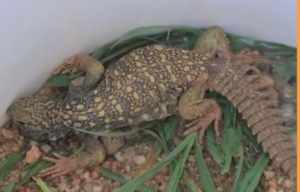
BERBERA — Somaliland police and the Ministry of Environment have arrested an Austrian national in Berbera after he was caught attempting to buy Caasho-badhida, a local spiny-tailed lizard species (Uromastryx), with the intention of smuggling it to Europe, according to reports from from Somaliland.
The Ministry of Environment urged the public to remain alert to people collecting or trafficking the country’s wildlife and natural resources, and to report suspicious activity to the security authorities.
The arrest highlights a lesser-known dimension of Somalia’s illegal wildlife trade. While cheetah trafficking has received significant international attention, reptiles and other small species are also targeted by traffickers supplying the exotic pet market in Europe and the Middle East.
Somaliland as a Wildlife Trafficking Hub
The arrest is the latest in a series of enforcement actions targeting wildlife trafficking in Somaliland, which has become a major transit route for the illegal trade in exotic animals from the Horn of Africa. Hundreds of cheetahs and leopards have been transported from the region to Gulf countries via the Gulf of Aden, with Somaliland serving as a key collection and departure point.
Under Somaliland’s wildlife protection laws, foreigners convicted of wildlife offences face up to five years in prison or a financial penalty of SL. SH. 40,000,000. Residents face a minimum sentence of one year in prison and a fine of at least SL. SH. 3,000,000.
As reported in FTL Somalia’s coverage of previous enforcement operations, Somali authorities have arrested multiple individuals involved in trafficking cheetah cubs through the region. In August 2025, two people were arrested in the Sallahley district for possession of ten cheetah cubs intended for the illegal pet trade.
The Ministry of Environment has previously reported confiscating 163 cheetahs that had been illegally removed from the landscape, leading to the arrest and conviction of 25 smugglers. The government has also been coordinating with Ethiopian authorities to dismantle trafficking networks operating across the border.
Reptile Trafficking: An Overlooked Threat
While cheetah trafficking dominates headlines, the illegal trade in reptiles and other small species represents a parallel threat to Somaliland’s biodiversity. Spiny-tailed lizards, known locally as Caasho-badhida, are among the species targeted by traffickers. These reptiles are sought after in the international exotic pet trade, where they can fetch high prices in European and Middle Eastern markets.
The trafficking of reptiles is often more difficult to detect than the trade in large mammals. The animals are small, easily concealed, and can be transported in luggage or shipping containers. Unlike cheetah cubs, which require significant care and attract attention, reptiles can survive long journeys with minimal attention, making them a lower-risk commodity for smugglers.
This is not the first time an Austrian national has been implicated in wildlife trafficking in Somaliland. In 2021, Austrian national was arrested in Somaliland and accused of attempting to smuggle cheetah cubs out of the country. He was acquitted in 2022, but the case drew international attention to the involvement of European nationals in the illegal wildlife trade.
Demand from Europe and the Gulf
The illegal wildlife trade in the Horn of Africa is driven by demand from two primary markets: the Arabian Peninsula, where cheetahs are sought as status symbols, and Europe, where reptiles and other exotic species are sold through specialised pet dealers. Both markets rely on networks of local collectors, intermediaries and international transporters.
Conservationists have warned that the mortality rate for confiscated cheetah cubs is high, with many dying within 72 hours of confiscation due to dehydration, malnutrition and trauma. The ongoing trade is forcing the East African cheetah subspecies, Acinonyx jubatus soemmeringii, to the brink of extinction.
Recent legal changes in the Gulf may be reducing demand for cheetahs. The United Arab Emirates and Saudi Arabia have enacted laws banning the individual ownership of cheetahs as pets, a development that Somaliland officials say is contributing to a decline in demand.
Critical Note
The arrest of an Austrian national in Berbera for attempting to traffic shield-tailed lizards is a welcome enforcement action, but it also highlights the persistent challenge of wildlife trafficking in Somaliland. The region has become a major transit hub for the illegal trade in cheetahs, reptiles and other exotic species, driven by demand from Europe and the Gulf and enabled by weak enforcement capacity and porous borders.
The fact that the suspect is a European national attempting to smuggle reptiles to Europe underscores the international dimension of this criminal enterprise. Somaliland’s enforcement agencies can arrest traffickers, but they cannot dismantle the networks that link source countries in the Horn of Africa with consumer markets in Europe. That requires coordinated action by destination countries, international organisations and the private sector, including online platforms that facilitate the sale of exotic pets.
Somaliland’s legal framework for wildlife protection includes significant penalties, particularly for foreign nationals. However, enforcement remains constrained by limited resources, inadequate training for police and customs officials, and the absence of a dedicated wildlife protection unit. The Ministry of Environment has received support from international partners including the Cheetah Conservation Fund and TRAFFIC to strengthen its capacity, but the scale of the problem requires sustained investment in enforcement, prosecution and public awareness.
The recent bans on cheetah ownership in the UAE and Saudi Arabia are a positive step, but they must be accompanied by rigorous enforcement. The demand for exotic pets, whether cheetahs or shield-tailed lizards, is ultimately what drives the trade. As long as there are buyers willing to pay, there will be traffickers willing to supply them.