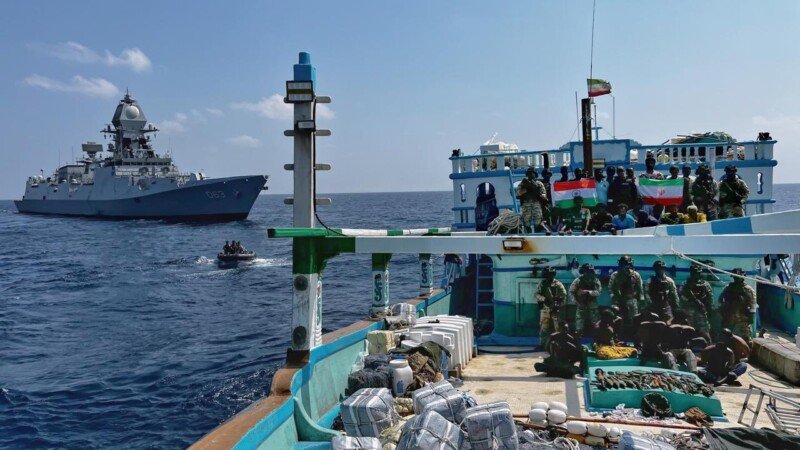
MOGADISHU, The Indian Navy has rescued 20 crew members of the Iranian fishing vessel Azini, completing a 48-hour operation more than 3,000 kilometres from Mumbai after the ship was hijacked by Somali pirates off the northeastern coast of Somalia last week.
The operation, carried out with support from the Indian Air Force, involved locating and intercepting the vessel before securing the release of the crew and the ship from 12 armed pirates on Monday. India’s Defence Minister Rajnath Singh congratulated the Navy, saying the operation demonstrated “India’s ability, intent and resolve to safeguard lives, uphold maritime security and ensure stability across the Indian Ocean Region.”
The Azini was seized on October 29 between the coastal towns of Bandar Bayla and Hafun in Puntland. According to Puntland security officials, the vessel was carrying 21 Iranian crew members and two Somali security guards, a total of 23 people on board. The pirates, initially eight armed men, boarded the vessel and overpowered the two Somali guards; four more later joined them, bringing the total number of pirates to 12.
The Maritime Security Centre Indian Ocean had issued an alert warning that the vessel was approaching a commercial shipping lane and could potentially be used as a “mother ship” to facilitate further attacks on merchant vessels, as detailed in the initial report on the Azini hijacking. The rescue resolves a hijacking that had raised fears of a new mothership threat in the western Indian Ocean.
A Resurgent Piracy Crisis
The Azini hijacking is the latest incident in a broader resurgence of Somali piracy. By August, pirates had hijacked six commercial vessels since April, with some attacks taking place considerable distances from Somalia’s coastline. Among the vessels seized was the oil products tanker Sibu 1, hijacked approximately 252 kilometres east of Al-Mukalla in Yemen.
In September, Puntland authorities said pirates had killed five crew members of the tanker MT Honour 25 before security forces recovered the vessel. The tanker had been held since April, and authorities subsequently detained 16 suspected pirates.
The resurgence has been linked to a shift in international naval priorities, with Western forces redeployed to the Red Sea and Gulf regions, creating gaps in maritime surveillance. As the diversion of anti-piracy patrols created a security vacuum, pirates began exploiting the gaps with increasing sophistication. The Azini is the third Iranian fishing vessel to be hijacked off the Somali coast since July, and the conversion of captured vessels into floating bases, such as the hijacked MV Sward used as a mothership, has marked a significant escalation in the maritime crime off the Horn of Africa.
The human cost has been severe. At the peak of the crisis in August, more than 90 seafarers were being held captive across six merchant ships. The hijacking also adds to the security challenges facing commercial shipping in a region already disrupted by the Iran war, attacks in the Strait of Hormuz, and threats by Yemen’s Houthi rebels against shipping through the Bab el-Mandeb Strait.
Somali authorities have acknowledged the scale of the problem. The federal government has called for international cooperation to address the surge off the Puntland coast, recognizing that national resources alone cannot patrol the vast maritime domain.
Critical Note
The Indian Navy’s rescue of the Azini is a genuine success. Twenty crew members are alive because a warship thousands of kilometres away was able to intercept a hijacked vessel and free it from armed captors. That is what naval power is for, and India’s willingness to act at that distance is a reminder that the Indian Ocean is not a lawless space by default. It is lawless when no one chooses to patrol it.
But the rescue also exposes a gap that Somalia cannot ignore. The Azini was a fishing vessel with a Puntland licence, operating close to shore, and it was seized by a dozen men in small boats. The pirates were not deterred by the presence of two Somali guards, and they were not stopped by any Somali maritime force before an Indian warship arrived from 3,000 kilometres away. The rescue came from outside. The vulnerability was local.
Puntland authorities have claimed progress in clearing pirate groups from their coastal areas. The Azini incident, and the broader pattern of hijackings since April, suggests that the problem has adapted rather than disappeared. The international patrols that once kept piracy in check have thinned. The ransoms that drive the networks have not stopped. And Somalia’s own maritime security institutions remain far from capable of patrolling a coastline of over 3,000 kilometres.
The Indian Navy did what Somalia’s navy cannot yet do. That is a credit to India and a warning to Mogadishu. The next hijacking may not end with a dramatic rescue. It may end with a crew held for months, or worse. The Azini is a success story. It should not be mistaken for a solution.
Recommended Reading On ftlsomalia.com
- Iranian Fishing Vessel Hijacked Off Puntland as Piracy Resurges
- Somali Pirates Turn Hijacked Ship into Mothership as Piracy Surges in Puntland Waters
- Global Naval Shifts Fuel Somali Piracy Return as Dozens of Crew Members Held Hostage
- IMO Sounds Alarm as Somali Pirates Hold More Than 90 Seafarers Hostage
- Somalia Calls for International Cooperation as Piracy Surges Off Puntland Coast