JERUSALEM — Israeli National Security Minister Itamar Ben-Gvir has unveiled a controversial plan to encourage the voluntary emigration of Palestinians from Gaza, reviving discussions that have previously included Somaliland as a potential destination for those who would leave the war-torn enclave.
Ben-Gvir’s proposal, dubbed “Disengagement 710,” aims to facilitate the departure of 250,000 Gazans in its first year, 1.11 million within three years, and approximately 1.86 million within seven years. The plan would establish a dedicated government ministry and provide financial assistance, legal status, and support packages to those who choose to leave.
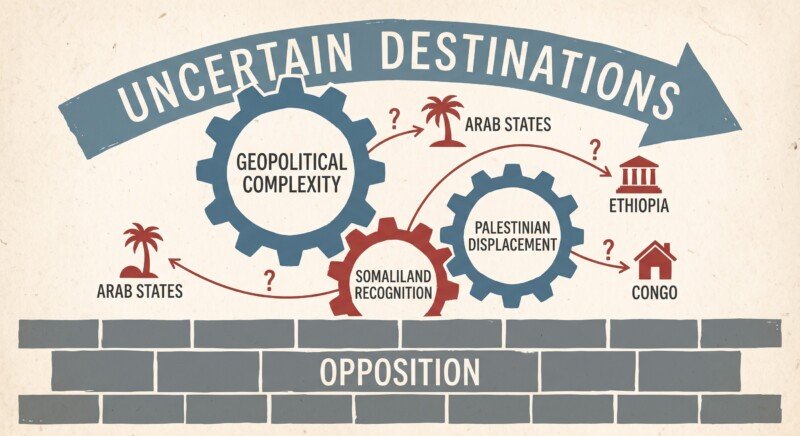
According to the plan, individuals and families would receive assistance covering destination country placement, legal status, documents and visas, travel costs, initial accommodation, vocational training, and up to 24 months of employment support. Among the countries being considered as possible destinations are Turkey, Ethiopia, Congo, and a number of Arab states, according to Ben-Gvir’s party.
Reporting on the plan, Ynetnews noted that Israeli Prime Minister Benjamin Netanyahu has held discussions with several African countries, including Ethiopia, Congo, and Somaliland, in an attempt to persuade them to accept Palestinians who would leave Gaza.
Somaliland’s Role in the Emigration Debate
Israeli Foreign Minister Gideon Sa’ar has firmly denied that any plan for the resettlement or emigration of Palestinians from Gaza is part of Israel’s agreement with Somaliland. When asked directly about the issue, Sa’ar stated: “I can say that this is not part of our agreement with Somaliland.”
Despite these denials, concerns persist. Following Israel’s recognition of Somaliland in December 2025, many observers linked the move to potential plans for Palestinian resettlement. The Arab League, African Union, Egypt, Türkiye, and numerous other states rejected the recognition, explicitly warning that it could facilitate the forced relocation of Palestinians.
Somalia and Egypt have since united against Somaliland’s recognition, with both governments viewing the Israeli move as a direct threat to regional stability and Somali territorial integrity.
The Organization of Islamic Cooperation has also condemned Israel’s recognition of Somaliland, describing it as a “flagrant violation of international law” and a “dangerous precedent” that threatens the territorial integrity of the Federal Republic of Somalia.
Somaliland’s Foreign Affairs Minister Abdirahman Dahir Adan has previously stated that while the government is open to discussions on various matters, no proposals regarding the resettlement of Palestinians from Gaza have been received. “I haven’t received such a proposal, and there are no talks with anyone regarding Palestinians,” he said.
Political Context and International Response
Ben-Gvir’s Otzma Yehudit party has made the plan a condition for joining the next Israeli government following the October 27 elections. The party is demanding the establishment of a dedicated ministry for voluntary emigration, headed by a minister with an independent budget and international negotiating team.
The plan has drawn sharp criticism and is likely to spark international uproar. No country has so far been found that is willing to accept migrants from Gaza in significant numbers. A senior Israeli official noted: “For emigration, you need people who want to migrate and a country willing to take them in. The second part exists even less than the first.”
Somaliland’s deepening ties with Israel have drawn sharp criticism from Somalia’s federal government, which has warned of “grave consequences” for the breakaway region over its expanding relationship with Tel Aviv.
The proposal also follows similar calls from Defence Minister Israel Katz, who stated there was “no real solution for Gaza ultimately without this emigration.” Katz claimed Israel was “organised and prepared to remove them by sea, by air, and by every possible means.”
For Palestinians, these plans evoke deep fears. Mohammed Abu Jabal, a resident of central Gaza, told The New Arab: “How can emigration be voluntary when we live among the rubble, have lost our homes and livelihoods, and fear for our lives every day? They want to destroy the place and then tell us that those who leave chose to leave.”
Critical Note
The revival of the Gaza emigration debate and the recurring mention of Somaliland as a potential destination highlight the complex geopolitical dynamics surrounding both issues. While Israeli officials have denied any formal agreement on Palestinian resettlement, the persistent speculation risks further entangling Somaliland’s quest for recognition with one of the most contentious issues in international politics.
For Somaliland, the association with Palestinian displacement plans presents a significant diplomatic challenge. The territory’s leadership has sought to present itself as a stable and reliable partner for international engagement, but being linked to proposals widely condemned as ethnic cleansing could undermine its legitimacy and complicate its relationships with Arab and African nations that have rejected the idea of Palestinian resettlement.
The practical obstacles to such plans remain formidable. No country has publicly agreed to accept large numbers of Palestinians, and the plan faces near-universal opposition from Arab states and the broader international community. As a senior Israeli official noted, the absence of willing destination countries makes the proposal largely theoretical. For now, the plan appears to serve primarily as a campaign tool for Ben-Gvir’s party, rather than a realistic policy proposal.
Recommended Reading On ftlsomalia.com
- Israel Denies Plans to Resettle Gazans in Somaliland
- Israel Formally Recognizes Somaliland Sovereignty
- Somalia, Egypt Unite Against Somaliland Recognition
- OIC Condemns Israeli Recognition of Somaliland
- Israel Names First Ambassador to Somaliland
- Somaliland Journalist Criticizing Gaza Refugee Plans Arrested