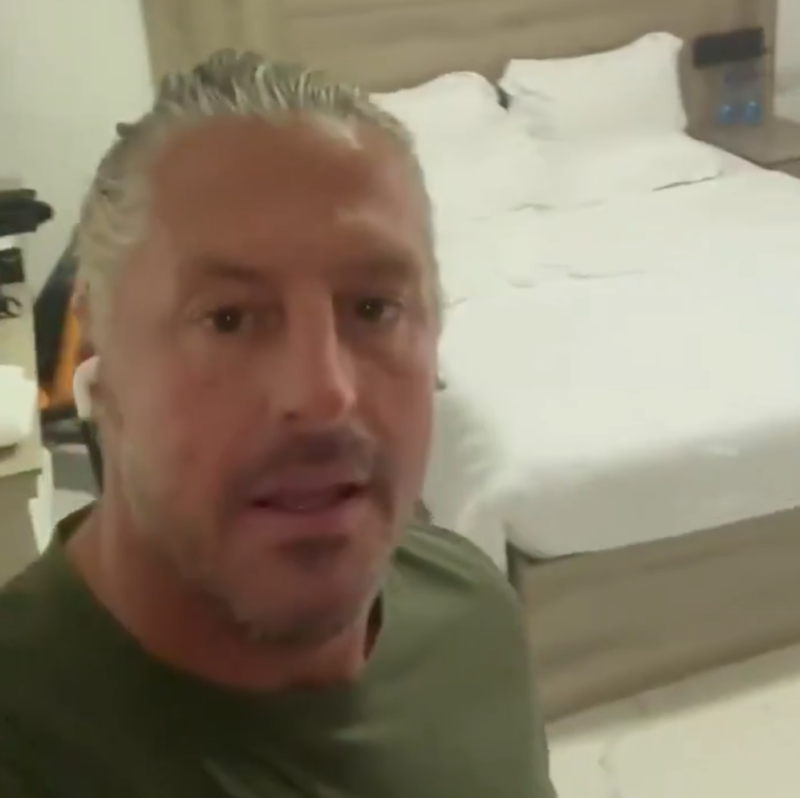
MOGADISHU, Ryan Bridge, the British founder of the far-right activist group Raise the Colours, remains under house arrest in Mogadishu, with videos circulating on social media showing him complaining about the heat and expressing a desire to leave Somalia. Sources familiar with the situation indicate he is most likely about to be deported, though Somali authorities have not issued any public confirmation.
Bridge was detained by Somali authorities, who seized his equipment over what has been described as ‘unauthorized filming and concerns about his activist background’. The available information originates almost entirely from his own group’s social media account and a small number of online posts, none of which could be independently verified by FTL Somalia.
Bridge’s organization, Raise the Colours, posted that he had been “detained and put on the house arrest Mogadishu Somalia,” claiming that Somali authorities had confiscated his recording equipment and that the UK government had described him as a “political activist.” A post on a football fan forum, which first surfaced the claim that Bridge had traveled to Somalia and Ethiopia to “confront the migrants at source,” stated that he was being held in a house with guards outside and had not been charged with anything.
The situation has also drawn sharp public reaction online. One widely shared comment responding to reports of his detention challenged the official justification, asking: “Unauthorised filming? Why then is he posting every hour? trashing our people and our country? Why was he allowed to come to our country in the first place?” The commenter added that “these racist xxx only job is to insult and attack Immigrants and Muslims. That’s how they make money.” The exchange captures the tension at the heart of the case: authorities point to regulatory violations, while Somali citizens question why a foreign activist with a hostile public profile was allowed entry in the first place.
The Deportation Question
The likelihood of deportation rests on the legal framework available to Somali authorities. Under Somalia’s Immigration Law, enacted in March 2023, a foreigner may be deported if they violate Somali laws, pose a security risk, threaten public order or national security, or enter the country illegally. The law requires that undesirable foreigners leave Somalia within seven days unless a court grants an extension.
Bridge’s unauthorized filming and his history of far-right activism would fall within the categories that Somali authorities could invoke to justify deportation. The confiscation of his equipment suggests authorities viewed his activities as a violation of Somali law or a security concern. Whether he has been formally designated as an “undesirable foreigner” under Article 37 of the Immigration Law, or whether his detention is an administrative measure pending removal, has not been disclosed.
The absence of formal charges against him under Somali law, as claimed in the forum post, is consistent with a deportation process that operates through administrative rather than criminal channels. If Somali authorities have decided to remove him, they are not required to prosecute him first. They can declare him undesirable and put him on a plane.
The UK Charges Awaiting Him
Bridge, 45, from Bromsgrove in Worcestershire, was already facing significant legal pressure in the UK before his detention in Mogadishu. On September 5, Thames Valley Police announced that he had been charged with 14 criminal offences arising from a two-month period in Oxfordshire between January 31 and March 31, 2026.
The charges comprise seven counts of using threatening words or behaviour to cause harassment, alarm or distress; three counts of using threatening, abusive or insulting words or behaviour with intent to cause fear of, or provoke, unlawful violence; two counts of racially aggravated intentional harassment, alarm or distress; one count of racially aggravated fear of violence; and one count of common assault.
He is scheduled to appear at Oxford Magistrates’ Court on November 3. Separately, he is due in Birmingham on November 2 for a High Court hearing concerning Birmingham City Council’s application for an injunction against him and other Raise the Colours activists over unauthorized flag installations.
Oxfordshire County Council had already secured a High Court injunction in July 2026 preventing the placement of flags near highways, citing safety concerns, trespass, and obstruction. Birmingham City Council was seeking a similar order. Bridge has previously denied any wrongdoing in relation to the UK charges.
A Pattern of Legal Troubles
The detention in Somalia is not Bridge’s first encounter with legal difficulties. He is also scheduled to stand trial at Brighton Magistrates’ Court on March 15, 2027, after pleading not guilty to one charge of assault by beating, related to an alleged incident at an anti-immigration protest in Brighton on June 13, 2026.
Raise the Colours has been a visible presence across England since last year, with members erecting Union Jack and St George’s Cross flags on lampposts, roundabouts, and other public infrastructure. The campaign has drawn praise from Reform UK leader Nigel Farage, who told Bridge at the party’s conference in September 2026 that “what your campaign has done is wake up vast parts of this country,” and offered legal support.
Ten members of the group, including Bridge, were banned from France in January 2026 after traveling there to take part in actions intended to stop migrant boats crossing the Channel. The French Interior Ministry characterized the group’s militants as “extreme right” and described their activities as a potential threat to public order.
Critical Note
The story of Ryan Bridge’s detention in Mogadishu is, at present, a story told almost entirely by his own organization and a handful of online observers. The videos circulating on social media show a man complaining about the heat, but also complementing the place where he is held, showing the high standard of the place where he is being held, highly positive on how he is being treated, but also stating that he is bored and want to leave. They do not show any legal proceedings, any formal charges, or any official interaction with Somali authorities. The suggestion that he is about to be deported is consistent with the legal framework and the available evidence, but it has not been confirmed by the Somali government.
This silence is not unusual for Somalia. The country’s detention practices are frequently opaque, and foreign nationals have been held without public explanation in the past. But the lack of transparency in this case cuts both ways. It denies Bridge the ability to challenge his detention through a public legal process, and it denies the Somali public any understanding of why a foreign activist with a history of racially aggravated charges in his home country is being held in their capital.
Bridge’s own background complicates any simple narrative of victimhood. He arrived in Mogadishu, according to unverified claims, to “confront migrants at source,” and he was already facing 14 criminal charges in the UK related to a campaign that a council leader described as “an act of intimidation and division.” His detention in Somalia does not erase those charges, and his legal troubles in the UK will await him if and when he returns.
If deportation proceeds, the Somali government will have resolved the immediate problem of his presence without ever explaining what he did wrong or why he was admitted in the first place. A deportation without a public accounting is a silent removal, not a legal process. It may satisfy the public demand to see him gone, but it will not answer the question of why he was allowed in, and it will not prevent the next foreign activist from arriving with the same intentions and the same access.