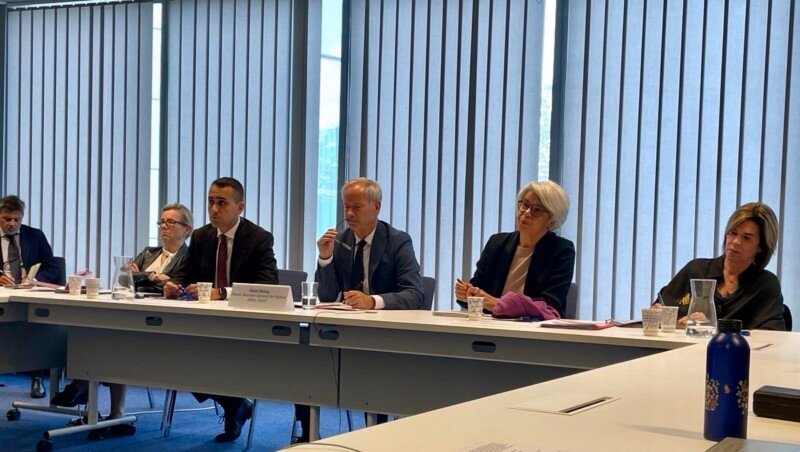
BRUSSELS, The European Union’s Task Force on the Red Sea convened in Brussels this week, bringing together senior diplomats to address what the EU’s Special Representative for the Horn of Africa described as “urgent challenges and way ahead” in the strategic waterway.
Annette Weber, the EU Special Representative for the Horn of Africa and the Red Sea, said the meeting was led by European External Action Service Deputy Secretary General Olof Skoog and included her colleague, the EU Special Representative for the Gulf. The discussions focused on the security situation in the Red Sea, where Houthi attacks on commercial shipping have disrupted global trade routes and forced vessels to reroute around the African continent.
The meeting comes as the EU’s naval mission in the Red Sea, Operation Aspides, continues to face a critical shortage of vessels. EU foreign policy chief Kaja Kallas told reporters in Luxembourg earlier this month that the mission still lacks the minimum of 10 ships required for full operations, despite repeated appeals to member states.
A Mission Stretched Thin
Aspides was launched in February 2024 as a defensive maritime operation to protect commercial vessels from Houthi attacks in the Red Sea and the Bab al-Mandab Strait. The mission currently operates with approximately six warships, primarily contributed by Italy and Greece, with periodic contributions from Germany, France, Spain, the Netherlands, and Belgium.
The shortfall has real consequences. Kallas said commercial ships are “waiting in the queue to receive the escort” because the EU does not have enough frigates available. Italy has pressed for reinforcement, with Defence Minister Guido Crosetto writing to Kallas to request additional capabilities. The Netherlands has offered a frigate in a supporting role, while Belgium’s frigate Leopold I has been delayed by technical problems and is not expected to join the mission until next year.
Other member states have preferred to keep their naval assets in the Baltic and Black Seas, where they face what European officials describe as hybrid threats from Russia. The EU’s naval capabilities, according to a confidential defence readiness assessment, have critical gaps that current investment levels will not close until after 2030.
The Broader Strategic Picture
The Red Sea Task Force meeting reflects the EU’s attempt to coordinate its approach across the Horn of Africa and the Gulf, two regions whose security dynamics are increasingly intertwined. Weber has previously engaged directly with regional leaders on these interconnected challenges, including talks with Somaliland President Irro in Hargeisa focused on peacebuilding, governance, and counter-terrorism.
She has also engaged with Somali federal leadership. In 2024, she met with Prime Minister Hamza Abdi Barre on the sidelines of the UN General Assembly to discuss enhancing cooperation across development, security, politics, and economics. The EU’s approach to the Red Sea is inseparable from its broader engagement in Somalia, where it remains one of the largest financial supporters of security and governance programmes.
The EU’s footprint in Somalia includes substantial security funding. The bloc approved a €75 million contribution to AUSSOM, making it the mission’s largest financial donor and bringing total support to successive AU-led missions to nearly €2.8 billion over two decades, as reported in FTL Somalia’s coverage of the funding decision. The EU also supports Somali security forces through EUTM Somalia, now in its ninth mandate, and maritime security through EUCAP Somalia.
On the maritime security front, the threats facing the Red Sea are overlapping. A tanker was struck by an unknown projectile off the Saudi coast in mid-October, the latest in a series of attacks. As reported in FTL Somalia’s coverage of the attack, the incident highlighted the convergence of Houthi attacks and a resurgence of Somali piracy, with analysts warning of growing collaboration between the two threat networks.
Somalia itself has become a participant in regional maritime security architecture, joining a Saudi-led 14-member coalition formed in July 2026 to protect freedom of navigation in the Bab al-Mandab, Red Sea, and Gulf of Aden, as reported in FTL Somalia’s coverage of the coalition.
Critical Note
The Red Sea Task Force meeting is a welcome sign that the EU recognizes the interconnected nature of security in the Horn of Africa and the Gulf. Weber’s mandate explicitly includes dialogue with Red Sea countries, and bringing together the Horn of Africa and Gulf envoys under Skoog’s leadership is a sensible bureaucratic step.
But coordination meetings do not stop Houthi missiles, and they do not escort commercial vessels through the Bab al-Mandab. The EU has spent months acknowledging that Aspides needs at least 10 ships while member states have offered two, neither of which is fully operational. Kallas’s warning that the EU must act “if it wants to be taken seriously in the region” is an admission that, so far, it has not.
The deeper problem is one of priorities. European navies are stretched between the Baltic, the Black Sea, and the Red Sea, and the political will to reinforce a mission in a distant waterway is limited when the threat is perceived as regional rather than existential. The Houthis have made the Red Sea dangerous, but they have not made it dangerous enough for European capitals to treat Aspides as a priority. Until that changes, task force meetings will produce communiqués, not capabilities.
Recommended Reading On ftlsomalia.com
- Red Sea Shipping Under Threat: Tanker Hit by Unknown Projectile Off Saudi Coast
- Saudi Arabia, Somalia and 11 Nations Form New Maritime Coalition to Secure Red Sea and Bab al-Mandab
- President Irro Holds Critical Talks with EU Horn of Africa Envoy in Hargeisa
- Somali PM Calls for Stronger Collaboration with the EU in Multiple Sectors
- EU Approves €75 Million for AU Mission in Somalia