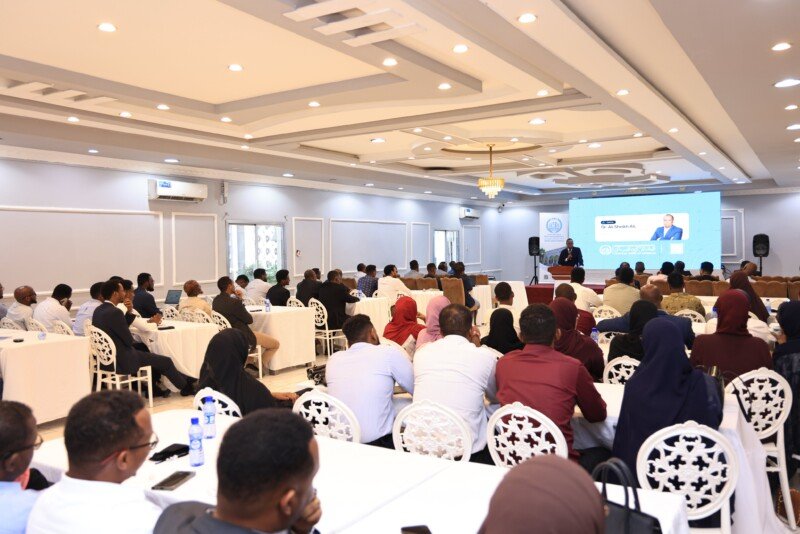
MOGADISHU, The Central Bank of Somalia held the 11th edition of its Internal Seminar Series in Mogadishu, organized by its Research and Statistics Department to bolster internal research capabilities, foster technical knowledge sharing, and build analytical capacity across its staff. The forum brought together central bank economists, policy analysts, and department heads to review domestic economic trends and evaluate the technical foundations underpinning monetary and financial oversight.
Focus on Forecasting, Stability, and Payments
The seminar examined several critical dimensions of Somalia’s evolving financial landscape, placing primary emphasis on macroeconomic forecasting, financial access, sector stability, and national payment systems. Institutional presentations focused on utilizing empirical research and structured data analytics to guide regulatory actions and enhance evidence-based decision-making across the monetary authority.
Staff discussions addressed quantitative modeling to evaluate inflationary pressures and external shocks as Somalia navigates economic growth pressures and shifting fiscal conditions. Participants also reviewed supervisory metrics designed to assess resilience as Somalia’s banking sector expands in total asset holdings, requiring more rigorous macroprudential oversight and capital adequacy monitoring.
Operational updates also centered on the performance and interoperability of the domestic transaction architecture. Officials evaluated national clearing mechanisms after reports indicated that Somalia’s payment system processed 337,788 transactions worth 593 million dollars in early 2026, alongside ongoing initiatives to expand retail digital payments and integrate regional settlement platforms.
Capacity Building and Institutional Reforms
The 11th edition forms part of a wider institutional development program initiated under the monetary authority’s multi-year strategic framework. The gathering follows previous technical workshops where the central bank conducted leadership training to strengthen institutional governance and prepare staff for complex regulatory mandates.
Central bank officials highlighted that deepening technical expertise remains a prerequisite for managing modern banking supervision, developing standardized credit reporting tools, and collaborating with multilateral partners such as the International Finance Corporation on macroprudential risk mechanisms.
FTL Critical Note
The Central Bank’s emphasis on data-driven policymaking and internal capacity represents a constructive move toward institutional maturity, yet substantial structural impediments continue to limit the direct transmission of its monetary authority. With cash transactions still largely dollarized, informal hawala networks handling considerable financial flows, and fiscal coordination across federal member states remaining fragile, the central bank’s analytical modeling often confronts severe limitations in baseline data reliability.
Moreover, while the proliferation of internal seminars and digital platforms demonstrates administrative initiative, genuine financial stability will depend on enforcing rigorous supervisory compliance across private commercial lenders and ensuring that rural and marginalized communities gain reliable access to formal banking channels beyond Mogadishu’s commercial core.
Recommended Reading On ftlsomalia.com
- Central Bank Ends Leadership Training Amid Reforms
- Somalia’s Payment System Processes 337,788 Transactions Worth US$593 Million in Q1 2026
- Somalia’s Banking Sector Expands to $2.3 Billion as Financial Confidence Grows
- Central Bank of Somalia Launches Instant Payment System
- Somalia’s Economic Growth Slows to 3.1% in 2025 Amid Aid Cuts and Drought