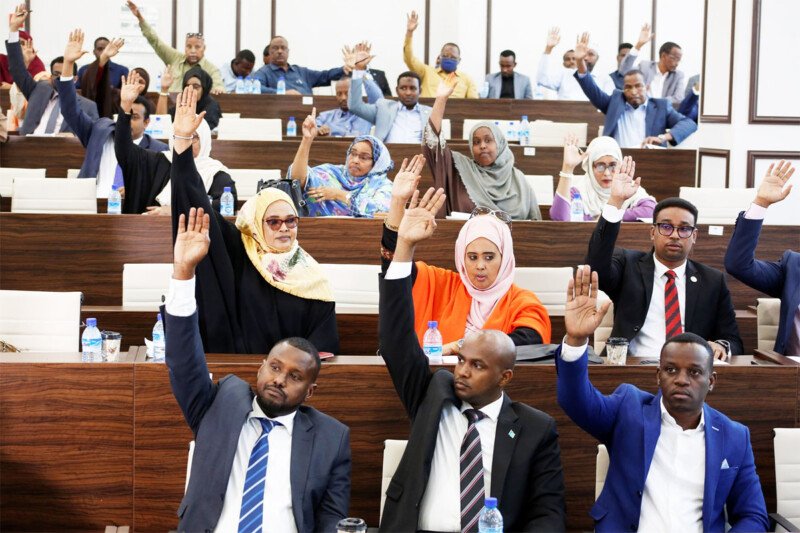
MOGADISHU — Somalia’s House of the People voted to revoke proposed civil service regulations on Tuesday, dealing a significant blow to a Villa Somalia plan to recruit department directors through the Prime Minister’s Office and the Civil Service Commission.
A majority of 136 MPs voted for the annulment, blocking measures critics argued would enable political appointments ahead of upcoming elections. The decision highlights deepening power struggles within federal institutions and represents a direct challenge to Prime Minister Hamza Abdi Barre’s civil service reform agenda.
The Civil Service Commission’s Directive
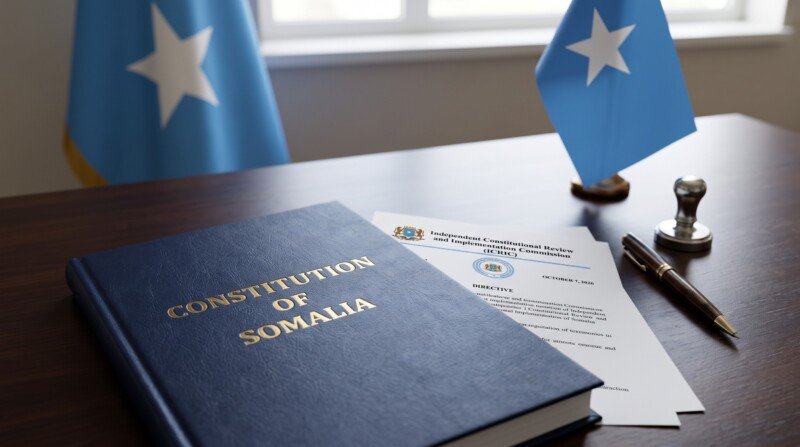
The parliamentary vote follows a directive issued by the National Civil Service Commission (NCSC) on 19 September 2026, reference XGG/NCSC/1488/09/2026, addressed to all government ministries and agencies and copied to the Prime Minister.
The NCSC directive, signed by Commission Chairperson Mohamed Bashiir Ali, implemented the Prime Minister’s 17 September 2026 order on open competition for government employment, based on qualifications and job requirements. The directive invoked Article 7 of the Civil Service Law, issued on 5 December 2006, and the 6th Regulation on Civil Service Employment.
The Commission outlined three key principles. First, all positions for Director Generals and equivalent departmental leadership roles will be filled through internal merit-based recruitment, giving priority to employees within those ministries or agencies who meet the qualifications. The restructuring process, the Commission said, should begin with the Administrative Affairs Department, as it is important for the restructuring of the civil service.
Second, any vacant or future positions will be filled through open competition, giving equal opportunity to all qualified Somalis who meet the requirements.
Third, the Commission said it will issue a timetable, conditions, and procedures for the open competition.
The NCSC also instructed ministries and agencies to take three immediate actions: refrain from making administrative decisions or new appointments that could disrupt the restructuring process; ensure employees receive their salaries and are given equal opportunities; and cooperate fully with the Commission to implement the Prime Minister’s order in a manner that is dignified, professional, transparent, and accountable.
The directive included a special note emphasizing that women working in government ministries and agencies who meet the requirements should be given priority and encouraged to apply.
Background: The Prime Minister’s Directive
The Prime Minister’s directive, issued on 17 September 2026, instructed ministries and government agencies to implement merit-based recruitment and appointments without delay. It directed the Civil Service Commission to begin the first phase of the process on 20 September, starting with directors who run departments of government institutions, following the Prime Minister’s earlier call for merit-based hiring and promotion at the government’s annual accountability session.
The instruction cited Article 161(1) of the Constitution, Article 7 of the Civil Service Law, and the regulations and decisions governing the federal civil service. The Prime Minister described directors general as the backbone of state administration and said the purpose of the exercise was to establish a professional and permanent administrative leadership capable of implementing government policy, as detailed in FTL Somalia’s reporting on the launch of the reform.
Committee Challenge and Legal Objections
Even before the parliamentary vote, the House of the People’s Committee on Social Services Development, chaired by MP Nadra Salah Abdi, had formally challenged the Prime Minister’s directive. In a letter dated 21 September 2026, the committee requested the Speaker of the House, who also serves as Acting President, to suspend the executive order until a civil service law is approved by Parliament.
The committee cited Articles 94(9), 95(2), and 158 of Somalia’s Provisional Constitution, along with Articles 34, 50(11), 56 and 59 of the House of the People’s Standing Rules. It argued that the existing Civil Service Commission, composed of 14 members established under Law No. 10 of 2006, does not comply with Article 158(3) of the current Constitution, which requires 15 members proposed by the Council of Ministers, approved by Parliament, and appointed by the President.
The committee also challenged Resolution No. 132 of 11 May 2023, which transferred powers related to recruitment, transfer and restructuring of civil servants to the Prime Minister’s Office, stating that it contravenes the Constitution and the Commission’s authority under Articles 158 and 159. The committee requested the acceleration of a new civil service law and the restructuring of the Federal Civil Service Commission in accordance with constitutional requirements.
Conflicting Positions Within Government
The dispute exposed contradictory responses from within the government itself. The Ministry of Health and Human Services issued a directive on 20 September 2026, instructing all health sector agencies to implement the Prime Minister’s order and halt any administrative, dismissal, transfer, or new appointment decisions pending the formal procedures of the restructuring framework.
Signed by Health Minister Dr. Ali Haji Adam Abubakar, the letter directed the Somali Medical Association, the National Health Institute, the National Health Professions Council, and the National Health Insurance Agency to maintain the existing administrative status quo and avoid any changes that would alter the employees’ mandate or structure.
In direct contradiction, the Office of the Auditor General issued a statement defending its constitutional independence and warning the Civil Service Commission against taking any action that would undermine its autonomy. The Auditor General cited Article 177 of the Constitution, along with Law No. 17 of 2019 and Law No. 14 of 2023, establishing the office as an independent constitutional body with administrative and financial autonomy, as reported in FTL Somalia’s coverage of the cabinet’s approval of civil service reforms.
The Auditor General emphasized that Article 63(2) of the Government Procedures Law, Law No. 174 of 15/02/2025, requires that “independent constitutional bodies shall be governed by their own founding laws,” and warned the Commission that any action affecting the Office of the Auditor General is prohibited.
Internal Criticism and Political Timing
The directive drew immediate criticism from within government circles. Omar Hashi, a Member of the Federal Parliament and the Special Presidential Envoy for Stabilization and Civilian Protection, questioned the timing and consistency of the government’s commitment to merit-based appointments.
Writing on social media, Hashi noted that the government had promised the public that senior appointments would be merit-based, advertised, and selected through a competitive process, and asked: “So, what has changed?” He added that filling positions should not be seen as clan-centric political rewards but should add value to the country.
The criticism followed the Cabinet’s approval on September 10 of the Director General and Deputy Director General of the Somalia Investment Authority, as well as the appointment of a Director General for the Halmeel Integrated Services Centre. Critics pointed out that these appointments were made through the same process the government now says it is reforming.
Political Implications
The parliamentary vote represents a significant setback for the Prime Minister’s reform agenda and raises questions about the balance of power between the executive and legislative branches. Critics have argued that the proposed measures would enable political appointments ahead of upcoming elections, while supporters of the reform describe it as a necessary step toward professionalising Somalia’s civil service.
The Civil Service Commission had been positioned as the lead institution for implementing the reforms. Deputy Prime Minister Salah Jama has described the Commission as the backbone of government reform, and the Commission has emphasised that improving the skills and capacity of government employees is essential to strengthening public services.
Critical Note
The parliamentary vote to revoke the civil service regulations is not merely a procedural rebuke. It reflects a fundamental disagreement over who controls the machinery of government hiring and promotion at a politically sensitive moment. With elections approaching, control over civil service appointments carries significant political weight.
The committee’s legal objections raise substantive constitutional questions. If the current Civil Service Commission was never properly constituted under Article 158, its decisions over the past several years could be vulnerable to legal challenge. The committee’s call for a new law under Article 158(5) is an attempt to resolve a constitutional gap that has persisted since 2012.
The NCSC’s directive, while framed as a merit-based reform, also raises practical questions. The directive instructs ministries to refrain from making new appointments that could disrupt the restructuring process, effectively freezing hiring in the civil service pending the outcome of a process whose legal basis is now contested. The emphasis on internal merit-based recruitment, while giving priority to existing employees, could also limit opportunities for qualified outsiders.
The contradictory responses from the Health Ministry and the Auditor General illustrate the fragmentation of the government’s own position. The Health Ministry moved quickly to implement the Prime Minister’s directive, while the Auditor General asserted constitutional independence and warned the Commission against overreach. This suggests that the executive’s restructuring agenda was not fully coordinated across all government institutions.
The criticism from within government, including from a sitting MP and presidential envoy, suggests that skepticism about the reform agenda extends beyond anonymous commentary and into the institutions of government itself. The timing of the directive, issued as the government’s mandate draws to a close, has fueled perceptions that the announcement is a late attempt to rewrite the government’s record. Whether the Civil Service Commission can conduct a genuinely competitive process, and whether the results will be respected, will be the test of whether this is meaningful reform or a political gesture.
Recommended Reading On ftlsomalia.com
- Prime Minister Hamza Calls for Merit-Based Hiring and Promotion as Government Reviews Annual Performance
- Civil Service Reform Gains Momentum in Somalia as Minister Engages Key Commission
- Salah Jama Hails Civil Service Commission as Backbone of Government Reform
- Somalia’s PM Launches Civil Service Reform to Modernize Workforce
- Somalia’s Cabinet Approves Civil Service Reforms
- Somalia Advances Public Sector Reform with Landmark Pay & Grading Policy Launch