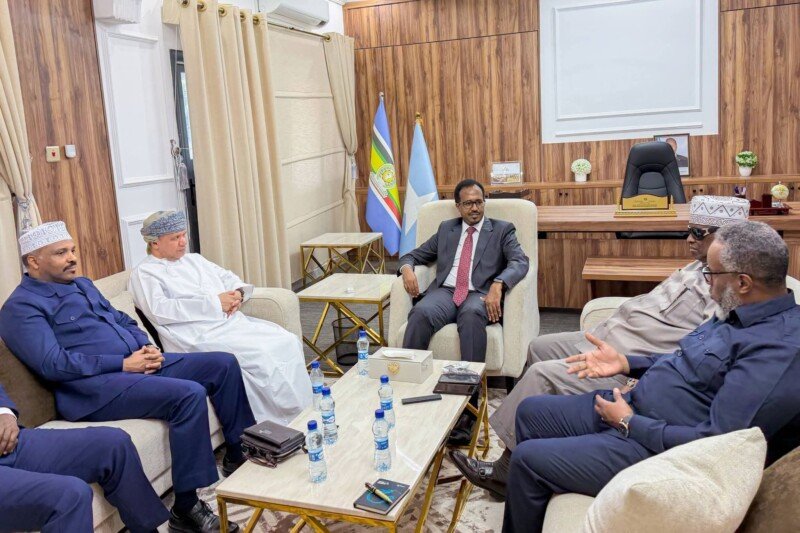
MOGADISHU, Somalia’s Minister of Commerce and Industry, Gamal Mohamed Hassan, met with Oman’s Ambassador to Somalia, Salim bin Habib bin Salam Al Amiri, to discuss strengthening trade and investment ties between the two countries.
The meeting, attended by Deputy Minister Mohamed Abubakar Sherif and State Minister Osman Mohamed Abdi (Daalo), focused on expanding economic cooperation and creating new business opportunities for traders in both nations. The talks are the latest in a series of engagements that have accelerated since Oman reopened its embassy in Mogadishu in October 2026 after a 36-year closure.
That diplomatic re-engagement has been accompanied by concrete economic discussions. In April 2026, Somalia’s Foreign Minister met with the Oman Investment Authority to explore opportunities in energy, infrastructure, logistics, food security, and information technology. Omani officials have also expressed interest in Somalia’s Al-Ula Special Economic Zone, with the Omani Authority for Investment Promotion and Export Development offering technical expertise and training to zone management staff.
The Trade Numbers Behind the Diplomacy
The commercial relationship is growing, though from a modest base. Bilateral goods trade reached approximately $538 million in 2025, according to UN Comtrade data, up from $429 million in 2022. Oman maintains a trade surplus, exporting $323 million to Somalia against $215 million in imports. Somalia is a significant market for Omani goods, with dairy, milling products, and salt among the top exports.
For Somalia, Oman’s importance extends beyond bilateral trade. Omani ports and logistics networks serve as a conduit for Somali trade with the wider Gulf and Asian markets. As FTL Somalia reported, a significant portion of Somalia’s imports pass through logistical hubs in the United Arab Emirates and Oman before reaching Somali ports, making the relationship strategically vital for supply chain resilience.
A Relationship with History
The current warmth is not new. Somalia and Oman share deep historical, cultural, and commercial ties dating back centuries, rooted in Indian Ocean trade networks that linked Mogadishu and Berbera to Muscat and Salalah long before the modern state system. The reopening of Oman’s embassy in October 2026 was framed by Somali officials as a restoration of a relationship that had been interrupted by civil war, not a new departure.
The diplomatic momentum has been building for over a year. In February 2025, Somalia’s Transport Minister welcomed an Omani delegation in Mogadishu for talks on transport and civil aviation cooperation. In December 2025, Somali business leaders held a strategic forum with Oman’s Minister of Commerce, Industry, and Investment Promotion, who described bilateral trade as “poised for significant growth.”
Oman has also been a consistent diplomatic voice in support of Somalia’s territorial integrity. During the April 2026 Muscat talks, Omani Foreign Minister Sayyid Badr Albusaidi reaffirmed Oman’s firm position in support of Somalia’s unity, sovereignty, and territorial integrity, and its non-recognition of any entities outside the framework of the Somali state, as reported in coverage of the embassy reopening.
Beyond diplomacy, the commercial footprint is expanding. Oman’s SalamAir launched biweekly flights to Mogadishu in January 2025, enhancing connectivity for business travelers and the Somali diaspora. The two countries have also signed a livestock trade agreement aimed at strengthening veterinary standards and facilitating exports, and Omani transport officials have held talks with their Somali counterparts on port development and logistics cooperation through the ASYAD Group.
Critical Note
The meeting between Minister Gamal and Ambassador Al Amiri is a routine diplomatic engagement, and it should be reported as such. What matters is not the photo opportunity but whether the commercial promises that have accompanied the reopening of Oman’s embassy translate into measurable outcomes.
The trade figures suggest a relationship that is real but limited. $538 million in annual goods trade is meaningful for Somalia, particularly given its narrow export base, but it is a fraction of what a functioning commercial relationship between two Indian Ocean states could generate. Oman’s interest in the Al-Ula Special Economic Zone has been expressed for over a year. Technical assistance and training offers are welcome, but they are not investment. The zone needs capital, infrastructure, and anchor tenants, not just expertise.
Somalia’s diplomatic outreach to the Gulf has been one of the more successful elements of its foreign policy in recent years, and Oman has been a reliable partner. But reliability cuts both ways. Muscat has consistently supported Somalia’s sovereignty and territorial integrity, including its rejection of any entities outside the Somali state framework. That support is valuable. It is not, however, a substitute for the kind of commercial engagement that creates jobs and generates revenue.
The test of the Oman relationship will be whether the embassy in Mogadishu becomes a hub for business facilitation, whether Omani investment materializes in the Al-Ula zone, and whether Somali exporters gain access to Omani ports and markets on terms that benefit both sides. Until those things happen, the meetings and the memoranda will remain what they are: diplomacy, not development.
Recommended Reading On ftlsomalia.com
- Oman’s Embassy Reopens in Mogadishu as Al-Umairi Presents Credentials
- Somali Foreign Minister Engages Omani Officials on Telecommunications, Port Development and Cultural Diplomacy in Muscat
- Somalia’s Customs Revenue Falls 40% as Hormuz Disruption Hits Trade
- Somalia Signs a Livestock Trade Agreement with Oman
- Somali and Omani Expected to Sign Transport and Aviation Agreements