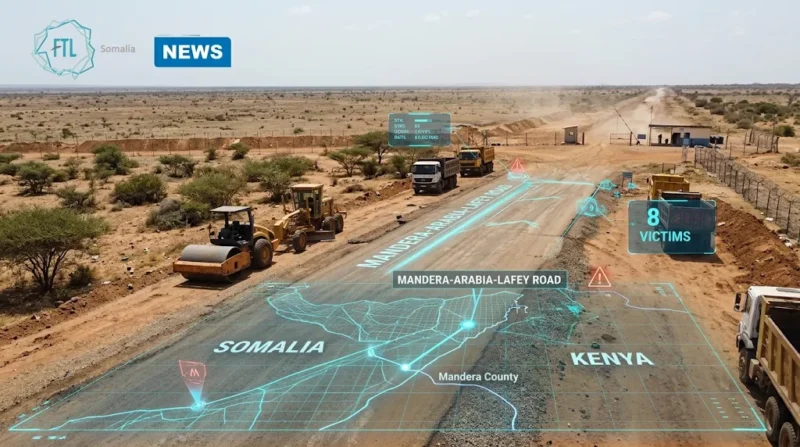
MOYALE, Heavy fighting has erupted across neighborhoods in the border town of Moyale, leaving at least nine people dead and forcing more than 2,500 Ethiopians to flee across the border into Kenya, according to hospital officials and Kenyan government authorities.
The violence, which broke out on Wednesday and continued into Friday, involves clashes between Oromo and Somali communities in the Ethiopian town that sits opposite a Kenyan settlement of the same name. Residents reported sustained gunfire, with a hospital official on the Ethiopian side confirming that about 30 injured people had been admitted over several days, many with injuries caused by heavy weapons.
Images verified by Reuters showed a bulldozer burning near a petrol station and people overturning fuel-dispensing equipment. The fighting has also affected the Kenyan side, where a stray bullet struck a Kenyan woman in the neck. She was treated at a private hospital and reported to be in stable condition.
The Flag Dispute Behind the Violence
The immediate trigger for the clashes appears to be a dispute over the display of the Somali Regional State flag. According to local reports, tensions began on October 18 when an administrative office associated with Ethiopia’s Somali Regional State opened in Moyale, an area administered by the Oromia region, and raised its regional flag.
The confrontation escalated into an exchange of gunfire involving Oromia militia members and Somali regional police. A 13-year-old girl was killed during the initial violence, further heightening tensions before armed confrontations rocked the town with heavy gunfire on Wednesday night.
Residents on both sides said the fighting, which began around 5:30 a.m., appeared to ease around lunchtime but continued as of the time of reporting. Security forces from the Oromia and Somali regions exchanged heavy gunfire, and the fighting spread to several locations, including Malab, Chamuk, Bole, Kebele 01, and Waqo Dogo localities in South Oromia.
A Humanitarian Emergency Unfolding
The Kenya Red Cross has launched an emergency humanitarian response, initially targeting 1,000 households. Teams are providing temporary shelter, food, safe water, and essential household items, including tents, blankets, sleeping mats, and kitchen sets. The organization is also distributing Super Cereal, a fortified porridge flour for young children, pregnant women, and breastfeeding mothers, and providing first aid to those in need.
“Our priority is to make sure every family arriving in Moyale is safe, sheltered and treated with dignity,” said Kenya Red Cross Secretary General Dr. Ahmed Idris. “Our volunteers and staff are on the ground and will continue to respond as needs evolve.”
Marsabit County Commissioner Stanley Kamande confirmed that at least 2,500 displaced people from Ethiopia were staying in the Kenyan town of Moyale by Friday, with many seeking shelter among relatives and local residents.
The violence has raised concerns about further displacement and disruption of cross-border trade. Moyale is a major commercial crossing between Kenya and Ethiopia, approximately 780 kilometers north of Nairobi and 775 kilometers south of Addis Ababa, serving communities in both countries with close family and trading connections.
What This Means for Somalia
For Somalia, the Moyale violence is a direct concern. The fighting involves ethnic Somali communities in Ethiopia’s Somali Regional State, whose security and stability are intertwined with Somalia’s own. The flag dispute that triggered the violence speaks to the broader tensions over administrative control and regional autonomy within Ethiopia, tensions that have implications for the Somali region’s relationship with Addis Ababa and, by extension, with Mogadishu.
The displacement of thousands of ethnic Somalis across the border into Kenya also carries humanitarian and security implications. Kenya’s Marsabit County, where the displaced are arriving, is already a fragile area with limited resources. A prolonged influx could strain local services and create new vulnerabilities that Al-Shabaab, which has historically exploited instability in the borderlands, could seek to exploit.
The violence comes amid renewed conflict in Ethiopia’s northern Tigray region, adding to concerns over civilian safety and humanitarian needs across the Horn of Africa. As reported in FTL Somalia’s coverage of the Ethiopia-Eritrea standoff, Ethiopia’s internal and external conflicts are increasingly interconnected, and the Moyale clashes demonstrate how local disputes over flags and administrative boundaries can escalate into deadly confrontations with regional consequences. The broader context of Ethiopia’s regional ambitions, including its push for sea access, further complicates the security landscape, as detailed in FTL Somalia’s coverage of Abiy Ahmed’s Red Sea strategy.
Critical Note
The Moyale violence is a stark reminder of the fragility of ethnic and regional coexistence in the Horn of Africa. A flag, a symbol of administrative authority, became the spark for a confrontation that has killed at least nine people and displaced thousands. The underlying tensions, over land, resources, and political control between Oromia and Somali regional states, are not new. They have been simmering for years, and the current escalation suggests that the mechanisms for managing them have failed.
For Somalia, the crisis is a warning. The ethnic Somali communities in Ethiopia are not distant relatives. They are part of a cross-border population whose security and stability are inseparable from Somalia’s own. When they are displaced, when their towns become battlegrounds, the reverberations reach Mogadishu. The Kenyan authorities and humanitarian agencies are responding with urgency, but the root causes of the violence remain unaddressed. Until the political disputes between Oromia and Somali regional administrations are resolved, Moyale will remain a flashpoint, and the people who live there will continue to pay the price.