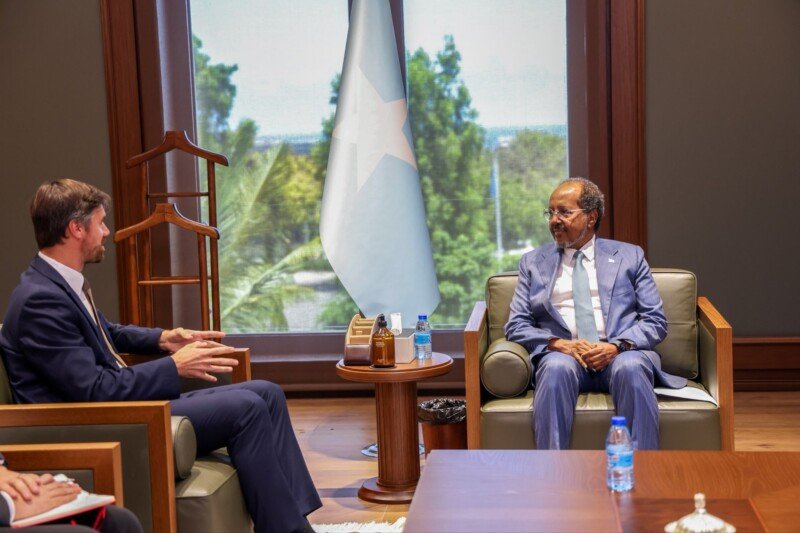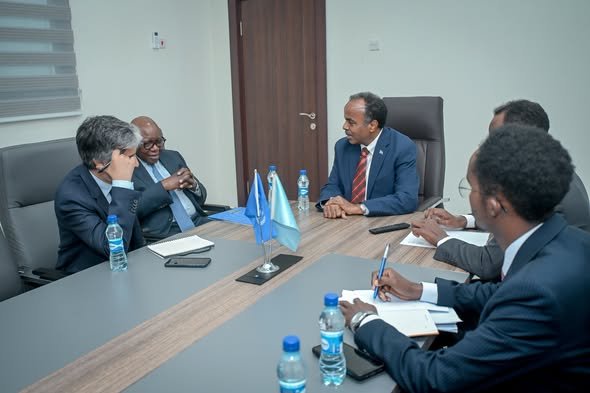
MOGADISHU — The Deputy Minister of Foreign Affairs and International Cooperation, Ali Mohamed Omar (Ali Balcad), has met with a delegation from the United Nations Transition Mission in Somalia (UNTMIS) led by the Acting Head of Mission, Raisedon Zenenga, to discuss the mission’s transition process .
The meeting, which also included the Head of the Policy and Mediation Team, Vikram Parekh, focused on the transition process from UNTMIS and the continued coordination and cooperation between the Federal Government of Somalia and the United Nations .
Deputy Minister Balcad affirmed the Federal Government’s commitment to ensuring that the transition is Somali-led and Somali-owned, and that international support remains aligned with Somali national priorities and obligations .
Both sides agreed to continue close coordination and cooperation to support Somalia’s stability and the development of government institutions.
The UNTMIS Transition
UNTMIS succeeded the UN Assistance Mission in Somalia (UNSOM) on November 1, 2024, in accordance with UN Security Council Resolution 2753. The transition is a two-year process scheduled to conclude by October 31, 2026, when UNTMIS will end its operations. The “sunset clause” sets a definitive timeline for transferring technical and political advisory functions to Somali national institutions and the UN Country Team.
The transition is structured in two main phases. Phase One (November 2024 – October 2025) prioritized support and capacity building in state-building, human rights, rule of law, security sector support, coordination of international aid, and countering violent extremism. Phase Two (November 2025 – October 2026) involves the progressive transfer of all remaining functions to the Federal Government, the UN Country Team, and other partners .
The transition also involves the handover of security responsibilities from the African Union Transition Mission in Somalia (ATMIS) to Somali forces, with the African Union Support and Stabilization Mission in Somalia (AUSSOM) playing an ongoing role in supporting Somali security forces.
Critical Note
The meeting between Deputy Minister Balcad and the UNTMIS delegation reflects the government’s ongoing engagement with international partners to ensure a smooth transition of the UN mission. The emphasis on Somali leadership and ownership of the transition process aligns with the government’s broader efforts to strengthen national institutions and sovereignty.
Yet, the success of the transition will depend on the ability of Somali institutions to assume responsibility for security and governance functions. Somalia continues to face significant challenges, including ongoing insecurity, limited institutional capacity, and a complex political landscape. The international community must ensure that its support is coordinated and aligned with Somali priorities.
The Deputy Minister’s emphasis on Somali-led transition is welcome, but it must be accompanied by concrete progress on security sector reform, political reconciliation, and governance improvements. Without such progress, the transition risks leaving a security vacuum that could be exploited by extremist groups.