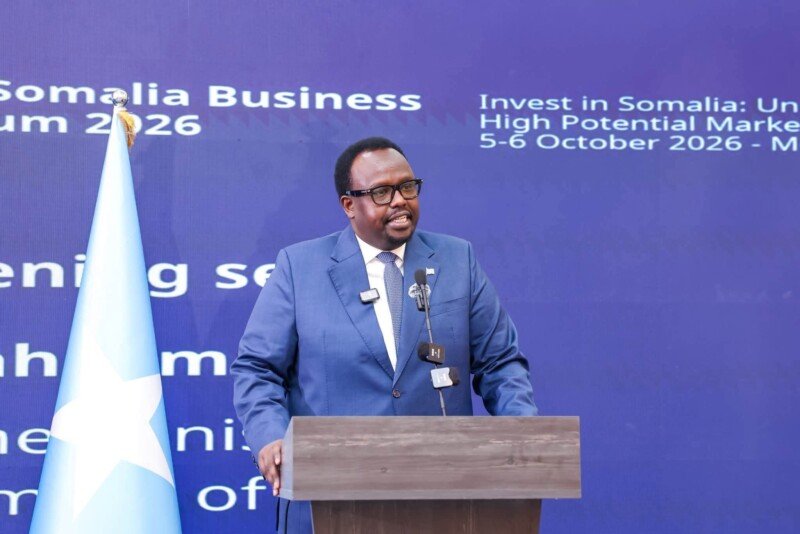
MOGADISHU — Deputy Prime Minister Salah Ahmed Jama officially opened the inaugural Somalia-European Union Business Forum in Mogadishu on Monday, launching a two-day gathering aimed at strengthening trade and investment ties between Somalia and EU countries [citation:1][citation:4].
The forum, running from 5 to 6 October, was jointly organised by Somalia’s Ministry of Commerce and Industry and the European Union Delegation to Somalia. It brings together traders, investors, financial institutions, and officials from Somalia and Europe, including EU Ambassador to Somalia László Eduárd Máthé and European delegations that travelled to Mogadishu to participate [citation:1][citation:4].
The event is being held under the theme “#InvestInSomalia: Unlocking High-Potential Markets,” with a focus on strengthening Somalia’s investment ecosystem, fostering regional trade integration, and catalysing sector transformation [citation:3].
Priority Sectors and Investment Opportunities
The forum’s agenda centres on four strategic sectors: agriculture, energy, digital services, and trade logistics. Within these areas, discussions are focusing on agricultural value chains including crop production, livestock, fisheries, agricultural processing, cold chain solutions, and export logistics [citation:3][citation:12].
Energy discussions are centred on renewable energy, solar mini-grids, utility-scale renewables, clean cooking solutions, and energy services for productive uses. The digital economy segment covers fintech, e-commerce, digital payments, cybersecurity, and digital skills development. Trade logistics discussions address port infrastructure, logistics parks, supply chain digitalisation, and regional connectivity initiatives [citation:3][citation:12].
As reported in FTL Somalia’s coverage of the renewable energy education initiative, the European Union has also been supporting higher education programs focused on enhancing renewable energy expertise in Somalia [citation:29].
Transforming Reforms into Investment
In his opening remarks, Deputy Prime Minister Salah Jama emphasised the importance of transforming progress made in economic and institutional reforms into investment and cooperation opportunities that boost domestic production, job creation, and increase income for citizens [citation:1][citation:4].
The Deputy Prime Minister also noted that such cooperation will give a greater role to Somalia’s private sector. He praised Somali traders for bringing the country through difficult phases and said they now face broad opportunities to contribute to the development of the country’s production and economy [citation:1][citation:8].
The forum is part of the EU-Somalia Investment, Trade and Business Platform (ITBP), a flagship initiative under the European Union’s Global Gateway strategy. As detailed in FTL Somalia’s coverage of EU-Somalia relations, the European Union has been expanding its engagement in private-sector development in Somalia, with the forum serving as a platform to present investment opportunities, connect EU companies with Somali firms, and identify financing pathways including blending, guarantees, and partnerships with EU development finance institutions [citation:3][citation:21].
Business Matchmaking and Financing
The forum features structured business-to-business meetings, government-to-business discussions, and academic panels where participants exchange views and experiences on developing the country’s productive resources. Somali companies are showcasing investment opportunities and projects they are developing [citation:1][citation:4].
Businesses and financial institutions are taking part in dedicated matchmaking sessions designed to turn policy discussions into concrete commercial agreements. The second day of the forum is focusing on Somalia’s economic transformation, reforms to the business environment, trade and logistics, the digital economy, and access to financing for economic growth [citation:30].
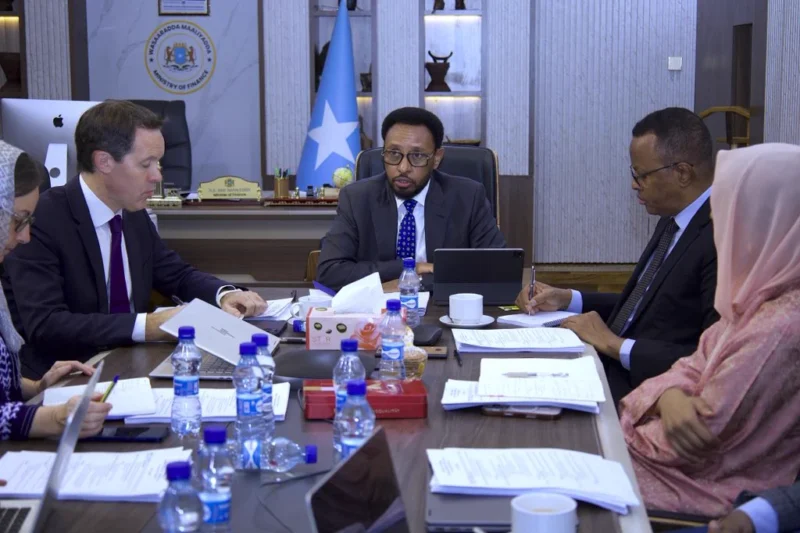
The forum also brings financial institutions into the discussion, potentially helping connect investment projects with financing and technical expertise. EU Ambassador Máthé and European delegates are attending alongside Somali government officials, business leaders, and investors [citation:4].
Critical Note
The Somalia-EU Business Forum represents a significant diplomatic and economic engagement for a country that has spent years rebuilding its international standing after decades of conflict. The presence of European investors, financial institutions, and government officials in Mogadishu signals growing confidence in Somalia’s reform trajectory and its potential as a frontier market in East Africa.
However, the gap between investment forums and actual implementation remains wide. Somalia’s business environment faces persistent challenges: limited access to finance, fragmented markets across federal and regional authorities, and security constraints that continue to affect operations in many parts of the country. The forum’s emphasis on four key sectors, agriculture, energy, digital services, and logistics, reflects a recognition that these are the areas where Somalia has the most potential, but they are also the areas where structural barriers are most entrenched.
The involvement of the European Union as a convener and financier is important, but it cannot substitute for domestic policy reforms and institutional capacity. Somalia’s recent economic reforms, including debt relief, have improved the country’s fiscal position, but translating that into sustainable private-sector growth requires addressing the policy constraints that limit business expansion. The success of this forum will not be measured by the number of participants or the volume of discussions, but by whether it produces concrete commercial agreements and investment commitments that materialise in the months and years ahead.