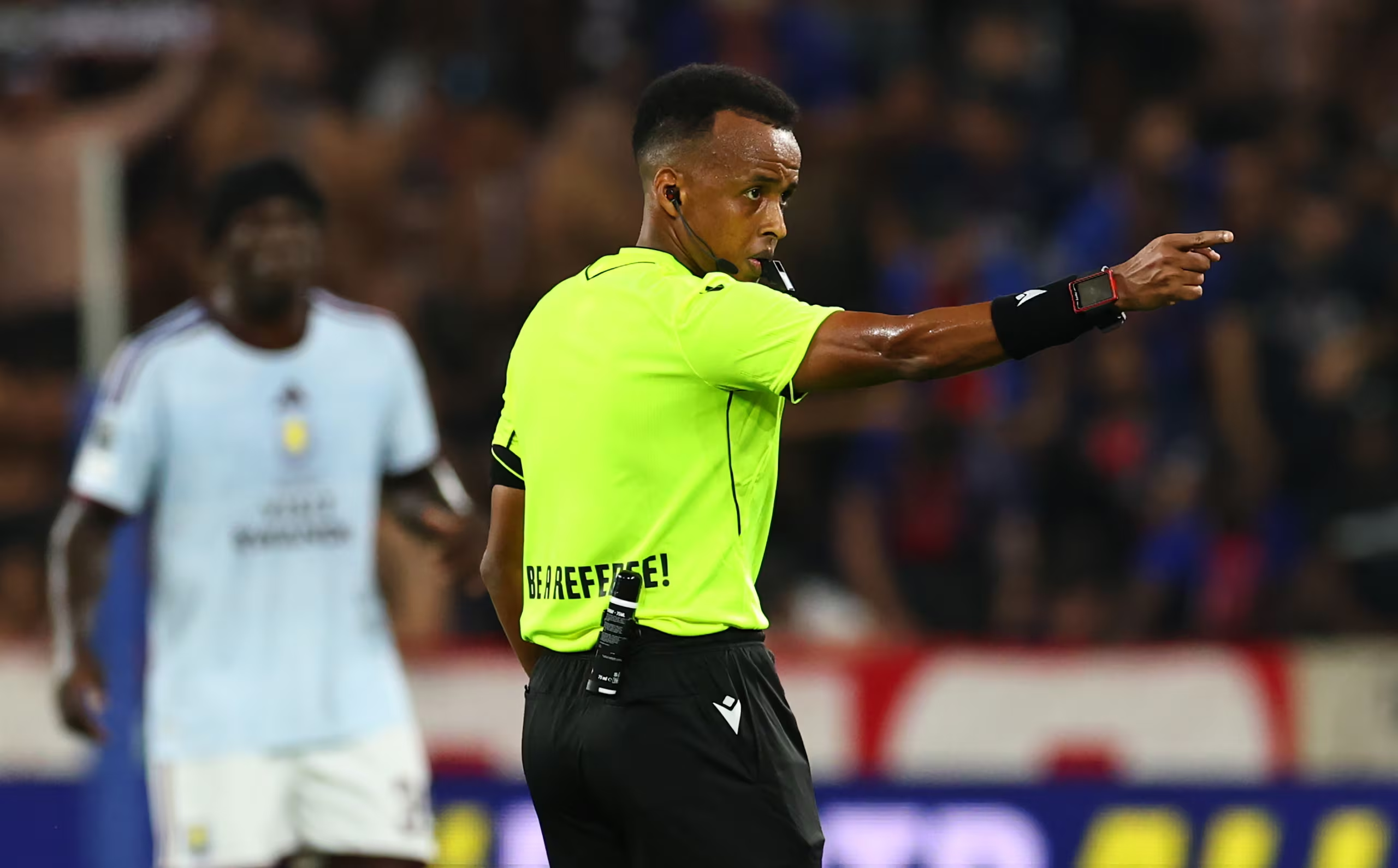
MOGADISHU — Somali referee Omar Abdulkadir Cartan has reportedly been asked by the Egyptian government to take up a refereeing position in Egypt and relocate to Cairo, according to reports circulating in Somali media this week.
The reports, which could not be independently verified, suggest that Egypt wants Cartan to officiate in its domestic football competitions and remain in the country until the end of 2027, after which he would be permitted to return to Somalia.
The news comes amid growing concern about the future of Somali football professionals, particularly regarding opportunities for them to develop their skills within the country.
Cartan’s Rising Profile
Cartan is widely regarded as one of Africa’s most accomplished referees. He became a FIFA-listed official in 2018 and made history in January 2024 as the first Somali to officiate at the Africa Cup of Nations, overseeing the Group E match between Tunisia and Namibia. He has since officiated the CAF Champions League final and was named CAF’s Best Male Referee for 2025.
In April 2026, Cartan was selected as one of 52 referees for the FIFA World Cup 2026, set to become the first Somali official to referee at football’s biggest tournament. However, upon arriving at Miami International Airport on 6 June 2026, he was denied entry by U.S. Customs and Border Protection, which cited “vetting concerns” that rendered him “inadmissible.”
After an 11-hour interview, Cartan was placed on a flight back to Istanbul. He later said the experience was “the biggest dream of my life” denied, and suggested his Somali nationality may have been a factor. A U.S. official, speaking anonymously, alleged “association with suspected members of terrorist organizations” as the reason, an accusation Cartan has not been charged with or formally confronted over.
Following his return to Somalia, Cartan received a hero’s welcome in Mogadishu. He was subsequently selected by UEFA to officiate the 2026 UEFA Super Cup between Paris Saint-Germain and Aston Villa, becoming the first African referee to take charge of a UEFA competition match.
Concerns About Talent Retention
The reports about Egypt’s interest in Cartan have intensified a broader debate about Somalia’s ability to retain its sporting talent. Deeq Mohamed Hassan, known as Deeq Afrika, a candidate for the presidency of the Somali Football Federation, has warned that the absence of planning, irregular competitions, and limited job opportunities could cause Somalia to lose talented players, coaches, and referees.
Deeq Afrika has criticized the current SFF administration for the decline in tournaments and the lack of a permanent national calendar, calling for a clear plan to develop Somali football. His campaign, launched under the message “Xiriir Furan. Fursad Siman” (An Open Federation. Equal Opportunity), focuses on expanding opportunities beyond Mogadishu and creating a national pathway for clubs, players, and regions across Somalia.
Deeq Afrika has also made serious allegations against the current federation leadership, accusing some members of involvement in human trafficking and illegal migration, using football-related travel as cover. He has called for an independent investigation into these claims, which remain unverified and have not been confirmed by any judicial or independent inquiry.
The debate over talent retention connects to broader questions about the SFF’s institutional capacity. As reported in FTL Somalia’s coverage of the CAF Strategy Conference, SFF President Ali Abdi Mohamed (Ali Shiine) led a Somali delegation to Cabo Verde in October 2026, where African football leaders discussed player and coach development, institutional strengthening, governance reform, and sustainable investment. FIFA President Gianni Infantino told the conference that FIFA had invested approximately one billion US dollars in African football through its Forward development program over the past decade.
Financial investment in Somali football has also increased in recent years. As detailed in FTL Somalia’s coverage of the FIFA Forward grant, FIFA awarded the Somali Football Federation $4.5 million in October 2025, one of the largest direct investments in Somali football in years, intended for infrastructure rebuilding, national team support, and grassroots expansion.
On the pitch, the national team has achieved notable milestones. As reported in FTL Somalia’s coverage of the AFCON qualifier, the Ocean Stars secured a historic victory over Mauritius in March 2026, advancing to the group stage for the first time. More recently, as detailed in FTL Somalia’s coverage of the Ivory Coast match, Somalia held the reigning African champions scoreless for 89 minutes before conceding two late goals in Abidjan.
These achievements suggest that Somali football is making progress on multiple fronts. But they do not resolve the structural challenges that push professionals like Cartan to consider opportunities elsewhere.
Critical Note
The reports that Egypt has offered Omar Cartan a refereeing position are unconfirmed, and it is important to treat them as such. No official statement from the Egyptian Football Association, the Somali Football Federation, or Cartan himself has verified the claim. What is clear is that Cartan is a world-class referee whose career has taken him far beyond Somalia’s domestic league, and that Egypt, a major football nation with significant resources, would have obvious reasons to want a referee of his caliber in its domestic competitions.
If the reports are accurate, they raise uncomfortable questions for Somali football. Cartan’s success has been a rare source of national pride, particularly after his unjust treatment at the U.S. border. That a referee of his standing would be recruited by another country is not a failure in itself; professional mobility is normal in global football. But it reflects a broader pattern in which Somali talent, whether players, coaches, or referees, seeks opportunities abroad because domestic structures cannot support their development or provide adequate compensation.
Deeq Afrika’s warnings about talent loss deserve attention, regardless of the outcome of his candidacy. A national football system that cannot retain its best professionals will struggle to build the institutional capacity needed for sustained success. The SFF’s next leadership will face a choice: continue with the status quo or implement the kind of structural reforms that would make staying in Somalia a viable option for its most talented people.