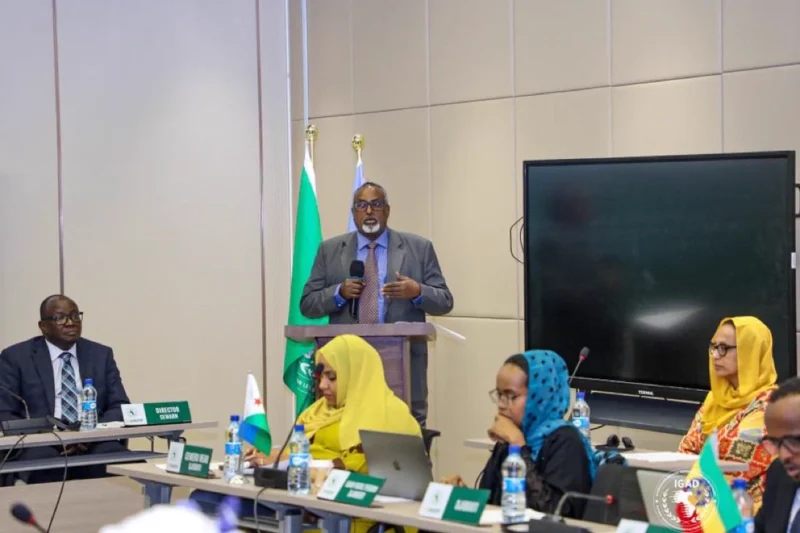
MOGADISHU — Somalia’s Third Disaster Resilience Congress (SDRC 2026) opened in Mogadishu on Monday, bringing together government ministers, researchers, academics and disaster management experts for a two-day forum focused on building lasting resilience against recurring climate shocks.
The congress, organized by the Somali Disaster Management Agency (SoDMA) in partnership with Mogadishu University, is held under the theme “Moving from Recurring Disasters to Sustainable Resilience: A Path to a Better Future and Durable Recovery for Somalia.”
Environment Minister Calls for Research-Driven Solutions
Minister of Environment and Climate Change Major General Bashir Mohamed Jama said the Somali government is now fully alert to disasters and the search for durable solutions. He stressed that genuine scientific research is the essential path to development and lasting solutions.
Speaking at the congress, the minister noted that climate change is a major driver of the disasters affecting the country. He praised SoDMA for its efforts in addressing the country’s challenges and called on the congress to produce practical recommendations that contribute to resolving the difficulties Somalia faces.
SoDMA Chief Emphasises Collective Action
SoDMA Director Mohamud Moallim Abdulle described the significance of the third edition of the congress, saying Somalia has long struggled with recurring disasters that have caused widespread suffering. He said these challenges can only be overcome through collective action, research and genuine planning aimed at achieving lasting solutions.
The congress comes as Somalia enters a dangerous Deyr season under Super El Niño conditions. As reported in FTL Somalia’s coverage of the Super El Niño warnings, SoDMA has placed 29 districts across 14 regions on high alert for riverine and flash flooding, with between 2.5 and 3.5 million people potentially exposed to flooding.
The Shabelle River has also reached critical levels. As detailed in FTL Somalia’s coverage of the FAOSWALIM report, 388 sites along the Shabelle River have been identified as flood-prone, with 150 sites recording water overflowing the riverbanks.
University Partnership and Knowledge-Sharing
Dr. Ibrahim Mohamed Mursal, President of Mogadishu University, which co-organized the congress, underscored the importance of knowledge, research and cooperation in preventing recurring disasters and building a resilient society.
He stressed the need for an inclusive vision and lasting solutions to reduce community vulnerability. He noted that knowledge and research play a critical role in understanding risks and preparing practical solutions, pledging that Mogadishu University will continue to strengthen cooperation with government agencies, the private sector and businesses to enhance Somalia’s resilience.
The congress was attended by cabinet ministers, researchers and specialists in disaster resilience. It runs for two days.
The government has taken several preparedness measures in recent weeks, including the approval of a National El Niño Preparedness Plan, as detailed in FTL Somalia’s coverage of the ministerial meeting. SoDMA has also signed a two-year cooperation agreement with the World Food Programme to strengthen disaster preparedness and early warning systems, as reported in FTL Somalia’s coverage of the agreement.
Critical Note
The Third Disaster Resilience Congress is a welcome initiative in a country that has become all too familiar with the cycle of climate shocks, displacement and humanitarian crisis. The partnership between SoDMA and Mogadishu University is a positive example of the kind of government-academic collaboration that can produce evidence-based policy rather than reactive crisis management.
However, the gap between congress declarations and operational reality is difficult to ignore. Somalia has held multiple disaster resilience forums in recent years, yet the underlying vulnerabilities remain. The Shabelle River’s embankments are still fragile after nearly 40 years of neglect. Mogadishu’s drainage systems are still blocked by unregulated construction. Humanitarian funding has fallen to its lowest level in a decade.
The congress theme, “moving from recurring disasters to sustainable resilience,” is precisely the right framing. But resilience is not built in conference halls. It is built through sustained investment in early warning systems, infrastructure, community preparedness and institutional capacity. The challenge for SoDMA and its partners is to ensure that the recommendations emerging from this congress translate into concrete action before the next flood, not after it.
Share your story. FTL Somalia is continuing to investigate Somalia’s disaster preparedness and the El Niño flooding emergency. If you have information or insights to share, contact us at info@ftlsomalia.com. Your identity will be protected.
Recommended Reading On ftlsomalia.com
- SoDMA Urges 29 Districts Across 14 Regions to Prepare for Super El Niño Flooding
- Over 300 Sites on Shabelle River Identified as Flood-Prone, FAOSWALIM Reports
- Deputy PM Chairs Ministerial Meeting as Government Approves National El Niño Preparedness Plan
- SoDMA and WFP Sign Two-Year Deal to Strengthen Somalia’s Disaster Preparedness