MOGADISHU — Eritrea has formally asked the United Nations Security Council to take “deterrent measures” against Ethiopia, accusing Addis Ababa of declaring war after Eritrean troops were reportedly targeted by Ethiopian drone strikes inside Ethiopia’s Tigray region.
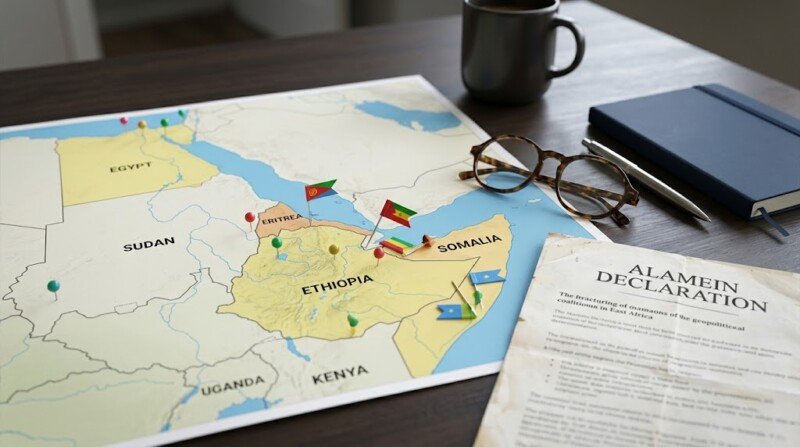
The request, contained in a letter from Eritrea’s Foreign Ministry, marks a dramatic escalation in the rapidly deteriorating relationship between the two neighbors, both of which are parties to the Alamein Joint Declaration that Somalia signed just six days ago.
What Happened: A Six-Day Cascade
The current crisis unfolded with remarkable speed. On 23 September, the Tigray People’s Liberation Front (TPLF) launched a “defensive war” against Ethiopian federal forces. By early October, Ethiopia accused Eritrea of backing the rebels, and the two countries severed diplomatic ties.
Reports emerged this week that Eritrean troops had crossed into northern Tigray, with witnesses and conflict monitors confirming their presence around the city of Adigrat. A foreign security source estimated that 5,000 to 8,000 Eritrean soldiers were present in Tigray.
Ethiopian forces responded with drone strikes targeting Eritrean positions. “There were many, many drone strikes yesterday. Some Eritrean lorries have been destroyed. They are no longer in the streets,” one witness told AFP. Eritrean troops appeared to be retreating northward.
By Friday, Ethiopia’s Foreign Minister had written to the UN Security Council describing Eritrea’s actions as “a blatant act of aggression that engages Ethiopia’s inherent right to self-defence.” On Saturday, Eritrea fired back with its own letter, calling Ethiopia’s accusations a “declaration of war” and requesting measures under Chapter VII of the UN Charter.
Why This Matters for Somalia: The Alamein Coalition Fractures
The Eritrea-Ethiopia standoff directly affects Somalia because both countries are signatories to the El Alamein Joint Declaration, signed on 4 October 2026 by Egypt, Sudan, Eritrea, and Somalia. As detailed in FTL Somalia’s coverage of the Alamein Declaration, the four leaders formalized coordination on regional security, economic cooperation, and shared political positions, including explicit support for Somalia’s sovereignty and rejection of recognition of Somaliland.
Now, two of Somalia’s four partners in that declaration are on the brink of war with each other. The coalition, which was designed to present a united front against Ethiopian regional ambitions and Israeli recognition of Somaliland, is fracturing before it can become operational.
The tension was already visible before the declaration was signed. As reported in FTL Somalia’s coverage of Ethiopia’s troop withdrawal and the Egypt-Eritrea alignment, Ethiopia’s decision to withdraw more than 3,000 troops from Somalia’s South West State, combined with Egypt’s expanding military footprint and Eritrea’s deepening role in training Somali forces, had already begun reshaping the security calculus in Mogadishu.
Allying with Both Sides
For Cairo, the situation is particularly complex. Egypt has cultivated close relationships with both Eritrea and Somalia, viewing them as partners in its regional strategy against Addis Ababa. For Somalia, the challenge is identical as it is demined to keep the relations with Egypt and Ethiopia warm as it needs both actors for is security apparatus.
Egypt’s relationship with Eritrea is long-standing, based on shared opposition to Ethiopian Red Sea ambitions. Egypt’s relationship with Somalia, formalized in the January 2025 strategic partnership and deepened through military cooperation, is also central to Cairo’s Horn of Africa strategy. As reported in FTL Somalia’s coverage of Egypt-Somalia air force cooperation, the two countries have deepened collaboration on rebuilding Somalia’s air force.
The Alamein Declaration represented the culmination of Egypt’s efforts to build a regional bloc against Ethiopian influence. Now, with Eritrea and Ethiopia on the verge of open conflict, Cairo faces a choice between its Eritrean partner and its broader regional strategy.
Egyptian President El-Sisi has repeatedly emphasized that Egypt will not relinquish its share of Nile waters, calling the issue a “red line.” Egypt has also consistently rejected Ethiopia’s claims to Red Sea access, viewing them as a threat to Egyptian national security.
Implications for Somalia
The immediate implications for Somalia are threefold.
First, the AUSSOM mission faces new uncertainty. The Alamein Declaration called for adequate and predictable funding for AUSSOM to support Somalia’s security transition. With Eritrea and Ethiopia potentially at war, and Egypt deeply involved in the regional standoff, the diplomatic bandwidth and resources available for Somalia’s security transition may be strained. The United States has already signaled it will end funding for the UN Support Office in Somalia beyond December 2026, as detailed in FTL Somalia’s coverage of US-Somalia relations.
Second, Somalia’s diplomatic positioning becomes more precarious. Somalia has aligned itself with the Egypt-led regional bloc, betting that Cairo and its partners will provide a counterweight to Ethiopian influence. That bet now looks riskier. If the Egypt-Eritrea-Somalia axis is destabilized by the Eritrea-Ethiopia conflict, Somalia may find itself without the regional support it has cultivated.
Third, Ethiopia’s preoccupation with the Tigray front may reduce its military pressure on Somalia. Ethiopia has been a key troop contributor to previous AU missions in Somalia. If its forces are redeployed to the northern front, that could open space for Al-Shabaab in southern and central Somalia. Conversely, an Ethiopia distracted by internal and regional conflict could be less willing or able to intervene in Somali affairs, reducing tensions over the Ethiopia-Somaliland Memorandum of Understanding.
The Broader Risk: A Regional War
The most alarming scenario is a full-scale regional war drawing in multiple actors. Ethiopia has accused Egypt, Eritrea, and Sudan of supporting the Alliance for Survival, a coalition of seven Ethiopian rebel groups. Ethiopia has severed diplomatic ties with Eritrea and expelled Eritrean diplomats.
Eritrea’s request for UN intervention under Chapter VII suggests Asmara is preparing for the possibility of a military confrontation it cannot win alone. Ethiopia’s claims of self-defence and its insistence on Red Sea access rights suggest Addis Ababa may be willing to escalate further.
Somalia, as a signatory to the Alamein Declaration and a party to the Egypt-Eritrea strategic framework, would be drawn into the diplomatic fallout regardless of its preferences. The federal government’s alignment with the Egypt-led bloc was already a high-stakes bet. That bet is now being tested in real time.
Critical Note
The Eritrea-Ethiopia crisis exposes a fundamental vulnerability in Somalia’s recent diplomatic strategy. The Alamein Declaration was an ambitious attempt to build a regional bloc that would support Somalia’s territorial integrity, reject Ethiopian regional ambitions, and secure funding for AUSSOM. But coalitions of convenience are fragile, and the Eritrea-Ethiopia confrontation shows how quickly they can fracture.
Somalia has placed significant faith in Egyptian and Eritrean support as a counterweight to Ethiopian influence. That faith may not be repaid. Egypt is deeply invested in its own Nile and Red Sea disputes, Eritrea is focused on its existential fear of Ethiopian invasion, and both have priorities that may diverge from Somalia’s. The Alamein Declaration’s provisions on Somalia were important, but they were one part of a broader agenda. As the Eritrea-Ethiopia crisis escalates, Somalia’s concerns may be pushed down the agenda.
For Mogadishu, the lesson is sobering. Strategic alignments with regional powers can provide short-term diplomatic cover, but they also create dependencies. Somalia’s security transition, the fight against Al-Shabaab, and the dispute over Somaliland remain fundamentally Somali problems that require Somali solutions. Regional allies can help or hinder, but they cannot substitute for the difficult work of building state capacity and securing the country. The Alamein coalition is fracturing. Somalia must be prepared to navigate the fallout on its own.
Recommended Reading On ftlsomalia.com
- Ethiopia’s Troop Withdrawal and the Egypt-Eritrea Alignment: What It Means for Somalia
- Alamein Declaration: Egypt, Eritrea, Sudan and Somalia Unite on Red Sea, Nile and AUSSOM
- Egypt Emerges as Key Partner in Rebuilding Somalia’s Air Force
- Somalia and US Reaffirm Strategic Partnership as Diplomatic Leadership Transitions in Mogadishu