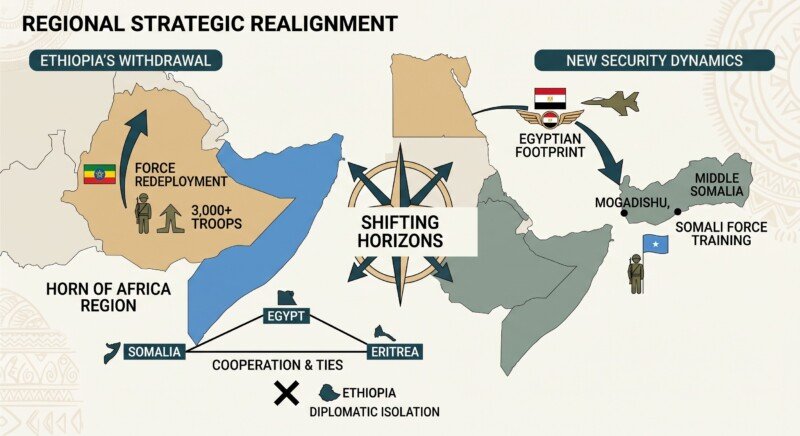
MOGADISHU — Ethiopia’s reported decision to withdraw more than 3,000 troops from Somalia’s South West State is reshaping the security calculus in Mogadishu, accelerating a strategic realignment that has seen Somalia deepen military cooperation with Egypt while maintaining longstanding ties with Eritrea.
The three developments, Ethiopia’s internal conflict, Egypt’s expanding military footprint, and Eritrea’s role in training Somali forces, are interlinked, and together they are transforming the Horn of Africa’s security architecture.
Ethiopia’s Withdrawal from South West State
The bulk of Ethiopian forces in Somalia are stationed in South West State, operating under AUSSOM’s Sector 3 command. Their primary base is Baidoa, the regional capital, with forward operating bases across the Bay and Bakool regions.
Bloomberg reported this week that more than 3,000 Ethiopian troops are expected to begin withdrawing from the Somali areas of Bay and Bakool in the coming days or weeks, redeploying to the Tigray, Amhara, and Afar regions. A Somali defence ministry official said Mogadishu had not been informed by Addis Ababa of any plan to withdraw its forces.
The withdrawal would create a significant security gap. As reported in FTL Somalia’s coverage of the Ethiopian withdrawal, Ethiopian forces handed over the Buurhakaba forward operating base to the Somali National Army’s 60th Division in August 2026 after nearly 12 years of occupation.
The South West State’s security situation is already fragile. Baidoa has seen repeated outbreaks of fighting involving forces loyal to former South West President Abdiaziz Hassan Mohamed Laftagareen. As detailed in FTL Somalia’s coverage of the ICRC response, the International Committee of the Red Cross has expressed deep concern over civilian casualties, with dozens of wounded treated at hospitals following clashes.
Egypt’s Expanding Military Footprint
As Ethiopia redirects its military resources homeward, Egypt is accelerating its own deployment to Somalia. Egyptian military officials arrived in Mogadishu this week, deploying to the coastal area of El-Adde near the Isiley airstrip in the Middle Shabelle region. The site is intended to serve as a military base for training Somali forces and hosting the Egyptian contingent expected to join AUSSOM.
Egypt has pledged approximately 1,091 troops to AUSSOM. As detailed in FTL Somalia’s coverage of the deployment, Egyptian Foreign Minister Badr Abdelatty confirmed the contingent would be stationed in the Middle Shabelle region. The deployment has been delayed by funding and logistical challenges.
Egypt’s military presence in Somalia carries strategic significance beyond the AUSSOM mission. As reported in FTL Somalia’s coverage of Somalia-Egypt relations, a permanent Egyptian military facility in Somalia places Cairo’s forces in a geographic position closer to Ethiopia than Egypt itself. Egypt has strengthened military ties with Somalia, political coordination with Eritrea, and cooperation with Djibouti.
Eritrea’s Deepening Role in Somalia
Somalia’s relationship with Eritrea is also a significant factor in the shifting regional alignment. Eritrea has trained thousands of Somali soldiers, a programme that began under the Farmajo administration and has continued under President Hassan Sheikh Mohamud. As reported in FTL Somalia’s coverage of the Eritrea-trained forces, batches of Somali National Army soldiers trained in Eritrea have been arriving back in Mogadishu to join operations against Al-Shabaab.
The programme was conducted in secrecy and drew criticism over Eritrea’s approach to military training. As detailed in FTL Somalia’s coverage of the handover, outgoing President Mohamed Abdullahi Farmaajo handed over the file on approximately 5,000 Somali soldiers trained in Eritrea to President Mohamud in May 2022.
Eritrea’s relationship with Ethiopia has deteriorated sharply in recent weeks. Ethiopia closed its embassy in Asmara and expelled Eritrean diplomats. Eritrea severed diplomatic relations in response. The rupture has reinforced Mogadishu’s ties with Asmara.
President Hassan Sheikh Mohamud previously participated in a trilateral summit in Asmara alongside Eritrean President Isaias Afwerki and Egyptian President Abdel Fattah el-Sisi, as reported in FTL Somalia’s coverage of the Asmara summit. The composition of that meeting — bringing together three countries with complex or openly conflictual relations with Addis Ababa — reflects the emerging regional alignment.
Critical Note
Somalia is walking a tightrope between three competing security partnerships, and the balance is shifting in ways that carry significant risks. Ethiopia has been Somalia’s principal security partner through African Union missions against Al-Shabaab for years. Its withdrawal from South West State, if confirmed, would create a security gap that Somali forces and other AUSSOM contributors may struggle to fill. The timing is particularly difficult given the ongoing political and armed conflict in Baidoa.
Egypt’s expanding military presence offers Somalia a new security partner, but it also embeds the country more deeply in the Egypt-Ethiopia rivalry. Egyptian forces in Somalia are positioned closer to Ethiopia than Egypt itself, a fact that Addis Ababa will not ignore. Somalia’s decision to host an Egyptian military base, combined with its deepening ties to Eritrea, signals a strategic realignment away from Ethiopia and toward Cairo and Asmara. Whether that alignment serves Somalia’s long-term security interests or makes the country a proxy battleground in a wider regional confrontation remains an open question.
Eritrea’s role in training Somali forces is longstanding, but it has always been controversial. The programme was conducted in secrecy, channelled through intelligence agencies rather than formal military structures, and drew criticism over Eritrea’s approach to military training. As Ethiopia and Eritrea sever ties, Somalia’s alignment with Asmara takes on greater geopolitical significance.
For Somalia, the challenge is to manage these competing relationships without becoming a proxy battleground. The country needs security partners willing to help it fight Al-Shabaab, but it cannot afford to be caught in the crossfire of a wider regional conflict. The withdrawal of Ethiopian forces, the arrival of Egyptian troops, and the deepening ties with Eritrea are developments that could either strengthen Somalia’s security or deepen its fragility. The outcome depends on whether Mogadishu can maintain a coherent national security strategy amid shifting regional alliances.
Recommended Reading On ftlsomalia.com
- Ethiopia to Withdraw 3,000 Troops from Somalia to Fight Rebels at Home
- Egyptian Troops Set for Deployment to Somalia Under New AU Mission AUSSOM
- Somalia and Egypt Strengthen Strategic Ties
- Somalia, Egypt Strengthen Military Alliance as AU Mission Approaches
- Somali and Egyptian Military Officials Discuss Enhanced Cooperation