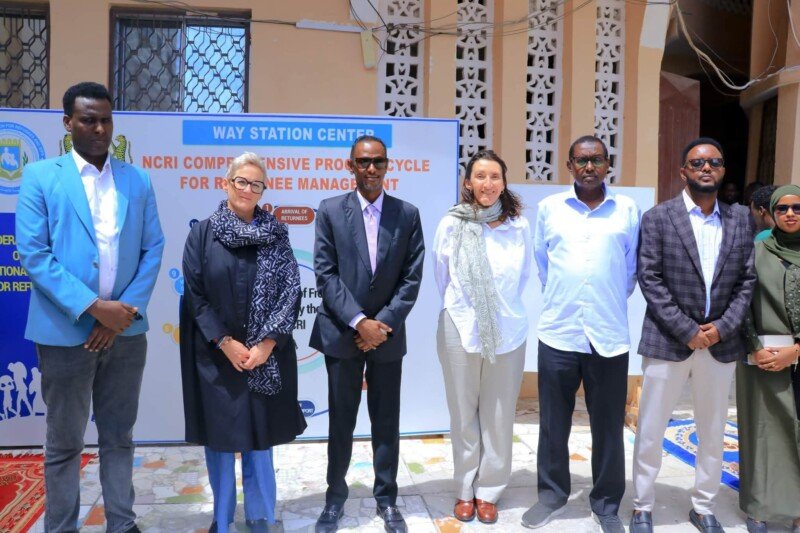
MOGADISHU — The European Union Delegation to Somalia visited the National Commission for Refugees and Internally Displaced Persons (NCRI) Return and Reintegration Centre in Mogadishu to meet with staff and Somali returnees, reaffirming its commitment to supporting reintegration efforts.
The delegation said that behind every return is an individual story, and that the EU remains committed to supporting each person’s unique journey to rebuild their life with dignity and safety.
The visit follows a recent exchange between the EU Delegation and the Somali Diaspora Returnees Network. The EU said diaspora expertise and investment contribute to institution building and economic growth, and can bring important elements to confidence building efforts at critical times.
EU Support for Repatriation and Reintegration
The EU has been a longstanding partner in Somalia’s efforts to repatriate and reintegrate its citizens. In July 2026, the NCRI provided immediate assistance to nearly 130 Somali nationals repatriated from Libya, where they had been held in detention centres and subjected to various hardships. The returnees, including young people and elderly individuals, received free medical check-ups, registration with the National Identification and Registration Authority (NIRA), and assistance in reuniting with their families.
In June 2025, Somali youth repatriated from Algeria were officially welcomed back home in a ceremony attended by NCRI officials and representatives of the Federal Government and the International Organization for Migration (IOM) Somalia. The youth, who endured significant hardships after embarking on irregular migration routes, were received with messages of hope and encouragement.
In October 2025, the Federal Government successfully repatriated 148 of its citizens from war-torn Yemen, marking a significant humanitarian achievement. The returnees arrived in Mogadishu, where they were warmly received by Minister of Foreign Affairs Abdulsalam Abdali.
Switzerland’s Deportation Controversy
The EU Delegation’s visit to the NCRI reintegration centre comes amid ongoing controversy over Switzerland’s plans to deport Somali nationals, including a seriously injured man whose case has drawn international attention.
Switzerland is due to deport a seriously injured Somali man to Mogadishu despite his lawyers’ objections and planned medical treatment, according to Swiss human rights group Augenauf. The man, a father of three children living in Europe who has been in Switzerland for 11 years, suffered multiple skull fractures, a traumatic brain injury and eye injuries after an alleged attack at an underground asylum accommodation. Two additional operations scheduled for the week of September 7 were prevented by Swiss authorities.
The case has raised concerns over the treatment of Somali nationals during forced deportations and Switzerland’s cooperation with Somali authorities on the return of migrants. Augenauf said Somalia’s Immigration and Citizenship Agency had issued the man with a provisional travel document despite his injuries, and that the photograph on the document did not resemble him.
Augenauf also said Switzerland provides financial and technical support to Somalia’s Immigration and Citizenship Agency, including computers, scanners and training opportunities, while simultaneously tightening visa rules for Somalia in August. The group described the approach as a “carrot and stick” strategy.
Allegations Over Sweden Deportations and Prime Minister’s Office
The Prime Minister’s Office has firmly denied reports alleging a secret agreement with Sweden concerning the deportation of Somali asylum seekers. In a statement released in October 2025, the office described the claims as “baseless and misleading,” stressing that no such agreement exists between Mogadishu and Stockholm.
“The Federal Government of Somalia has not entered into, nor has it discussed, any covert arrangement with the Government of Sweden regarding the return or deportation of Somali nationals,” the statement read. The government reaffirmed its commitment to transparency in all international engagements and reiterated that any bilateral discussions with partner nations are conducted through official diplomatic channels and in full accordance with international law.
The allegations intensified in September 2025 after the arrival of what critics called a “Special Case Flight” from Europe, carrying 28 deported Somali citizens from Sweden and Finland. Somali MP Dr. Abdillahi Hashi Abib, a member of the Foreign Affairs Committee, claimed the flight manifest was hand-delivered to Somalia’s Immigration and Citizenship Directorate before the group was processed and released without supervision.
Dr. Abib directly accused officials from the Office of the Prime Minister of orchestrating the scheme, alleging that Sweden, working through UNDP-managed channels, was paying $45,000 per deportee to Somali officials in exchange for accepting deported Somali-Swedish convicts. He labeled the scheme “bribery, treason, and a direct assault on Somalia’s sovereignty.”
Critical Note
The EU Delegation’s visit to the NCRI Return and Reintegration Centre highlights the continued engagement of international partners in supporting Somalia’s efforts to receive and reintegrate its citizens returning from abroad. The EU has been a consistent partner in these efforts, providing financial and logistical support for repatriation operations and capacity building for Somali institutions.
However, the delegation’s visit comes amid significant controversy over the treatment of Somali nationals deported from European countries. The case of the seriously injured man facing deportation from Switzerland, despite having undergone surgery and awaiting further medical treatment, raises serious questions about the medical safeguards surrounding forced removals. The allegations of a “carrot and stick” approach, combining technical support to Somalia’s immigration agency with tightened visa restrictions, underscore the political sensitivities of migration cooperation between Europe and Somalia.
The allegations involving the Prime Minister’s Office and Sweden, while denied by the government, have fueled debate within the Somali diaspora and raised concerns about transparency in bilateral arrangements. The claims that development assistance may have been linked to deportation cooperation, if substantiated, would represent a serious breach of the principles governing international development cooperation. The Somali government’s firm denial and its emphasis on transparency through UN-managed channels provide its account, but the absence of independent verification leaves questions unresolved.
For Somalia, the challenge is to balance its international obligations to accept returning citizens with its responsibility to protect their rights and dignity. The NCRI’s reintegration work, supported by the EU and other partners, is essential for ensuring that returnees can rebuild their lives. Yet the broader migration relationship with Europe remains fraught, with European governments increasingly linking development assistance and visa policies to cooperation on readmissions. Somalia’s ability to advocate for the fair treatment of its citizens abroad while maintaining constructive partnerships will be tested in the months ahead.
Recommended Reading On ftlsomalia.com
- Somali PM’s Office Denies Secret Deal with Sweden over Asylum Deportations
- Somalia’s Presidential Aspirant Provides Further Information on Secret Deportation Flight Scandal
- Somalia Welcomes Home 130 Citizens from Libyan Detention Centres
- Somalia Repatriates 174 Nationals from Libya
- Somali Youth Repatriated from Algeria Arrive Home
- Somalia Welcomes 148 Citizens Repatriated from Yemen