MOGADISHU — Somalia opened a two-day national conference on preventing and countering violent extremism on Wednesday, coinciding with the ninth anniversary of the October 14, 2017, Zobe Junction bombing, the deadliest attack in the country’s history.
The conference, organized by the Tubsan National Center for Preventing and Countering Violent Extremism (TNC-PCVE) under the Prime Minister’s Office, brought together senior government officials, international partners, women, youth and religious scholars.
Prime Minister Hamza Abdi Barre opened the conference, stating that the government has prioritized combating extremist groups both militarily and ideologically. He said growing public awareness has helped Somalis recognize the threat posed by extremist ideology to the country’s national identity and statehood.
“The Somali people have increasingly come to understand that the ideology of this group threatens our very existence as a nation and as a state,” the Prime Minister said.
Recalling the Zobe Bombing
The October 14, 2017, truck bombing at the Zobe intersection in Mogadishu killed at least 587 people and injured hundreds more, making it one of the deadliest terrorist attacks in African history.
Prime Minister Hamza, who narrowly survived the attack, recalled his personal experience at the conference. “I was among those saved by God. I passed that location before the explosion, then went to a house about 200 steps away.
He noted that Somali religious scholars had issued a religious ruling identifying the group’s conduct with the practices of the historical Khawarij and underscoring the need to confront its ideology and activities.
EU Pledges Continued Support
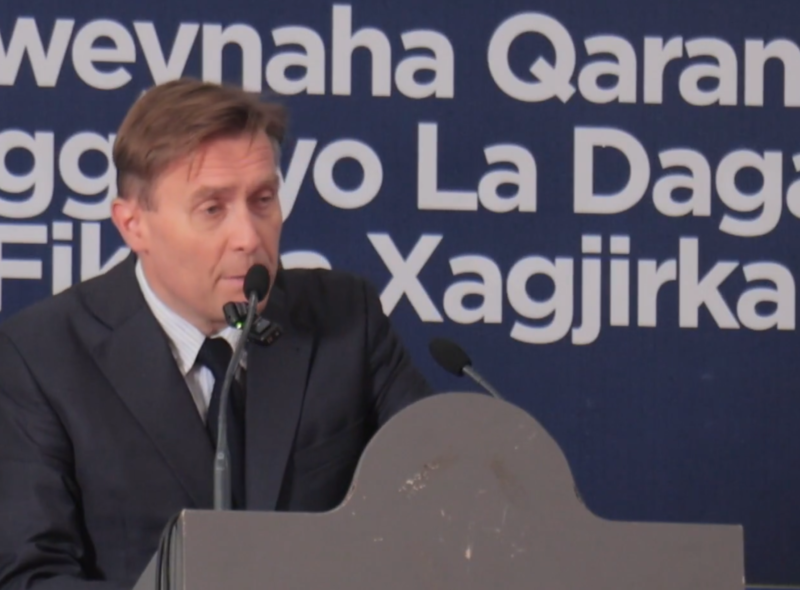
EU Ambassador to Somalia László Eduárd Máthé reaffirmed the European Union’s long-term commitment to Somalia’s security and community-level efforts to counter extremism, saying the bloc “will be by your side” as Somalia commemorates the anniversary of the Zobe bombing,.
The EU has been the largest direct contributor to successive African Union-led missions in Somalia, providing nearly €2.8 billion in support since 2007. As reported in FTL Somalia’s coverage of EU funding, the bloc approved an additional €75 million contribution to the African Union Support and Stabilization Mission in Somalia (AUSSOM) in April 2026, covering troop allowances and non-lethal equipment.
The EU-Somalia partnership has also emphasized stabilization and community recovery. At the first EU-Somalia Partnership Dialogue under the Samoa Agreement in May 2026, both sides reaffirmed their commitment to counterterrorism and stabilization efforts, with the EU commending Somalia’s military gains against Al-Shabaab while emphasizing the need to accelerate stabilization in liberated areas. As detailed in FTL Somalia’s coverage of the partnership dialogue, the EU delegation was led by Ambassador Di Mauro, who emphasized the importance of inclusive politics and democratization.
Government Strategy Against Extremism
The Prime Minister outlined a comprehensive strategy combining military operations, religious engagement and public awareness to weaken extremist groups and their influence on Somali society.
“I call on the Somali people to unite and work together to eliminate these hostile groups and their misguided ideology from our country,” he said.
The conference builds on a long-standing government strategy to counter extremism beyond purely military operations. As reported in FTL Somalia’s coverage of the TUBSAN forum, the government has adopted a “whole government approach” to dismantle Al-Shabaab, targeting the group’s combat capabilities, financial resources, influence, and ideological foundations.
In November 2025, TUBSAN hosted a dialogue on the role of Somali youth in preventing violent extremism. As detailed in FTL Somalia’s coverage of the youth forum, TUBSAN Director Ali Yasin Gurbe noted that combating extremism extends beyond military action to ideological, psychological, technological, and economic fronts requiring broad societal participation.
Critical Note
Nine years after the Zobe bombing, Somalia continues to grapple with the same extremist threat that claimed hundreds of lives in a single afternoon. The national conference on countering violent extremism is a necessary initiative, bringing together the stakeholders, government, religious scholars, civil society and international partners, whose cooperation is essential to addressing the root causes of radicalization.
The Prime Minister’s emphasis on the ideological dimension of the fight is significant. Military operations alone cannot defeat Al-Shabaab; the group’s ability to recruit and regenerate depends on its narrative, its exploitation of grievances, and its capacity to present itself as a defender of faith. Countering that narrative requires religious scholars who can challenge the group’s claims, community leaders who can offer alternatives to radicalization, and a government that delivers services and justice to the populations most at risk.
The EU’s reaffirmation of support comes at a critical moment. As AUSSOM faces funding uncertainties and Ethiopian troops prepare to withdraw from South West State, the EU’s €75 million contribution helps sustain the mission’s operations. But money alone is not enough. The EU’s emphasis on community-level efforts, alongside security support, reflects a recognition that stabilization requires more than military pressure.
What remains missing from the conference declarations is a clear-eyed assessment of why extremism continues to find recruits in Somalia. Poverty, marginalization, weak governance, and unresolved grievances all create the conditions in which extremist narratives take root. Countering extremism is not just a matter of messaging; it requires addressing the structural failures that make extremism attractive in the first place.
Recommended Reading On ftlsomalia.com
- Somalia Intensifies Anti-Terror Ideology Campaign at TUBSAN Forum
- TUBSAN Hosts Forum on Youth Role in Countering Extremism
- EU Approves €75 Million for AU Mission in Somalia
- Somalia Pushes for Enhanced EU Support on Human Rights and Governance
- Muslim World League Chief Meets Somali Scholars in Mogadishu, Agree Joint Project to Counter Extremism
- President Hassan Sheikh Meets Muslim World League Secretary-General to Counter Extremist Ideology