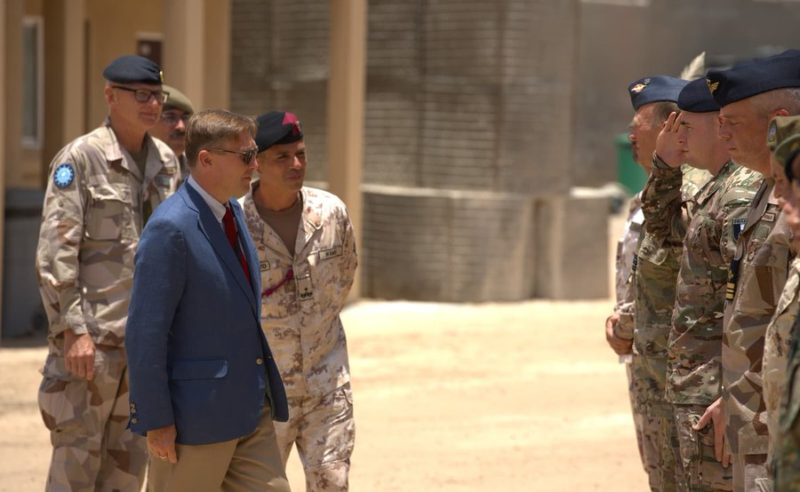
MOGADISHU — The new European Union Ambassador to Somalia visited the headquarters of the European Union Training Mission in Somalia (EUTM Somalia) on Tuesday, where he met with officials and commanders of the mission.
The visit focused on strengthening cooperation on security and the EU’s support for Somalia, particularly the development and professionalisation of the country’s security institutions. The Ambassador reaffirmed that the European Union would continue to strengthen its close cooperation with Somalia, noting that EU support is part of efforts to back the Somali government’s security priorities.
EUTM’s Role in Training Somali Forces
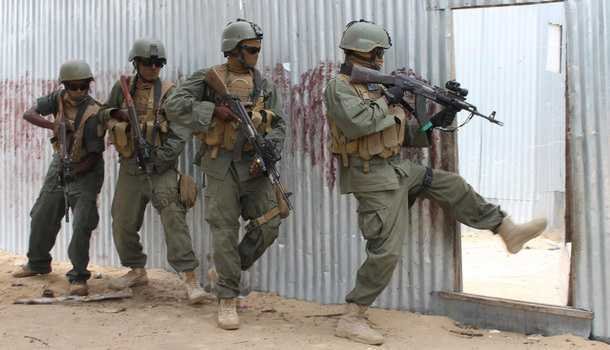
EUTM Somalia has for years played a role in the training and professionalisation of Somali security forces, with EU support forming part of broader efforts to build a Somali force capable of independently carrying out its security duties.
The mission, now in its 9th mandate, contributes to building up the Somali Security Forces accountable to the Federal Government, providing strategic-level advice to Somali authorities within security institutions in the Mogadishu area, as well as specific mentoring, advice and capacity building in the training domain.
EUTM Somalia has conducted a range of specialised training programmes in recent months, including joint logistics training with the African Union Support and Stabilization Mission in Somalia (AUSSOM) focused on vehicle recovery procedures and operational best practices.
In May 2026, the EUTM-S Mission Force Commander, Brigadier General Elio Manes, met with the Chief of Defence Forces, Brigadier General Ibrahim Mohamed Mohamud, to discuss capacity building, sustainable security, and deepening cooperation between the EU and Somalia.
The EU’s training efforts complement other partner-led programmes. As reported in FTL Somalia’s coverage of the latest Danab graduation, Prime Minister Hamza Abdi Barre presided over the closing ceremony of the 12th cohort of the Danab Commando Force, with training that included criminal law, human rights, medical and communications skills, and combat tactics.
Similar specialised training has been conducted with other partners, including Somali commandos who completed advanced training in Egypt earlier this month.
Broader EU Support to Somalia
The EU’s engagement in Somalia extends beyond training. In April 2026, the EU and its Member States confirmed a contribution of EUR 75 million to AUSSOM, maintaining its position as the largest supporter of the AU-led mission. This brings total EU support to successive AU-led missions over the last two decades to almost EUR 2.8 billion.
The EU has also supported leadership development for Somali security personnel, with ten Federal Darwish officers completing a Platoon Leaders Course run by EUCAP Somalia in September 2026, covering leadership, gender, human rights, and anti-corruption.
In May 2026, Somalia and the EU held a high-level Partnership Dialogue in Mogadishu under Article 3 of the Samoa Agreement, reaffirming their commitment to cooperation in security, governance, migration, and economic development. The Somali delegation was led by Deputy Prime Minister Salah Ahmed Jama, while the EU delegation was led by Ambassador Francesca Di Mauro and included ambassadors from EU member states, as detailed in FTL Somalia’s coverage of the Partnership Dialogue.
The EU has also engaged with Somalia on constitutional reform and electoral transition. In May 2026, Justice and Constitutional Affairs Minister Hassan Moallim Mahmoud met with EU ambassadors to discuss security, completion of the provisional constitution, economic reforms, and the government’s transition toward a one-person, one-vote electoral system, as reported in FTL Somalia’s coverage of the constitutional talks. The EU has allocated over EUR 10 million in budget support tied to progress in key reform areas, with a new budget support operation planned for 2026-2027.
The EU Ambassador designate also presented credentials to the Somali Deputy Foreign Minister in a ceremony that underscored the continuity of EU-Somalia diplomatic engagement, as reported in FTL Somalia’s coverage of the credentials presentation.
Critical Note
The visit by the new EU Ambassador to EUTM Somalia is a routine diplomatic engagement, but it carries significance at a moment when Somalia’s security transition is entering a critical phase. The EU has been a consistent partner in training and capacity building for Somali forces, and its continued engagement signals that Brussels remains committed to supporting Somalia’s security institutions even as other international actors recalibrate their presence.
The challenge for EUTM Somalia, and for the EU more broadly, is that training alone does not produce effective security forces. The mission has trained thousands of Somali soldiers over the years, but the Somali National Army continues to face structural challenges including inadequate pay, logistics constraints, and command fragmentation. The test of EUTM’s impact is not the number of soldiers trained but whether those soldiers can be deployed, sustained, and retained within a coherent security architecture.
The EU’s broader support to Somalia, including the EUR 75 million contribution to AUSSOM, reflects a recognition that stability in Somalia requires both capacity building and operational support. As the African Union mission prepares to draw down, the question is whether the EU and other partners will adjust their support to fill the gaps that will emerge. The new Ambassador’s engagement with EUTM Somalia suggests that the EU is at least aware of the challenge. Whether it can respond effectively remains to be seen.
Recommended Reading On ftlsomalia.com
- EU Ambassador Designate Presents Credentials to Somali Deputy Foreign Minister
- EU and Somalia Advance Constitutional Reforms and Direct Elections
- Ten Officers Complete EUCAP Somalia Leadership Course to Strengthen Federal Darwish
- Somalia, EU Hold High-Level Partnership Dialogue in Mogadishu
- Prime Minister Hamza Closes 12th Danab Commando Training Cohort
- Somali Commandos Return from Egypt After High-Level Military Programme