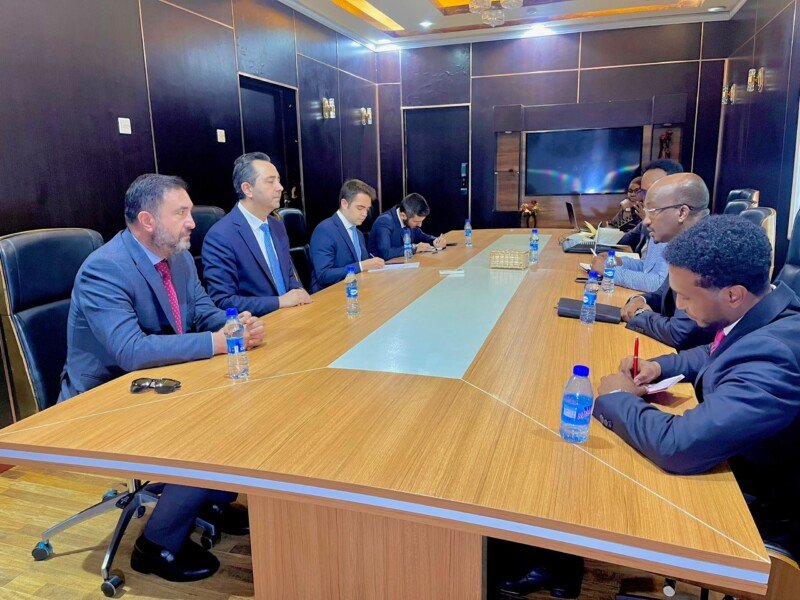
MOGADISHU, Somalia’s Minister of Fisheries and Blue Economy, Ahmed Hassan Aden, met with Türkiye’s newly appointed Ambassador to Somalia, Ferhat Alkan, on Sunday to discuss strengthening bilateral cooperation in fisheries and the blue economy, with a focus on attracting investment and promoting sustainable development.
According to a statement from the ministry, the meeting centered on expanding cooperation in fisheries, the blue economy, and the sustainable development of Somalia’s marine resources. Aden highlighted the importance of developing the fisheries sector and attracting investment to boost economic growth, create jobs, and increase domestic production.
Ambassador Alkan underscored the importance of deepening relations between Somalia and Türkiye, particularly in areas that could contribute to Somalia’s development. The ministry did not disclose details of specific investment commitments or agreements reached during the meeting.
A Relationship with Deep Roots
The meeting is part of a sustained diplomatic and economic engagement that has made Türkiye one of Somalia’s most consequential external partners. Turkish firms already manage Mogadishu Port and Aden Adde International Airport, and Ankara has invested over $1 billion in Somalia through aid, development projects, and economic partnerships, as detailed in FTL Somalia’s analysis of the Turkey-Somalia partnership.
The fisheries sector has been a particular focus. In December 2025, Minister Aden signed a major accord with Turkish conglomerate OYAK in Ankara, launching the Cooperation and Marine Production Development initiative. The agreement aimed to increase fish production, establish local processing facilities, and enhance the technical expertise of Somali fishermen, as reported in FTL Somalia’s coverage of the OYAK accord.
That partnership materialized in March 2026 with the launch of Somtürk, a joint venture between the Somali Fisheries Company and OYAK Group. The company was granted exclusive authority over fisheries licensing in Somalia’s Exclusive Economic Zone, with a mandate to combat illegal, unreported, and unregulated fishing and strengthen maritime surveillance capacity, as detailed in FTL Somalia’s coverage of the Somtürk launch.
However, the Somtürk arrangement has not gone unchallenged. In July 2026, Puntland issued a formal statement rejecting any Turkish maritime operations off its coastline, barring Somtürk from conducting fishing activities within Puntland’s territorial waters without prior approval. The administration argued that the Federal Government lacks the legal authority to grant concessions covering Puntland’s seas and land territory.
The Economic Stakes
Somalia has Africa’s longest coastline, stretching over 3,300 kilometers, and its waters are among the richest fishing grounds in the region. Yet the sector remains underdeveloped, contributing an estimated 2 to 3 percent of GDP. The Director General of the Ministry of Fisheries and Blue Economy, Abdi Dirshe, has emphasized that the country’s maritime resources could generate billions of dollars annually if managed effectively, as reported in FTL Somalia’s coverage of the sector’s potential.
Illegal fishing by foreign vessels continues to deplete stocks, while local fishermen lack access to markets, finance, and modern equipment. President Hassan Sheikh Mohamud has stated that more than a thousand vessels are currently fishing illegally in Somali waters.
Sunday’s meeting follows a pattern of high-level engagement. The government has also worked with international partners beyond Türkiye to develop the sector. Japan and the UN’s Food and Agriculture Organization launched a $2 million project to revitalize Somalia’s fisheries, focusing on sustainable management and job creation, as reported in FTL Somalia’s coverage of the Japan-FAO initiative. Minister Aden has also sought expanded technical support from the FAO to combat illegal fishing and improve data collection, as detailed in FTL Somalia’s coverage of the FAO talks.
Critical Note
The meeting between Minister Aden and Ambassador Alkan is a routine diplomatic engagement, and the ministry’s readout is notably thin on specifics. No investment figures were announced, no new agreements were signed, and no timelines were set. The absence of concrete outcomes does not mean the meeting was unimportant, but it does suggest that the relationship, however warm, has not yet produced the transformative investment that Somali officials have repeatedly promised.
The deeper issue is one of execution and sovereignty. The Somtürk model, which grants a foreign-backed joint venture exclusive licensing authority over Somalia’s Exclusive Economic Zone, is an extraordinary arrangement for a state that claims to be rebuilding its institutions. It reflects the government’s desperation for capital and technical capacity, but it also raises questions about who ultimately controls Somalia’s marine resources. Puntland’s rejection of the deal is not merely a federal-state dispute. It is a warning that any major fisheries arrangement will be contested by regional authorities who see the federal government’s concessions as overreach.
Ambassador Alkan arrives at a moment when Türkiye’s role in Somalia is expanding across security, energy, and maritime domains. The fisheries portfolio is one piece of a much larger partnership. Whether that partnership benefits ordinary Somalis, or primarily serves the interests of Ankara’s corporate champions and Mogadishu’s political elite, will depend on transparency and enforcement mechanisms that the government has not yet demonstrated it possesses. The meeting on Sunday produced no evidence that those mechanisms are being built.
Recommended Reading On ftlsomalia.com
- Somalia Establishes Somtürk Fisheries Partnership with Turkey to Enhance Blue Economy
- Turkish Delegation Launches Blue Economy Committees as SOMTURK Faces Puntland Ban and Federal Tensions
- Somalia Partners with Turkey’s OYAK to Advance the Blue Economy
- Somalia’s Blue Economy Holds Billion-Dollar Promise, Says DG Dirshe
- Japan and UN Join Forces to Revitalize Somalia’s Fisheries Sector
- Somalia Seeks Expanded FAO Technical Support to Combat Illegal Fishing