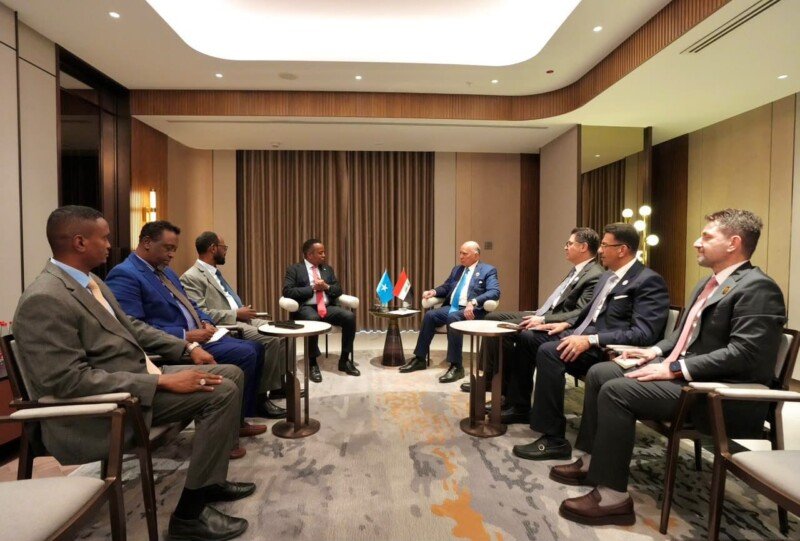
BAGHDAD, Somalia’s Foreign Minister Abdisalam Abdi Ali met with his Iraqi counterpart, Fuad Hussein, on the sidelines of the 52nd Organisation of Islamic Cooperation Council of Foreign Ministers in Baghdad, where the two discussed activating the Somalia-Iraq joint committee and expanding economic and agricultural cooperation, with Mogadishu expressing interest in launching livestock exports to Iraq.
According to a statement from the Somali Ministry of Foreign Affairs, the ministers agreed to accelerate the work of the joint committee and broaden cooperation in “vital sectors,” particularly the economy and agriculture. Ali conveyed Somalia’s desire to open new avenues for trade exchange, specifically the export of live Somali livestock to Iraqi markets, describing the opportunities for deepening the strategic partnership as “promising.”
The ministry did not disclose timelines for when shipments could begin, nor whether the two sides had reached specific agreements on veterinary requirements, quarantine procedures, or export volumes.
A Sector Under Pressure
The push into Iraq comes at a moment when Somalia’s livestock sector, the backbone of its economy, is facing significant strain. Livestock accounted for 75 percent of Somalia’s merchandise exports in the first quarter of 2026, contributing $257.76 million of the $344.91 million in total export receipts, according to the Central Bank of Somalia, as reported in FTL Somalia’s coverage of the export figures.
But the sector’s dominance masks a structural vulnerability. The same report noted that Somalia’s export base remains overwhelmingly dependent on a single commodity, despite a 20 percent year-on-year increase in overall exports. The country exported 1,424,413 heads of livestock during the quarter, comprising 1,293,931 sheep and goats, 71,921 cattle, and 58,561 camels.
At the same time, the sector is being squeezed by climate stress. Drought conditions have caused widespread water scarcity and pasture degradation, leading to declining animal health and rising mortality rates, as reported in FTL Somalia’s coverage of drought impacts on livestock. In the southwest, lack of rains has caused a sharp rise in livestock prices as feed becomes scarce and animals grow weaker, as detailed in FTL Somalia’s reporting on market pressures.
The sector’s concentration on Gulf markets remains a persistent risk. Saudi Arabia, the UAE, Oman, Yemen, and Qatar collectively account for the vast majority of Somalia’s livestock exports, making the sector highly exposed to import bans imposed over disease concerns.
The Iraqi Opportunity and Its Limits
Iraq represents a potentially significant new market. The country imports substantial quantities of live animals, particularly sheep, to meet domestic demand, and Somali livestock has historically been competitive in Gulf markets on price and availability.
Somalia and Iraq have been building a broader bilateral relationship in recent years. In November 2025, Somalia’s Agriculture Minister welcomed a high-level Iraqi delegation in Mogadishu to discuss cooperation in crop production, irrigation systems, and agricultural technology transfer, as reported in FTL Somalia’s coverage of the agricultural talks. The two countries have also deepened security cooperation, with the Somali Cabinet approving a security cooperation agreement with Iraq in February 2025, as detailed in FTL Somalia’s coverage of the agreement.
But opening a livestock export corridor requires more than diplomatic goodwill. Iraq will require veterinary certification, quarantine arrangements, and compliance with its own import regulations. Somalia’s veterinary infrastructure remains uneven, with disease surveillance, laboratories, and enforcement weak and concentrated in a few locations. The Somali Livestock Identification and Traceability System and the Livestock Market Information System are steps toward addressing these gaps, but their coverage and effectiveness remain limited. A fodder development centre launched in Dhusamareb in 2025, supported by the FAO and Denmark, represents an effort to build climate resilience, as reported in FTL Somalia’s coverage of the initiative, but such projects remain scattered.
The joint committee mechanism, if activated, could provide a framework for addressing these technical requirements. But joint committees in Somali diplomacy have a mixed record, often producing communiqués rather than concrete outcomes. The ministry’s statement did not indicate whether the committee had met previously, what its agenda would be, or when it would convene.
Critical Note
The meeting between Minister Ali and Foreign Minister Hussein is a routine diplomatic engagement, and the Somali government’s interest in opening new livestock markets is understandable. The sector is the country’s economic lifeline, and its over-reliance on a handful of Gulf markets has repeatedly exposed exporters to politically and epidemiologically motivated bans.
But the announcement should be read with caution. The ministry’s statement is aspirational, not operational. It expresses interest in exporting livestock to Iraq. It does not announce an agreement, a timeline, or a framework for meeting Iraqi import requirements. The gap between “expressing interest” and “shipping animals” is measured in veterinary protocols, quarantine facilities, and trade logistics that Somalia has historically struggled to provide.
The deeper issue is that Somalia’s livestock sector is being asked to expand into new markets while its existing export infrastructure is contracting. Exports are dominated by a single commodity, drought has decimated herds, and the government’s own traceability and investment systems remain works in progress. The broader trade picture is equally troubling: Somalia’s merchandise trade deficit widened to $2.13 billion in the first quarter of 2026, with imports outpacing exports by a wide margin, as reported in FTL Somalia’s coverage of the trade gap. Opening a corridor to Baghdad will not solve these problems. It may, if pursued seriously, provide a marginal diversification benefit. But the sector’s fundamental challenges will remain.
The Iraqi market is worth pursuing. But the government should be honest about what it will take to access it, and about whether it has the capacity to deliver on the veterinary and regulatory requirements that Iraq will inevitably demand. A diplomatic photograph in Baghdad is not an export agreement. The livestock herders who bear the costs of drought and export bans deserve more than another communiqué.
Recommended Reading On ftlsomalia.com
- Livestock Still 75% of Exports as Somalia’s Export Base Refuses to Diversify
- Somaliland Ministers Briefed on Drought and Livestock Export Efforts
- Lack of Rains Cause Huge Rise in Livestock Prices in Southwest
- Somalia and Iraq Deepen Agricultural Cooperation in Landmark Visit
- Somali Cabinet Approves Security Cooperation Agreement with Iraq
- New Fodder Development Centre Launched in Dhusamareb to Boost Sustainable Livestock Production
- Somalia’s Trade Gap Hits US$2.13 Billion as Imports Surge 16%