MOGADISHU, Members of the opposition Somali Future Council held a tense meeting at the residence of former President Sheikh Sharif Sheikh Ahmed on Monday night to debate how to respond to President Hassan Sheikh Mohamud’s invitation to a National Consultative Forum scheduled for November 14-18.
According to sources familiar with the discussion, council members weighed the political benefits and risks of accepting or rejecting the invitation. Some members appeared inclined to accept, signaling divisions within the coalition over the best approach to the government’s offer. However, no formal decision was reached, and consultations are continuing in an effort to reach a unified position.
The meeting followed the Presidency’s decision to extend formal invitations to four groups: the Somali Future Council, former President Mohamed Abdullahi Farmaajo’s Nabad iyo Nolol party, the National Unity Forum, and the Civil Society Coalition, as reported in FTL Somalia’s coverage of the invitation.
A Coalition With Deep Reservations
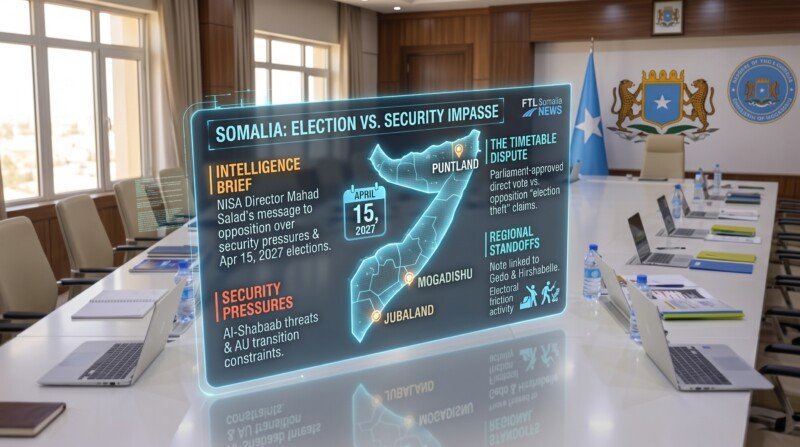
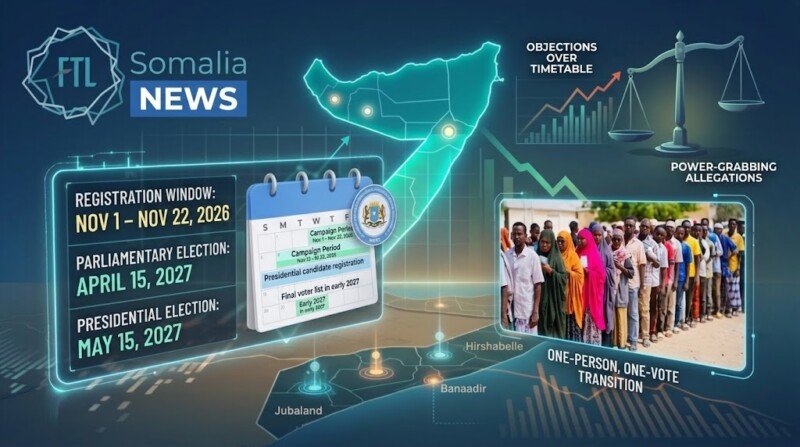
The Somali Future Council’s hesitation is rooted in its longstanding position on the electoral process. The coalition, which includes the leadership of Puntland and Jubaland, has consistently rejected the federal government’s unilateral electoral timetable and the constitutional amendments that extended President Mohamud’s term to May 2027.
As reported in Hiiraan Online’s coverage of the council’s earlier demands, the opposition has previously insisted that any dialogue be preceded by two conditions: an immediate suspension of all election-related activities and the appointment of an independent, credible mediator.
The council has also proposed an alternative “Transitional Direct Elections Model” that blends direct voting with the 4.5 clan power-sharing system, rejecting the government’s one-person, one-vote framework as impractical under current security and political conditions, as reported in FTL Somalia’s coverage of the opposition’s electoral proposal.
The Government’s Divide-and-Rule Calculation
The government’s decision to invite the Somali Future Council separately from Nabad iyo Nolol is politically significant. Farmaajo’s party has historically kept its distance from the broader opposition coalition, and by engaging it independently, the government may be attempting to create a more pliable interlocutor or to split the opposition’s united front.
Opposition figures have already questioned the legitimacy of the proposed forum. Abdullahi Abukar Haji, secretary of the Somali Future Council, has argued that President Mohamud’s term has expired, while MP Abdirahman Abdishakur Warsame has accused the president of conflating “consultation” with genuine negotiation, as reported in Somali Dispatch’s coverage of the opposition’s response.
What the Council’s Decision Means
The Somali Future Council’s internal debate reflects a broader strategic dilemma for the opposition. Accepting the invitation would grant legitimacy to a process convened by a president whose mandate they reject. Rejecting it outright risks ceding the political initiative to the government and being blamed for the failure of dialogue.
The council’s preliminary agreement to issue a unified response, rather than allowing members to answer individually, suggests an awareness that a fragmented response would undermine the opposition’s credibility. But a unified position may be difficult to achieve given the divergent views within the coalition.
The November forum will proceed regardless of the council’s decision. The question is whether it will be a genuine negotiation or a government-controlled consultation exercise. The opposition’s terms, a freeze on electoral activities and independent mediation, have not been accepted by the government. Without those conditions, the council’s participation would be a concession that its objections can be set aside.
Critical Note
The Somali Future Council’s internal divisions are not a sign of weakness. They are a sign that the opposition is weighing the costs and benefits of engagement with a government that has consistently refused to meet its core demands. The council’s members understand that attending a forum without preconditions would legitimize a process they have spent months rejecting.
But the government’s invitation is also a test for the opposition. If the council refuses to attend, it must offer a credible alternative path to resolving the political crisis. If it accepts, it must ensure that its participation does not become a rubber stamp for decisions already made. The council’s preliminary agreement to issue a unified response is a recognition that its credibility depends on presenting a coherent position, not on individual members pursuing their own agendas.
The deeper problem is that the government has not created the conditions for genuine dialogue. It has invited the opposition to a forum whose agenda and terms it controls, while refusing to suspend the electoral preparations that the opposition considers illegitimate. A dialogue under those conditions is not a negotiation between equals. It is an invitation to surrender. The Somali Future Council’s hesitation is a rational response to an offer that is designed to be difficult to refuse, but impossible to accept on terms that preserve the opposition’s integrity.