
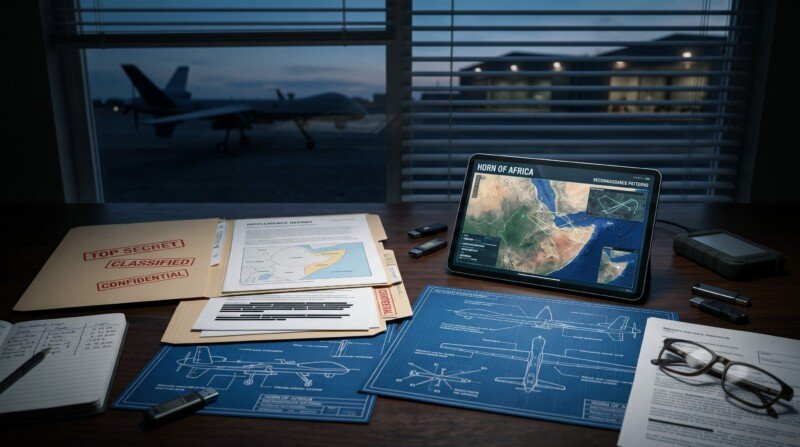
WASHINGTON, A former U.S. government contractor has pleaded guilty to conspiring to transmit highly classified national defense information to Ethiopia, in a case that exposes how American intelligence was used to support military operations during a war that has now drawn in Somalia’s regional partners and fractured the Red Sea security architecture.
Abraham Teklu Lemma, 54, of Silver Spring, Maryland, admitted in federal court on Tuesday that he exploited his position as an information technology contractor at the State Department, the Department of Justice, and the National Reconnaissance Office to remove and hand over dozens of classified documents and materials to senior Ethiopian government officials between 2021 and his arrest in August 2023.
Lemma held a Top Secret security clearance, and the material he shared was classified up to the Top Secret/Sensitive Compartmented Information level. Much of the intelligence he passed to Ethiopia concerned an armed conflict in the country, and his contacts included senior officials within Ethiopia’s political, military, and intelligence branches.
“Please Send Drones”
According to court documents, Lemma did not merely pass information passively. On December 18, 2021, he told one conspirator, “We have to finish these people once and for all, otherwise there will never be peace in Ethiopia.” Later that same day, he shared additional intelligence and wrote, “Please send Dro[nes].”
The FBI has stated that Ethiopian officials subsequently used the intelligence Lemma supplied in military operations. The disclosures began during the 2020-2022 war between Ethiopian federal forces and Tigrayan fighters, a conflict in which researchers at Ghent University estimated that up to 500,000 civilians died.
A Regional Architecture of Intelligence and Drone Warfare
The Lemma case is not an isolated incident of espionage. It sits within a broader regional architecture that FTL Somalia has documented extensively, one in which Ethiopia’s drone capabilities, intelligence networks, and military partnerships have reshaped the security landscape from the Blue Nile to the Gulf of Aden.
Sudan has formally accused Ethiopia of serving as the launchpad for a sustained drone campaign against its territory, presenting a report that documents 70 attacks involving 187 one-way drones and 82 strategic munitions. As detailed in FTL Somalia’s reporting on the Sudan report, the allegations place Ethiopian air bases at Asosa and Bahir Dar at the center of a cross-border war that has killed and wounded hundreds of civilians. The same report implicates Somali territory, identifying Bosaso in Puntland as a logistical hub for personnel and cargo destined for the Rapid Support Forces, and Berbera in Somaliland as the site of a UAE military base intended to serve U.S. and Israeli interests.
The intelligence that Lemma provided to Ethiopia was used in a war that Ethiopia was fighting against Tigrayan forces. But the capabilities it enabled, particularly drone targeting and operational planning, are the same capabilities that Sudan now says are being used against its territory. The Lemma case reveals that at least some of the intelligence supporting Ethiopia’s military machine came from a U.S. clearance holder who believed he was helping Ethiopia “finish these people once and for all.”
The Alamein Coalition and the Red Sea Fracture
The regional context has become more complex since Lemma’s espionage activities. In October 2026, Somalia signed the Alamein Declaration alongside Egypt, Eritrea, and Sudan, formalizing coordination on Red Sea security, the Nile dispute, and the war in Sudan. The declaration affirmed support for Somalia’s sovereignty and rejected recognition of Somaliland, aligning Mogadishu with a bloc explicitly designed to counter Ethiopian regional ambitions.
But that coalition is now fracturing. Eritrea has formally asked the UN Security Council to take “deterrent measures” against Ethiopia, accusing Addis Ababa of declaring war after Eritrean troops were reportedly targeted by Ethiopian drone strikes inside Tigray. As detailed in FTL Somalia’s coverage of the standoff, two of Somalia’s four partners in the Alamein Declaration are now on the brink of open conflict with each other, leaving Mogadishu in an impossible position.
Ethiopia has rejected the Alamein Declaration as a “coercive measure,” framing its position in geographic and historical terms rather than engaging with the specific provisions on the Nile and Red Sea. As FTL Somalia reported on Ethiopia’s response, Addis Ababa’s statement appeared to respond directly to the four-nation declaration, and its refusal to accept external constraints on its use of the Blue Nile or its claims to Red Sea access remains a core driver of regional instability.
The Red Sea itself has become a theater of overlapping threats. A tanker was struck by an unknown projectile near Al Jubayl, Saudi Arabia, in October, the latest in a series of attacks threatening shipping. As FTL Somalia reported on the attack, the incident underscores the convergence of Houthi strikes, Somali piracy, and the militarization of the Bab el-Mandeb corridor. Somalia’s participation in the Saudi-led Multinational Maritime Defence Alliance reflects its strategic position, but its own coastline remains largely unguarded, as the U.S.-Djibouti naval training exercises highlight the asymmetry between Djibouti’s fortified maritime perimeter and Somalia’s unprotected littoral.
Critical Note
The Lemma case is a reminder that the intelligence wars that shape the Horn of Africa are not fought only by spies in the shadows. They are fought by contractors with Top Secret clearances, by IT administrators who can copy a file and walk out of a building, and by individuals who believe they are serving a cause higher than the oath they swore to the United States.
Lemma’s messages are chilling in their clarity. He wanted drones sent. He wanted the fighters “finished once and for all.” He was not a passive conduit for information. He was an active participant in a war, using the access granted to him by the U.S. government to help one side kill the other.
But the case also exposes a deeper truth about the regional order that Somalia now navigates. Ethiopia’s military capabilities, including the drones that Lemma helped enable, are the same capabilities that Sudan says are being used against its cities, and that Eritrea says are being used to strike its troops. The United States has prosecuted the spy who provided the intelligence. It has not suggested that Ethiopia, the government that received and used that intelligence, will face any accountability at all. The Alamein Declaration was supposed to present a united front against Ethiopian expansionism. Instead, two of its signatories are now trading accusations of war, and the Red Sea security architecture that Somalia depends on is fracturing faster than any coalition can hold it together.
For Mogadishu, the lesson is uncomfortable. Somalia has aligned itself with Egypt, Eritrea, and Sudan against Ethiopia, while Ethiopian troops remain in Somalia under AUSSOM and Ethiopian drones patrol the same regional airspace that Lemma’s intelligence once helped target. The government’s claim of neutrality in the Ethiopia-Eritrea crisis, as FTL Somalia reported, is difficult to sustain when its partners are at war with each other and its own territory has been used as a transit hub for the weapons and personnel fueling the conflict in Sudan [citation:11]. The Lemma case is a spy story. But it is also a map of the networks that connect Washington, Addis Ababa, Abu Dhabi, and Mogadishu, and of the costs that those networks impose on civilians from Tigray to Blue Nile to the Gulf of Aden.
Recommended Reading On ftlsomalia.com
-
- From Bosaso to Berbera: How Somali Territory Became Part of Sudan’s War
- Alamein Declaration: Egypt, Eritrea, Sudan and Somalia Unite on Red Sea, Nile and AUSSOM
- Eritrea-Ethiopia Standoff Escalates as Somalia Watches Its Regional Partners Confront Each Other
- Ethiopia Rejects ‘Coercive Measures’ as Egypt, Eritrea, Somalia and Sudan Formalize Bloc