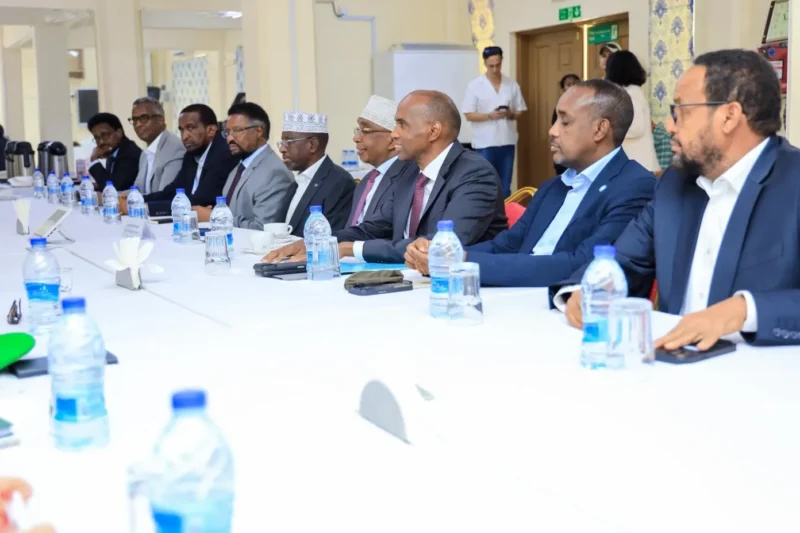
MOGADISHU, President Hassan Sheikh Mohamud has extended a formal invitation to four major political and civic groups, including former President Mohamed Abdullahi Farmaajo’s Nabad iyo Nolol party, to participate in a five-day National Consultative Forum in Mogadishu from November 14 to 18, 2026.
According to a press release from the Presidency dated October 26, the invitation was sent to Nabad iyo Nolol, the Somali Future Council (Golaha Mustaqbalka Soomaaliyeed), the National Unity Forum (Madasha Midnimo Qaran), and the Civil Society Coalition (Dalladda Bulshada Rayidka). The stated objective of the forum is to discuss federal election matters and reach a political consensus based on mutual understanding and compromise.
A Significant Shift, But With Complications
The invitation represents a notable shift in the federal government’s posture. For months, President Mohamud has insisted on a unilateral electoral timetable that sets parliamentary elections for April 2027 and presidential elections for May. The opposition Somali Future Council, which includes the leadership of Puntland and Jubaland, has rejected that timetable and the constitutional amendments that extended the president’s term.
But the invitation also carries political nuance. Nabad iyo Nolol, led by former President Farmaajo, is a distinct entity from the Somali Future Council. While Farmaajo has been one of the government’s most vocal critics, accusing President Mohamud of sabotaging talks and risking civil conflict, his party has historically refrained from formally joining the broader opposition alliances that include Puntland and Jubaland.
That distinction matters. By inviting Nabad iyo Nolol separately from the Somali Future Council, the government may be attempting to engage a prominent opposition figure without negotiating with the coalition that has taken the most uncompromising stance. It is a divide-and-rule tactic, or an attempt to create multiple channels of dialogue, depending on how one reads it.
As reported in FTL Somalia’s coverage of Farmaajo’s statement, the former president called on international partners not to “again endorse the agenda of the term-expired President.” Inviting him to a government-hosted forum is a significant gesture, whether it is genuine or tactical.
The Opposition’s Response
It is not yet clear whether the invited parties will accept. The Somali Future Council has consistently demanded that any dialogue be preceded by a freeze on the government’s unilateral electoral preparations and mediated by an independent third party, preferably the United Nations. The government has rejected international mediation, framing it as an infringement on Somali sovereignty.
The invitation also comes days after former NISA Director Abdullahi Mohamed Ali Sanbaloolshe claimed that he met with Puntland’s Deni, Jubaland’s Madobe, and Somaliland’s Cirro in the UAE to discuss forming a front to remove President Mohamud from power, potentially with Ethiopian support. As reported in FTL Somalia’s coverage of Sanbaloolshe’s allegations, the government has also accused the UAE of backing an RSF-style militia plot, though it has not presented public evidence.
Against that backdrop, the invitation to the National Consultative Forum can be read in two ways. It could be a genuine attempt to de-escalate and find a negotiated solution to the electoral impasse. Or it could be an attempt to split the opposition by inviting its constituent parts to a government-controlled process, thereby isolating the most hardline elements and presenting the government as the reasonable party in the dispute.
The Broader Context
The forum is scheduled to take place as Somalia’s political crisis continues to deepen. President Mohamud’s original four-year term expired in May 2026, and the constitutional amendments passed in March extended his mandate to May 2027. The opposition has rejected both the extension and the federal electoral timetable. Puntland and Jubaland have withdrawn from federal processes, and the opposition coalition has warned of parallel elections and civil conflict if the government proceeds unilaterally.
The invitation also follows Puntland President Said Abdullahi Deni’s warning that Somali statehood is at risk and his call for urgent national dialogue. As reported in FTL Somalia’s coverage of Deni’s intervention, the Puntland leader accused President Mohamud of refusing an agreed election and obstructing talks. Whether the president’s invitation is a response to that pressure, or an attempt to seize the initiative, is the central question.
Critical Note
The invitation to a National Consultative Forum is a welcome development in principle. Somalia’s political crisis cannot be resolved through unilateral decisions, and any genuine dialogue that brings the government and its opponents to the same table is preferable to the current trajectory of accusations, foreign interference, and the slow accumulation of armed fronts.
But the invitation must be judged by its terms, not its existence. The government has set the dates and the venue and has framed the agenda around “federal election matters.” It has not said whether it is willing to suspend its unilateral electoral preparations, whether it will accept independent mediation, or whether it will address the opposition’s core demands, including the reversal of the constitutional amendments and a negotiated electoral framework. An invitation to a forum that is designed to ratify the government’s existing position is not a negotiation. It is a demand for endorsement.
The separate invitation to Nabad iyo Nolol is particularly telling. Farmaajo’s party has historically kept its distance from the Somali Future Council, and by engaging it independently, the government may be trying to create a more pliable interlocutor. Whether Farmaajo accepts the invitation, and on what terms, will be a test of whether he sees himself as a bridge-builder or a spoiler. The Somali Future Council, for its part, must decide whether to engage or boycott. Engaging carries the risk of legitimizing a stacked process. Boycotting carries the risk of being blamed for its failure. The opposition’s decision will determine whether the forum is a genuine step toward resolution or another chapter in the crisis.