HARGEISA — The first significant rains of the Deyr season have fallen in Hargeisa and its surrounding areas this week, as forecasters confirm that a strengthening Super El Niño is driving wetter-than-normal conditions across the Horn of Africa.
Residents in Hargeisa and the surrounding countryside reported rainfall beginning on 7 October 2026, with the Somaliland Information Management Centre (IMC) projecting moderate to very heavy rainfall across several parts of Somaliland for the week of 7 to 13 October. The highest totals are expected in localized areas of Borama, Gabiley, Hargeisa, Sheikh, and Burco, with selected areas forecast to receive cumulative rainfall of 150 to 250 millimetres.
Vehicle Swept Away as Drivers Ignore Police Warnings
The first serious incident of the season occurred in Hargeisa this week when a vehicle was swept away by fast-moving floodwaters, with two people trapped inside. According to reports, the two occupants were rescued and are being questioned by police after they ignored instructions from officers to avoid crossing the flooded area.
The incident underscores the risks posed by flash flooding in urban areas where drainage infrastructure is limited and where drivers may underestimate the force of moving water. Police have repeatedly warned residents against attempting to cross flooded roads during heavy rains.
Super El Niño Driving the Rains
The rainfall is directly linked to a strengthening El Niño event in the tropical Pacific, which forecasters say is on track to rank among the strongest on record. According to the Puntland Information Management Centre, the Niño 3.4 sea surface temperature anomaly has reached +1.8°C, and the May-July 2026 Relative Oceanic Niño Index stands at +1.0°C, confirming significant ocean warming. Forecasts from the World Meteorological Organization and major global producing centres indicate an 81 percent probability of a very strong El Niño during the October-December season.
The World Meteorological Organization has warned that the Greater Horn of Africa faces an increased likelihood of wetter-than-normal conditions in the last quarter of 2026, with a 90 percent chance of enhanced rainfall over southern Ethiopia, central to southern Somalia, and north-eastern Kenya. October to December is a critical rainfall period for the region, contributing up to 70 percent of total annual rainfall in parts of Somalia.
ICPAC, the IGAD Climate Prediction and Applications Centre, has identified 1997 and 2023 as relevant analogue years. Both years experienced El Niño conditions and recorded wetter-than-normal rainfall across much of Somalia. The 1997 floods caused more than 2,300 deaths in Somalia, while the 2023 Deyr brought widespread displacement, infrastructure damage, crop and livestock losses, and disease outbreaks.
Flood Risk and Preparedness
While the rains bring welcome relief after prolonged drought conditions, they also carry significant flood risk. The Somaliland IMC has warned that localized rainfall exceeding 200 millimetres may increase the potential for flash flooding and surface runoff, particularly around Hargeisa and Gabiley.
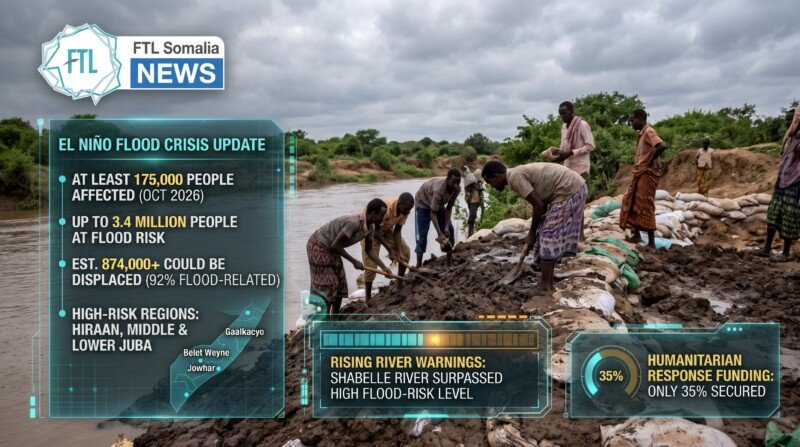
Hargeisa is among 29 districts across 14 regions that the Somali Disaster Management Agency (SoDMA) has identified for heightened preparedness. As reported in FTL Somalia’s coverage of SoDMA’s warning, the agency has urged communities in vulnerable areas to take early precautions, including clearing drainage channels and preparing for possible displacement.
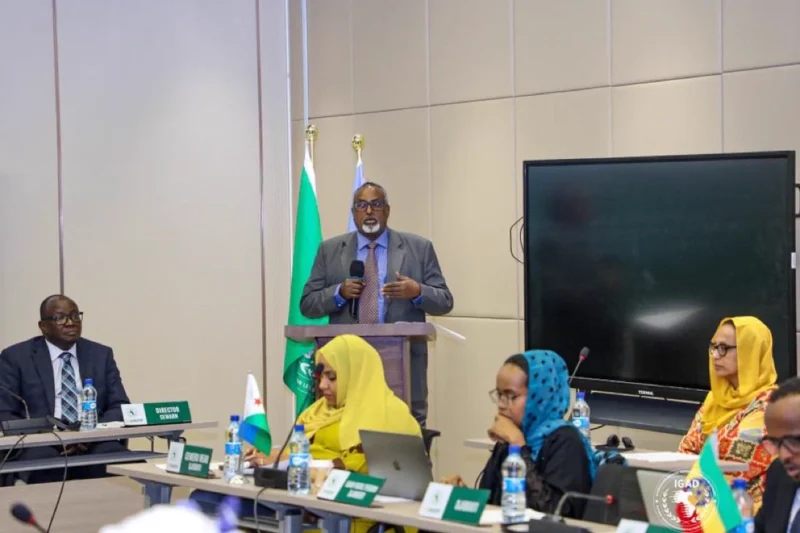
SoDMA Commissioner Mahmoud Moallim Abdulle has emphasised the importance of accelerating joint preparedness efforts for Super El Niño to reduce its potential impact on Somali communities, particularly the most vulnerable populations. As detailed in FTL Somalia’s coverage of SoDMA’s consultations with UN officials, the agency has been coordinating with international partners on flood preparedness and planning joint assessment missions to Somaliland, North Eastern State, and Puntland.
Funding Gaps Constrain Response
Despite the warnings, Somalia’s capacity to respond to a major flood event remains severely constrained. Pre-positioned financing stands at approximately $17 million against a credible worst-case scenario in the range of the 2023 floods, which cost $176 million in damages and losses alone. Humanitarian funding fell 27 percent year-on-year in January 2026, widening the financing gap.
The World Food Programme has warned that its ability to respond to a major El Niño event in Somalia is significantly reduced compared with previous years. During the 2022-23 El Niño, WFP scaled up to reach 10 million drought-affected Somalis with food assistance. This time, the agency is only reaching 670,000 people due to funding shortfalls.
Critical Note
The arrival of the Deyr rains in Hargeisa marks the beginning of what forecasters have consistently warned will be a dangerous season. The same climate phenomenon that brought relief from drought now threatens to bring destructive flooding. Hargeisa’s topography, with its steep hillsides and limited drainage infrastructure, makes it particularly vulnerable to flash flooding when rainfall exceeds normal levels.
The incident in which a vehicle was swept away, and its occupants rescued and questioned for ignoring police instructions, illustrates a recurring problem in flood-prone cities. Warnings are issued, but compliance is uneven. Drivers underestimate the force of moving water, and the consequences can be fatal. The police response, questioning those who ignored instructions, signals an intent to enforce safety measures, but enforcement alone will not prevent future incidents. Public education and visible risk communication are equally important.
The preparedness efforts by SoDMA, the Somaliland IMC, and international partners are necessary, but the funding gap is stark. Seventeen million dollars in pre-positioned financing against a potential $176 million in damages is not a preparedness posture; it is a hope that the worst-case scenario does not materialise. The WFP’s admission that it can reach only 670,000 people compared with 10 million during the last El Niño is a measure of how much the humanitarian system has been stretched.
For Hargeisa residents, the practical question is whether the drainage channels will be cleared, whether evacuation routes are identified, and whether the most vulnerable communities have access to the early warning information they need. The rains have arrived. The window for anticipatory action is narrowing.