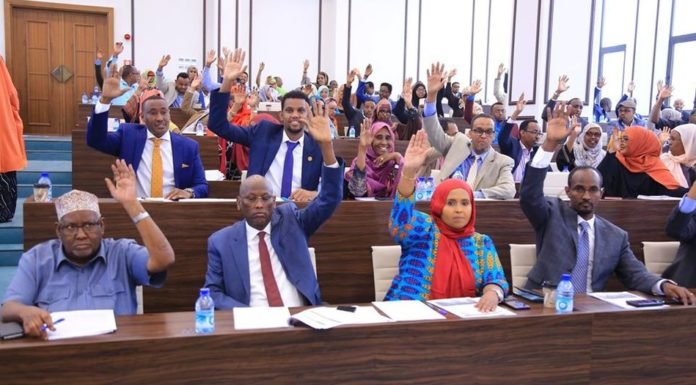
MOGADISHU — Somalia’s House of the People approved the Rape and Sexual Offences Bill on Wednesday, in a vote that saw 132 members in favour, three against, and five abstaining, during the 24th sitting of the 8th session.
The session, chaired by Speaker Abdulkadir Mohamed Nur (Jamac) and Second Deputy Speaker Abdullahi Omar Abshirow, opened with a quorum of 140 members, according to a statement from the House.
The passage of the sexual offences bill marks a significant step in Somalia’s legislative efforts to address gender-based violence. The bill now awaits further procedural steps before becoming law.
Minister Welcomes Approval
Minister of Family and Human Rights Development Ambassador Khadija Mohamed Al-Makhzoumi welcomed the approval, describing it as a significant step towards strengthening victims’ rights and access to justice.
“I extend my sincere appreciation to the leadership and Honourable Members of the House of the People of the Federal Parliament of Somalia for passing the Bill on Rape and Sexual Offences following extensive deliberation and legislative review,” Al-Makhzoumi said. “On behalf of Somali women and girls affected by sexual violence, and the Ministry of Family and Human Rights Development, I welcome this important milestone towards strengthening legal protection, ensuring accountability, and safeguarding victims’ rights and access to justice.”
Consumer Protection Bill Advances
In the same sitting, members of the House advanced the Consumer Protection Bill to its third reading. Lawmakers debated the provisions of the bill and its importance to the country.
The Consumer Protection Bill is intended to establish legal safeguards for consumers, regulate market practices and provide mechanisms for redress. Its advancement to the third reading brings it closer to a final vote.
A Long-Awaited Bill
The sexual offences bill has been under consideration in various forms for years. In August 2026, the House of the People was presented with four new draft laws, including the sexual offences bill. In 2023, the Cabinet approved the Sexual Offences Bill, with Prime Minister Hamza Abdi Barre stating that it would enhance human rights in the nation.
Despite these earlier steps, the bill had remained stalled in Parliament. As noted in Somalia’s 2026 Voluntary National Review, the absence of a federal Sexual Offences Bill meant that women and girls across Somalia lacked equal and consistent legal protection, and accountability for perpetrators of gender-based violence remained inadequate without statutory foundations.
The session was notable for achieving quorum, a persistent challenge for the House in recent weeks. As reported in FTL Somalia’s coverage of recent quorum failures, only 115 members attended a sitting earlier this month, falling short of the 138 required. The 140 members present on Wednesday represented a significant improvement.
The Speaker has also prioritised legislation related to women, family and children’s rights. As detailed in FTL Somalia’s coverage of the Speaker’s engagement with the Human Rights Committee, Jamac has directed the committee to accelerate its work on pending bills, particularly those addressing the rights of women and children.
Critical Note
The passage of the sexual offences bill is a positive development for Somalia’s legislative framework. The bill addresses a gap in the country’s legal protections against gender-based violence, an issue that has long been under-addressed in both formal and customary justice systems. The existing Penal Code, dating from 1962, classifies sexual violence under “Crimes against Morals and Decency” rather than as a crime against the person, and its definitions are restrictive and not in line with international standards.
The vote, 132 in favour, three against, five abstaining, reflects broad but not unanimous support. The abstentions and opposition votes suggest that some members have reservations about the bill’s provisions. Whether those concerns are substantive or procedural remains unclear from the available information.
The session’s achievement of quorum is also notable. The House has repeatedly failed to reach the 138-member threshold in recent weeks, delaying legislative work and undermining the institution’s credibility. Wednesday’s sitting, with 140 members present, suggests that the leadership’s calls for attendance and the imposition of financial penalties may be having an effect.
However, one successful session does not resolve the House’s structural problems. The chamber has 275 members, and its persistent difficulty in achieving quorum reflects deeper issues with absenteeism and the political incentives facing MPs. The passage of the sexual offences bill and the advancement of the Consumer Protection Bill are welcome, but they do not change the fact that the House has struggled to function consistently.
Recommended Reading On ftlsomalia.com
- House of the People Misses Quorum for Second Time in a Week
- ICRIC Requests Urgent Judicial Reform as Speaker Presses Human Rights Legislation
- Parliament Passes Environmental Management Bill, Advances Central Bank Amendment and Judicial Cooperation Legislation
- Somalia’s Constitutional Review Body Sets October 14 Deadline for Key Amendments