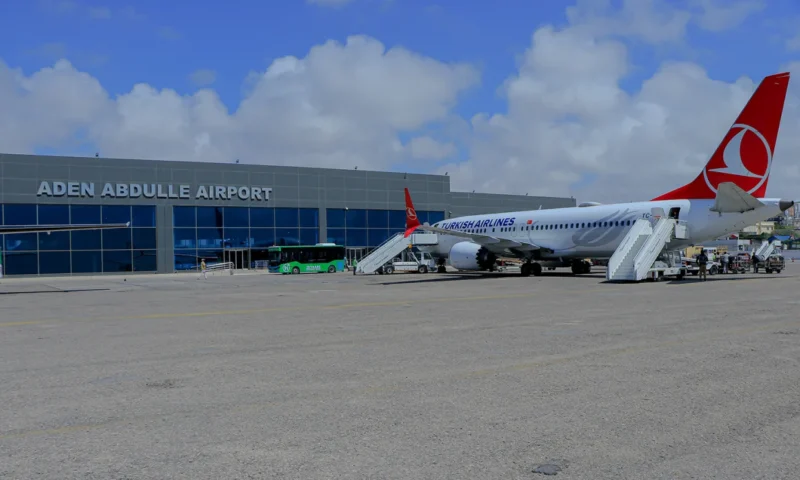
MOGADISHU — For nearly three decades, the airspace over Mogadishu was defined by absence: no national carrier, no major international airlines, and an airport that survived on humanitarian flights and the illicit qaat trade. Today, Aden Adde International Airport handles hundreds of thousands of passengers annually, Somali Airlines is preparing to resume operations after 35 years, and Somalia’s airspace has become a vital corridor for global aviation.
It is a transformation that few would have predicted in the years following the collapse of the Siad Barre government in 1991, when Somali Airlines ceased operations and the country’s aviation sector fragmented along factional lines.
The Long Road Back
The first airport in Mogadishu was established in 1928 as Aeroporto di Mogadiscio-Petrella, making it the first such facility in the Horn of Africa. By the mid-1930s, it offered commercial routes connecting Mogadishu to Asmara and Assab, and by 1936 a four-day intercontinental connection to Rome. In the early 1960s, Alitalia was the real caretaker of the sector, alongside airlines like Aden Airways, Egypt Air, and Air France. Somali Airlines was established in 1964 and later became a parastatal.
That era ended abruptly in 1991. The civil war led to the total collapse of Somali Airlines and most regular commercial air service. During the years of anarchy, aviation in Mogadishu was dominated by small, factional airstrips. Airports like Jaziira and Daynille were used primarily for landing qaat planes and, occasionally, UN humanitarian flights.
Mogadishu Airport nonetheless remained a crucial lifeline. In 2008, despite threats from Al-Shabaab, at least five commercial flights arrived weekly from Kenya, Djibouti, and Dubai. Airlines like Daallo Airlines and Jubba Airways operated risky flights using older aircraft, often landing at airstrips outside the city due to security concerns.
The Return of Major Carriers
The situation began to improve as stability slowly returned. In March 2012, Turkish Airlines became the first major international commercial airline to fly to Mogadishu in over 20 years, launching a route from Istanbul.
The pace of change accelerated in the 2020s. In February 2023, the IATA Billing and Settlement Plan was relaunched in Mogadishu after a 33-year hiatus. The safety and operational efficiency of Somali airspace was also enhanced, with modern radio navigation infrastructure deployed. Before these upgrades, there were approximately 220 daily flights through the country’s airspace; by June 2024, this had increased to 500.
In 2024, the National Bureau of Statistics reported that in 2023 the number of arrivals was 253,008 and departures was 233,808 at Mogadishu International Airport.
New Somali Carriers and Market Expansion
The domestic and regional market saw notable growth as new carriers entered the scene. In June 2024, Premier Airlines became the first passenger airline fully owned by Somali entrepreneurs in three decades, operating from Aden Adde International Airport.
Other carriers followed. Hilaac Air took delivery of its first aircraft, a Saab 340, in February 2024. Later that year, KESOM Air and Fajr Airlines began domestic services from the capital. Sabar Airlines launched its scheduled network connecting Mogadishu with Nairobi, Juba, and Hargeisa.
Security Challenges and Suspensions
The recovery has not been without setbacks. In March 2025, a US Embassy warning about a “potential imminent attack” at Aden Adde International Airport led to immediate flight cancellations. Turkish Airlines and Qatar Airways both suspended their flights. Turkish Airlines cancelled flights from March 6 to March 12, while Qatar Airways halted operations indefinitely at the time.
The alert followed a mortar attack on the airport during a diplomatic visit, part of a broader surge in militant activity near the capital.
National Carrier Revival and Infrastructure
Despite the security setbacks, the groundwork for long-term growth continued. The Somali government announced that Somali Airlines would resume operations, with the fleet to include two Airbus A320s purchased in July 2025. In August 2026, reports indicated the government had acquired two Airbus A320-200s and that the airline was targeting a return in mid-September 2026, after a 35-year hiatus.
The government has also announced plans for a new international airport in the El Ma’an area of Mogadishu to alleviate congestion at Aden Adde, following a five-year environmental and safety survey that found the site suitable for construction. The current airport features a 3,150-meter runway, a recently renovated international terminal, and a dedicated cargo terminal.
The Airspace Dividend
One of the most significant developments has been the transformation of Somali airspace from a liability into an asset. Somalia regained Class A airspace status in January 2023, and the improvement in safety standards led to a surge in overflight traffic. By March 2025, the daily average of overflights reached 520, with a record single day of 1,540 flights on March 1, 2025.
This traffic has generated substantial revenue. The basic overflight fee is $560 per aircraft, with congestion charges of $150 during peak hours and preferred route fees of $100. In a single three-day period in March 2025, Somalia collected more than $2.14 million in overflight fees, a 115 percent increase over the same period the previous year.
Critical Note
The recovery of Mogadishu’s airport and Somali airspace is one of the more tangible indicators of Somalia’s slow stabilisation. The contrast with the 1990s and 2000s, when the airport operated on the margins of the global aviation system, is stark. The return of Somali Airlines after 35 years, the entry of new Somali-owned carriers, and the surge in overflight traffic all point to a sector that is rebuilding.
But the recovery remains fragile. The March 2025 security alert demonstrated how quickly progress can be reversed by a single credible threat. The airport’s location near Al-Shabaab-controlled territory makes it a persistent target. The suspension of Turkish Airlines and Qatar Airways, even temporarily, showed that major carriers will not hesitate to withdraw when security conditions deteriorate. And the new airport planned for El Ma’an, while a welcome sign of ambition, will take years and over $500 million to complete, assuming it proceeds at all.
For Somalia, the aviation sector represents both an economic opportunity and a security vulnerability. Overflight revenue provides a rare source of hard currency for the state, and the airport is a gateway for investment, remittances, and humanitarian aid. But the sector cannot thrive without sustained investment in security and infrastructure. The progress of the past decade has been real, but it remains contingent on conditions that are not yet guaranteed.
Recommended Reading On ftlsomalia.com
- Somali Airlines Returns to the Skies: Government Sets September Deadline for Flag Carrier’s Resumption
- New Mogadishu Airport Construction Takes Flight
- SalamAir Launches Direct Flights Between Muscat and Mogadishu
- PM Orders Urgent Fixes at Mogadishu’s International Airport
- Mogadishu Mayor Unveils New Airport Parking Facility
- China and Somalia Deepen Transport and Aviation Cooperation