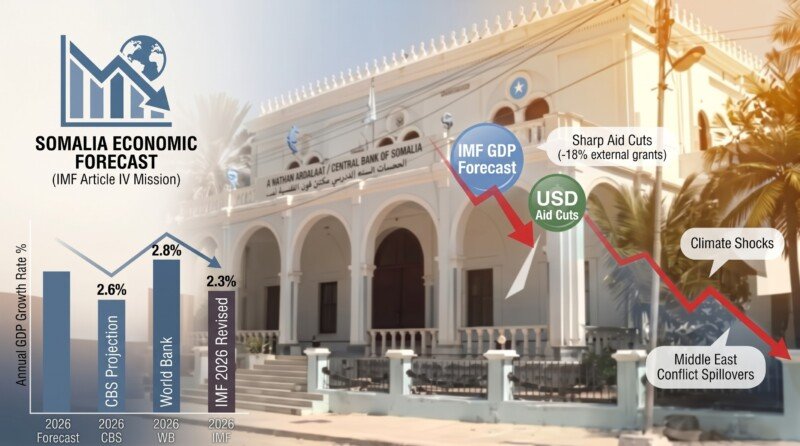
NAIROBI — The International Monetary Fund has cut Somalia’s 2026 economic growth forecast to 2.3 percent, down from earlier projections, citing a confluence of global and domestic challenges including sharp foreign aid cuts, severe climate shocks, and spillovers from the Middle East conflict.
The revised forecast, issued at the conclusion of the IMF’s 2026 Article IV consultation mission to Somalia, represents a further downgrade from the 2.6 percent growth projection contained in the Central Bank of Somalia’s Quarterly Economic Review published earlier this year, and well below the 3.1 percent growth recorded in 2025.
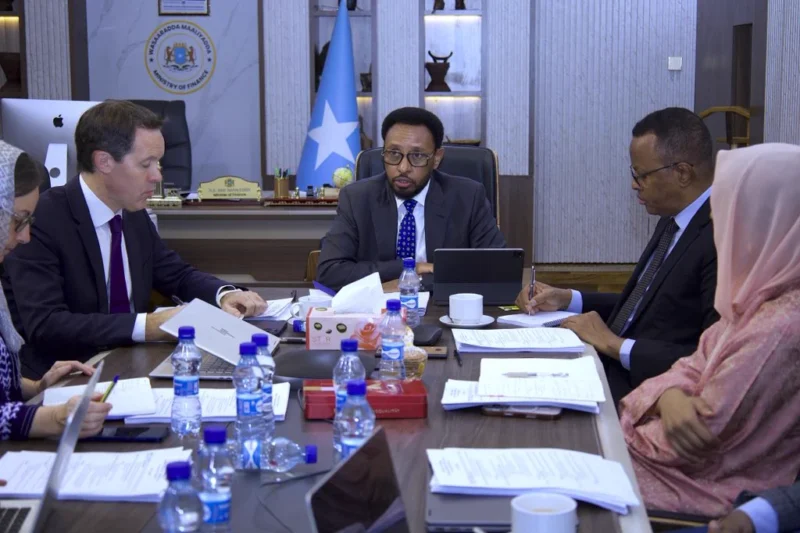
An IMF staff team led by Ms. Ran Bi conducted discussions with Somali authorities in Nairobi from September 21 to October 1, 2026. In a statement issued at the conclusion of the mission, Bi said Somalia is facing “a confluence of significant global and domestic challenges, including sharp foreign aid cuts since 2025, severe and recurrent climate shocks, spillovers from the Middle East war and evolving electoral dynamics.”
These challenges “have weighed on economic activity, raised inflation and food insecurity, pressured public finances, and dampened the near-term outlook,” Bi said. Growth is expected to recover gradually to 2.7 percent in 2027 and to 4 percent over the medium term.
Inflation to Reach 6.5 Percent
Inflation is projected to reach 6.5 percent in 2026, up from 3.7 percent in 2025, driven by prolonged drought conditions and global trade disruptions. As reported in FTL Somalia’s coverage of the inflation crisis, domestic fuel prices more than doubled from approximately US$0.60 per litre to roughly US$1.50 per litre in the first quarter of 2026, driving headline inflation to 6.3 percent.
While resilient remittance inflows continue to provide an important source of household income and foreign exchange, the IMF noted that Somalia’s external position remains vulnerable. “Near-term risks are high, including from more severe climate shocks, renewed regional conflict, further aid retrenchment, and domestic challenges,” Bi said. “Sustained donor support is critical, especially if downside risks materialize.”
Fiscal Deficit Narrowing
The IMF projects an overall fiscal deficit of 0.9 percent of GDP for 2026, narrowing to 0.5 percent in 2027. The authorities continue to focus on domestic revenue mobilization, although the current shock-prone environment has slowed progress.
As detailed in FTL Somalia’s coverage of the fiscal situation, domestic revenue increased by 7 percent to US$100.6 million in the first quarter of 2026, but bilateral grants fell to zero and total external grants declined by 18 percent.
Key near-term revenue measures recommended by the IMF include enhancing customs and income tax enforcement, harmonizing sales tax across the federal government and member states, and raising non-tax revenues. The authorities are encouraged to accelerate revenue reforms to achieve the objective of fully covering operational expenditure by domestic revenues in the near term.
Currency Reform and Financial Sector
The Central Bank of Somalia is making steady progress in strengthening financial supervision and inclusion, according to the IMF. The currency reform remains a national priority and should proceed carefully once key prerequisites are in place.
As reported in FTL Somalia’s coverage of the currency reform, Somalia is preparing to reintroduce the Somali shilling under a currency board arrangement, ending a 35-year period without new domestic banknotes.
Further progress in strengthening the anti-money laundering and counter-terrorism financing framework is critical to safeguard financial integrity and facilitate new correspondent banking relationships, the IMF said.
Medium-Term Reforms
Guided by the 2025-29 National Transformation Plan, the authorities are committed to reforms to bolster more inclusive and resilient private sector-led growth. Recommended reform priorities include implementing high-impact governance reforms, improving the business environment and access to finance, strengthening trade integration and supporting greater domestic value addition and export diversification.
The IMF also called for ensuring sound governance and operation of the Somali Development and Reconstruction Bank to facilitate financial access by underserved productive sectors. Sustained investment in education and climate resilience will also be critical, alongside continued improvements in the quality, coverage, and timeliness of economic and financial statistics.
Critical Note
The IMF’s downgrade to 2.3 percent confirms that Somalia’s economic trajectory is deteriorating more rapidly than the government’s own projections suggested. The Central Bank’s Q1 2026 report projected 2.6 percent growth; the World Bank projected 2.8 percent. The IMF’s figure is the lowest of the three and reflects a more pessimistic assessment of the combined impact of aid cuts, drought, and regional conflict.
The divergence between these forecasts matters because it shapes policy expectations and donor engagement. A 2.3 percent growth rate, against a population growth rate estimated at around 3 percent, means that real GDP per capita is contracting. Living standards are falling. For a country where multidimensional poverty already affects two-thirds of the population, this is a deeply concerning trajectory.
The IMF’s emphasis on domestic revenue mobilization is correct in principle, but the fiscal arithmetic is unforgiving. The government is being asked to accelerate revenue collection while the economy slows, aid declines, and security spending needs rise. The commitment to fully cover operational expenditure by domestic revenues in the near term is ambitious. Whether it is achievable depends on political will and administrative capacity, both of which have been constrained by the electoral disputes and governance challenges that the IMF’s own statement acknowledges.
The Article IV mission’s findings will inform the IMF Executive Board’s discussion and decision on Somalia’s reform program. The question for the Board, and for Somalia’s other partners, is whether the current policy mix is sufficient to stabilize an economy facing simultaneous external and domestic shocks, or whether additional support and more aggressive reforms are needed.
Recommended Reading On ftlsomalia.com
- Fuel Prices Double and Inflation Hits 6.3% as Middle East War Reaches Somali Households
- Four Federal Member States Raise US$15 Million as Federal Government Collects US$100 Million
- Somalia’s Currency Reform: New Shilling to Be Backed by Currency Board Arrangement
- World Bank: Only 21% of Somali households receive more than eight hours of electricity daily
- UNDP urges increased funding for employment, services to aid Somalia’s recovery