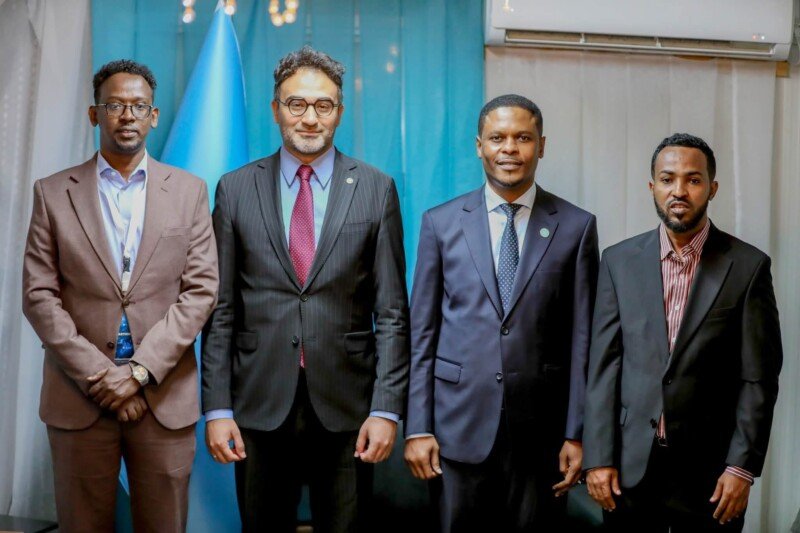
MOGADISHU — Somalia’s Minister of Information, Culture and Tourism Abdifatah Qasim Mohamud met with the Coordinator of the Center for Combating Disinformation at the Turkish Presidency’s Directorate of Communications, Deniz Demir, in Mogadishu on Saturday to discuss strengthening cooperation in countering disinformation and misleading narratives.
The meeting focused on leveraging Turkey’s expertise and knowledge in combating disinformation and propaganda, with discussions on the dangers such information poses to society, security, and the strategic relationship between the two countries. The officials also emphasized the importance of continuous cooperation to safeguard accurate information and public trust.
Those attending the meeting alongside the Minister included the Director of the Strategic Communication Department at the Ministry, Abdishakur Ali Ahmed, and the Director of Somali National Television, Mohamedkafi Sheikh Abukar.
Protests and Turkish Flag Burning
The meeting comes as protests have erupted in several parts of Somalia over allegations that Turkish drones were involved in an attack on the residence of former Somali Custodial Corps commander General Mahad Abdirahman Aden in Doolow on the night of September 3. Jubaland authorities accused Turkish drones of carrying out the strike, saying the general was targeted because of his political differences with the federal government .
Demonstrations were reported in Kismayo, Afmadow, Doolow and Garbaharrey. In Kismayo, hundreds of demonstrators burned the Turkish flag, with some carrying images of Turkish President Recep Tayyip Erdogan with bloody hands and banners reading “We don’t need Erdogan” . Protesters chanted “We once loved Erdogan and Turkey, now we hate them”.
The federal government has rejected the airstrike claim, saying preliminary information indicated the explosions were caused by explosives being prepared inside the house, and announced it would appoint a fact-finding committee . Turkey has not officially commented on the incident .
A Pattern of Deepening Media Cooperation
This is not the first engagement between Somali and Turkish officials on media and information matters. In September 2026, the same Minister Mohamud and Coordinator Demir attended a program titled “A New Era in Türkiye-Somalia Relations” at Aden Adde International Airport, where Speaker of the House Abdulkadir Mohamed Nur called for enhanced efforts to counter disinformation.
The Turkish Ambassador to Somalia, Alper Aktaş, visited the Ministry of Information in May 2026 to discuss media modernization, institutional capacity building, and cross-cultural exchange programs, including plans for cooperation on countering regional disinformation campaigns.
Somalia has also launched a National Policy Consultation on Managing the Risks of Social Media Misuse, bringing together government officials, civil society, media professionals, and legal experts to develop a framework to mitigate harms including cyberbullying, hate speech, online radicalization, and the spread of false information.
Turkey’s Disinformation Law and Its Consequences
Turkey’s approach to disinformation has drawn significant international criticism. Article 217/A of the Turkish Penal Code, widely known as the “disinformation law,” has been used extensively to prosecute journalists since it entered into force in October 2022. At least 83 journalists have been charged 114 times under the provision.
The law’s vague language, which fails to clearly define what constitutes “untrue information,” has left courts with unchecked power to determine criminality. As one journalist prosecuted under the law noted, any information not sourced from the government is liable to be deemed false.
In recent months, authorities have escalated use of the law to arrest and sentence journalists. In April 2026 alone, journalists Murat Ağırel and Barış Pehlivan were each sentenced to one year and three months in prison for commentary on a television broadcast, while Zafer Arapkirli received a two-year and six-month sentence for a social media post.
The International Federation of Journalists and its partners have condemned the escalating use of the law, calling for its immediate repeal and describing Turkey as a “regional and even global outlier in the misuse of regressive fake news and disinformation legislation.”
Somalia’s Own Press Freedom Challenges
The meeting comes as Somalia faces its own significant challenges regarding freedom of expression and media freedom. Journalist Mascuud Warsame, founder of Xogbile TV, was released in August 2026 after 40 days in detention without formal charges, raising serious concerns about the legality of his detention and the state of press freedom in Somalia.
In May 2026, Somali security forces detained and allegedly assaulted three journalists in Mogadishu, with media organizations reporting that police threatened them with death if they did not remain silent about planned protests and other sensitive developments in the capital.
Social media activist Sacdiya Macalin Ali was detained for 122 days before an appeals court overturned her three-year sentence for “insulting state institutions” and “incitement,” stemming from videos she posted criticizing government officials.
Somali police have also detained TikTok content creators accused of mocking President Hassan Sheikh Mohamud, with authorities describing their actions as a “criminal offense” under laws against insulting national leaders.
The country’s draft Penal Code, currently before parliament, contains provisions that press freedom organizations warn could further criminalize journalism. Reporters Without Borders and the National Union of Somali Journalists have identified articles that penalize “false,” “misleading,” or “exaggerated” information with sentences of up to ten years, and up to 20 years when linked to a “hostile state.”
Critical Note
The meeting between Somali and Turkish officials on countering disinformation raises uncomfortable questions about the direction of Somalia’s media policy. Turkey’s disinformation law has been weaponized against journalists on a scale that has drawn condemnation from international press freedom organizations, and its vague provisions have been used to prosecute reporting on matters of clear public interest. Somalia’s own draft Penal Code contains strikingly similar language, criminalizing “false” or “misleading” information without clear definitions or safeguards for journalistic work.
The risk is that Somalia is importing not just Turkey’s technical expertise but its approach to controlling narratives. Somali journalists already face arbitrary arrests, equipment confiscation, and degrading treatment at the hands of security forces. Social media users have been detained for posts criticizing government officials or discussing sensitive topics. Adding a legal framework modeled on Turkey’s disinformation law would further shrink the space for independent reporting and public debate in a country where access to credible information is already constrained.
The government frames its efforts as combating harmful falsehoods, and disinformation is indeed a genuine concern in any society. Yet the record in Turkey and the pattern of arrests in Somalia suggest that such laws are more often used to silence critics than to protect the public. Without robust safeguards for journalists, clear definitions of prohibited content, and independent judicial oversight, cooperation on countering disinformation risks becoming a tool for suppressing dissent rather than a means of protecting accurate information.
Recommended Reading On ftlsomalia.com
- Turkey-Somalia Forum Highlights Deepening Ties Amid Growing Media Crackdown in Both Nations
- Somalia Defense Minister Warns Against Politicizing Turkey Relations Amid Protests
- Jubaland Condemns Alleged Turkish Drone Strike on Former Prison Chief in Doolow as Federal Government Denies Involvement
- Turkish Ambassador Visits Somali Information Ministry
- Somalia Launches Consultation on Social Media Misuse Risks
- Journalist Mascuud Warsame Released After 40 Days of Unlawful Detention
- Journalists Arrested, Beaten in Mogadishu Amid Press Freedom Crackdown
- Sacdiya Bajaaj Released After Appeals Court Overturns Sentence