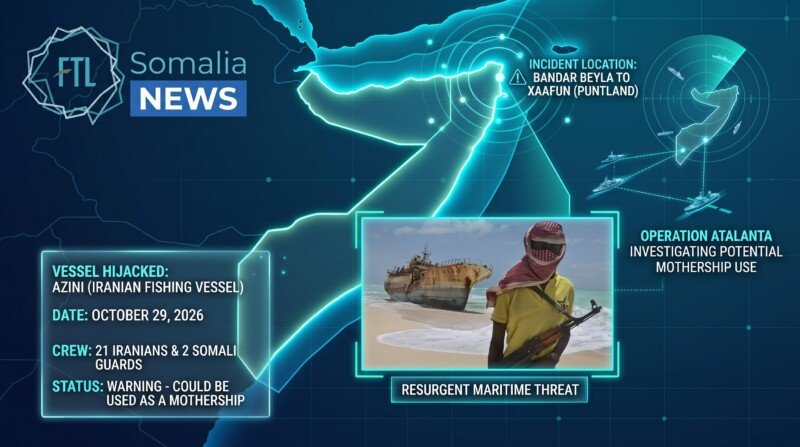
MOGADISHU, Armed men have reportedly hijacked an Iranian fishing vessel off the northeastern coast of Somalia, with maritime authorities warning that the ship could be used as a mothership to launch further attacks on commercial shipping.
The vessel, named the Azini, was seized on October 29 at approximately 09:00 UTC, according to an alert issued by the Maritime Security Centre Indian Ocean (MSCIO), which supports the EU’s Operation ATALANTA. The reported hijacking occurred between the coastal towns of Bandar Beyla and Xaafun in the semi-autonomous Puntland region.
The safety of the crew remains unknown. According to Puntland security officials cited by AFP, 21 crew members were aboard, excluding two Somali guards who were working as security personnel. The guards were reportedly overpowered when the attackers, initially eight armed men, boarded the vessel. Four more gunmen later joined them, bringing the total number of pirates aboard to twelve.
MSCIO issued an update on October 31 stating that the Azini was approaching a maritime traffic lane and “could potentially be used as a mothership to conduct further piracy attacks.” Operation ATALANTA is investigating the incident. No confirmed follow-on attacks have been reported.
A Resurgent Threat
The Azini is the third Iranian fishing vessel to be hijacked off the Somali coast since July. The incident comes amid a broader resurgence of Somali piracy, with at least 15 attacks reported since April, the highest number since 2013.
The use of fishing vessels as motherships is a recurring tactic that allows pirate groups to operate farther from the coastline and target commercial shipping across wider areas of the Indian Ocean. Earlier this year, pirates used the hijacked cargo vessel MV Sward, seized in April, to capture at least two Iranian fishing boats and a Cameroon-flagged cargo ship. The conversion of the MV Sward into a floating base marked a significant escalation in the resurgence of maritime crime off the Horn of Africa that had been dormant for over a decade.
The resurgence has been linked in part to a shift in international naval priorities. Western naval forces that had been deployed to patrol waters near the Horn of Africa have been redirected to the Red Sea and Gulf regions, creating gaps in maritime surveillance that pirate groups have exploited. The diversion of international anti-piracy patrols to counter Houthi rebels has created a security vacuum that pirates are exploiting with increasing sophistication.
The human cost has been severe. The International Maritime Organization has repeatedly warned about the deteriorating conditions of hostages held aboard hijacked vessels. At the peak of the crisis in August, more than 90 seafarers were being held captive across six merchant ships, with limited access to food, water, and medical support. The violence has not been confined to the hostages; earlier this year, five crew members were killed during the liberation of the MT Honour 25, underscoring the lethal risks of these operations.
Somali authorities have acknowledged the scale of the problem. The federal government has called for international cooperation to address the surge off the Puntland coast, recognizing that national resources alone cannot patrol the vast maritime domain.
Critical Note
The hijacking of the Azini is a reminder that Somalia’s maritime security is not a closed chapter. The international patrols that once kept piracy in check have thinned, and the networks that profited from ransom payments have not disappeared. They have adapted, using captured vessels as floating bases and exploiting the same coastal connections that sustained them during the peak years.
Puntland authorities have recently claimed success in clearing pirate groups from their coastal areas. The Azini incident challenges that narrative. A fishing vessel with a Puntland license, represented by a local businessman, was seized in Puntland waters and is now reportedly moving toward a commercial shipping lane. If the authorities cannot protect licensed vessels operating close to shore, the claim that the coast is secure is difficult to sustain.
The international response has been limited to an alert and an investigation. Operation ATALANTA has warned ships to maintain vigilance and follow best management practices. That is necessary, but it is not a solution. The gaps in naval patrols that created this opening will not close on their own, and the economic incentives that drive piracy remain intact as long as ransoms are paid and coastal communities see little benefit from the state’s presence.
For the crew of the Azini, twenty-one Iranians and two Somalis, the immediate concern is survival. For Somalia, the incident is a test of whether the country’s maritime security institutions, and the international partners that support them, can prevent a localized hijacking from becoming the start of another cycle.
Recommended Reading On ftlsomalia.com
- Somali Pirates Turn Hijacked Ship into Mothership as Piracy Surges in Puntland Waters
- Global Naval Shifts Fuel Somali Piracy Return as Dozens of Crew Members Held Hostage
- IMO Sounds Alarm as Somali Pirates Hold More Than 90 Seafarers Hostage
- Five Crew Killed During Liberation of MT Honour 25 as EUNAVFOR Updates Piracy Cases
- Somalia Calls for International Cooperation as Piracy Surges Off Puntland Coast