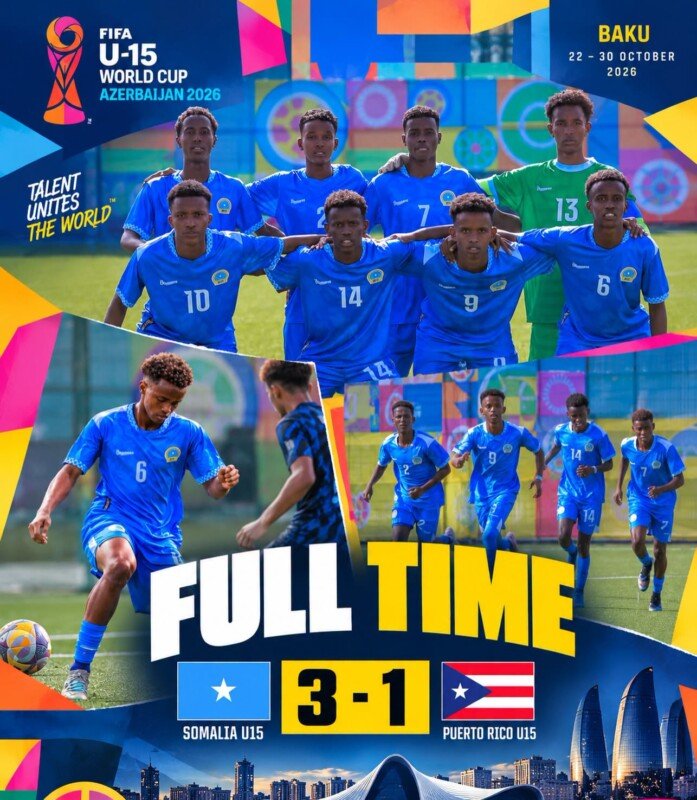
BAKU, Somalia’s Under-15 national football team opened its campaign at the inaugural FIFA U-15 World Cup and Festival with a 3-1 victory over Puerto Rico on Saturday, led by a standout performance from Ismail Mohamed, who was named Man of the Match after scoring two goals and providing one assist.
The victory, Somalia’s first at any FIFA tournament, was witnessed by the country’s Ambassador to Azerbaijan, Abdinur Dahir Fidow, who attended the match to support the young players. Mohamed’s contribution accounted for all three of Somalia’s goals, a performance that underlined the forward’s importance to the team’s campaign.
For a nation whose football infrastructure has been rebuilt from the ruins of more than three decades of conflict, the moment carried significance beyond the scoreline. The Somali Football Federation described the participation as a historic milestone for the country’s youth program, noting that Somalia had never previously competed in a FIFA World Cup tournament at any age level.
Group T: A Competitive Field
Somalia has been drawn in Group T alongside Venezuela, Madagascar, Mozambique, Puerto Rico, and New Zealand. The group stage is compressed into a tight schedule, with teams playing multiple matches between October 24 and 26.
Somalia’s next match is against Venezuela on Sunday, October 25. Venezuela enters the match with momentum after a 5-0 victory over New Zealand in their opening fixture. The result will be crucial in determining Somalia’s placement within the tournament’s unique tier system.
A Tournament Unlike Any Other
The inaugural FIFA U-15 World Cup and Festival is unlike any previous FIFA competition. Matches are played eight-a-side over two 20-minute halves on smaller pitches, with unlimited substitutions and kick-ins replacing throw-ins. There are no knockout rounds. Instead, after a group stage, teams are placed into one of six performance tiers, with each tier crowning its own winner.
Somalia is among 189 FIFA member associations taking part, and one of 78 countries making their first appearance in a FIFA World Cup competition at any level. The tournament runs from October 24 to 30, with most matches staged at the Hovsan Competition Complex and the finals at Baku Crystal Hall.
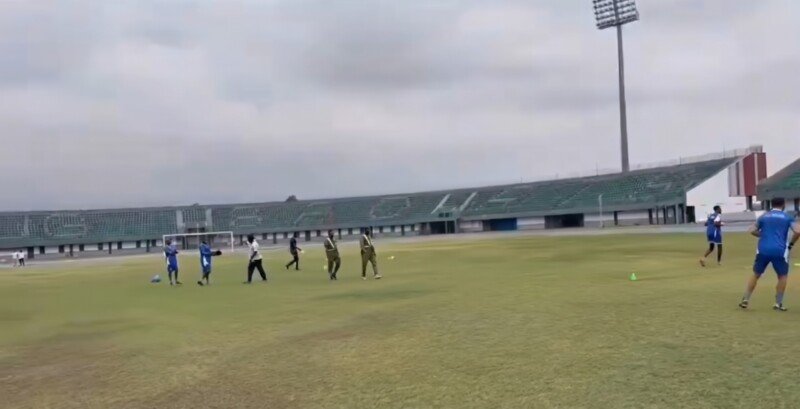
The Somali squad, drawn from a national U-15 championship held earlier this year in Mogadishu and regional states, had been in a centralized training camp for four months under the supervision of the national youth technical staff before departing for Baku.
What This Means for Somalia
The image of Somali teenagers in Baku, wearing the national jersey and singing a patriotic song after a FIFA victory, is not merely a sports story. It is a counter-narrative to the headlines that usually define Somalia in international media: conflict, famine, piracy, and political dysfunction. For a generation of Somalis who have known little else, the sight of their peers competing on a world stage, and winning, is a powerful affirmation of national identity and potential.
The tournament’s development-focused format, with its emphasis on education, life-skills programs, and shared athletes’ villages, is designed to produce exactly this kind of experience. FIFA’s decision to open the competition to nearly all member associations, rather than restricting it to traditional football powers, has given countries like Somalia an opportunity that the senior World Cup has never provided.
The victory over Puerto Rico is a single result in a tournament that will ultimately rank teams across six tiers. It will not, by itself, transform Somali football. But it is a beginning, and the players who sang “Somalia belongs to Somalis” in Baku will carry that moment with them, as will the millions of Somalis who watched them.
Critical Note
The celebration is genuine, and the achievement is real. Somalia’s U-15 team has done something no Somali team has done before: won a match at a FIFA tournament. The players, most aged 13 and 14, have earned the right to sing whatever they want after a victory that their country has waited decades to see.
But the moment also invites a question that Somali football must eventually answer. The Somali Football Federation has prioritized youth development, regional leagues, and international exposure. The Baku squad is a product of that policy. The next step, as federation officials have said, is to make this regular rather than exceptional. That will require sustained investment in academies, coaching, and infrastructure, not just a single tournament appearance.
For now, the image of Somali teenagers celebrating in Baku is enough. It is a reminder that Somalia’s youth are not defined by the country’s crises. They are defined by what they can achieve when given the chance to compete. The song they sang, “Somalia belongs to Somalis,” is a statement of ownership and belonging. On a football pitch in Azerbaijan, they earned the right to sing it.