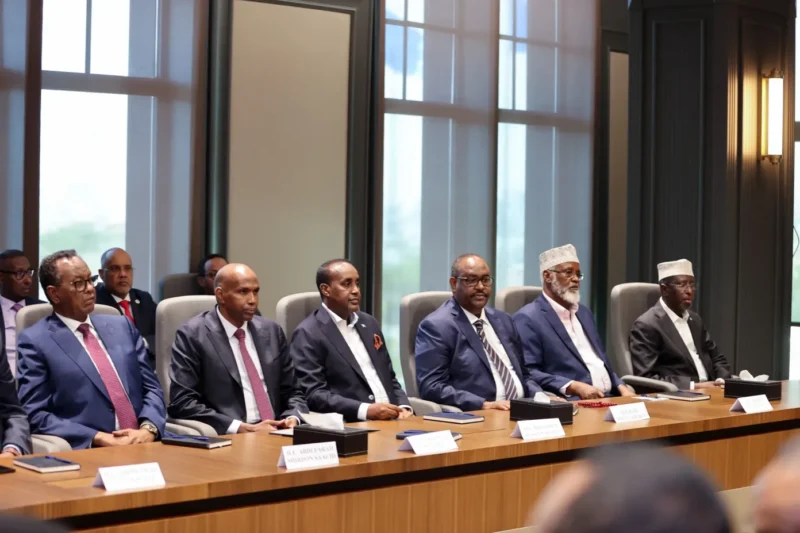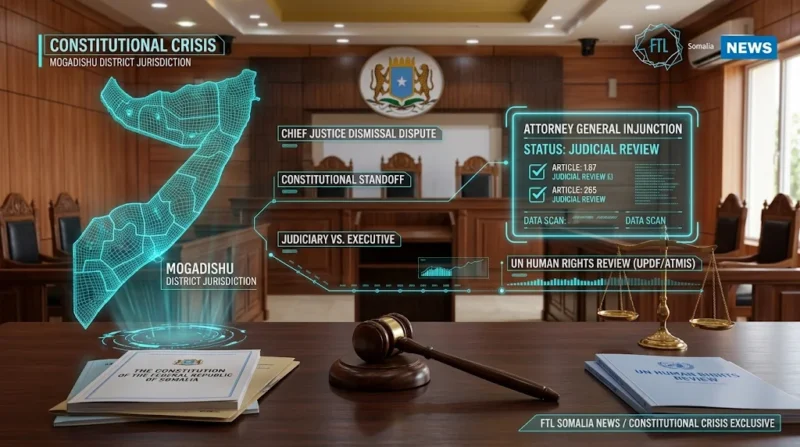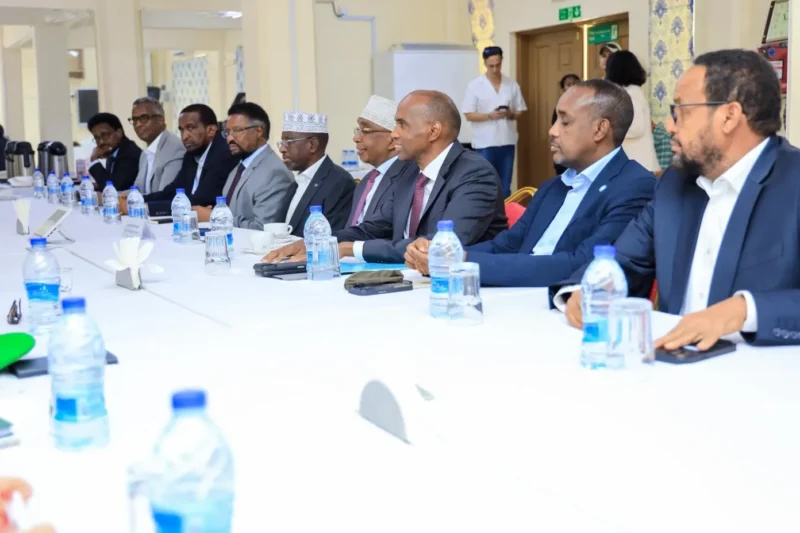


MOGADISHU, Justice and Constitutional Affairs Minister Hassan Moalim has defended the government’s decision to delay the separation of lawmakers from the cabinet, arguing that forcing 44 dual-role officials to choose between their seats and their ministerial posts would create a constitutional vacuum that could destabilize the state.
Speaking on the Miizaan Podcast, Moalim said that the new constitution, which took effect in April, bars cabinet members from holding parliamentary seats, and that a six-month transition period ended on October 14. However, he argued that ministers who are also lawmakers cannot simply return to parliament because the government lacks a law on the structure of government, which is required to define the size of the cabinet and the duties of each ministry .
“You cannot fill them the way you brought them in, because the constitution has changed from the one under which you brought them in,” Moalim said. He estimated the vacuum could last two, three, or four months and warned that it would amount to a constitutional crisis . The cabinet appointed a ministerial committee on October 13, chaired by Moalim, to draft the required legislation within two months .
The Case of the Ports Minister
The legal dispute has been brought into sharp focus by the appointment of Abdulkadir Omar Macalin as Minister of Ports on October 17. Macalin replaced Abdulkadir Mohamed Nur, who vacated the ministry after being elected Speaker of the House of the People in August . Macalin is himself a federal lawmaker.
As reported in FTL Somalia’s coverage of the appointment, Speaker Nur asked Macalin to choose between his parliamentary seat and his cabinet post. During a parliamentary session on October 24, Macalin publicly agreed that he had relinquished his parliamentary membership, stating: “Honourable Speaker, I agree with what the Constitution stipulates,” His statement is being interpreted differently.
But the Justice Minister’s statement now provides the legal cover for the government to retain Macalin and dozens of other dual-role officials in their cabinet posts, despite the constitutional prohibition. The government’s argument is that compliance is impossible until the structure law is passed.
Selective Implementation
The government’s approach to the constitution has been highly selective. The same amendments that prohibit dual roles also extended the presidential term from four to five years, keeping President Hassan Sheikh Mohamud in office until May 2027 despite his original mandate expiring in May 2026. The government has applied that provision without hesitation, as reported in FTL Somalia’s coverage of the dual-role controversy.
It has also enforced the amendments that extended parliamentary terms, aligning the legislature’s incentives with the executive’s. But the provisions that would constrain the executive, including the dual-role prohibition, have been met with delay and legal argumentation. The Independent Constitutional Review and Implementation Commission had explicitly directed that, effective October 14, ministers who are also MPs would cease to be members of the Council of Ministers. Yet the government did not prepare the enabling legislation during the six months it had.
Critics, have accused the government of cherry-picking the constitution. They argue that the administration is treating provisions that extend its power as fully in force, while deferring those that would weaken its parliamentary bloc.
Critical Note
The Justice Minister’s legal argument is not frivolous. A constitution that creates vacancies without providing a mechanism to fill them is a recipe for dysfunction. But the government cannot have it both ways. It cannot insist that the constitutional amendments are fully in force when they extend the president’s term, and then argue that they are unenforceable when they require the separation of powers.
The 44 ministers who hold parliamentary seats are the government’s political base. They were appointed precisely because they could deliver votes in the House. Forcing them to choose between their seats and their ministries would weaken the government’s control over parliament at a moment when it faces a united opposition, a contested electoral timetable, and accusations of foreign-backed plots. The “constitutional vacuum” is not an accident. It is a convenient excuse.
The new law on the structure of government may eventually be drafted and passed. But the delay it creates gives the government time to consolidate its position, negotiate with individual ministers, and prepare for the electoral contest ahead. The opposition, meanwhile, is left to argue that the government is violating the very constitution it imposed on the country. That is a potent criticism, but it is also a losing one if the institutions that would enforce the constitution are controlled by the government itself.
The deeper problem is that Somalia’s constitutional order is being built on a foundation of political exclusion. A constitution that is imposed by one side and selectively enforced by that same side is not a framework for governance. It is an instrument of power. The Justice Minister’s statement clarifies the government’s position. It does not resolve the question of whether that position is legitimate.