NAIROBI — Kenyan security forces have launched a major multi-agency operation targeting Al-Shabaab militants in Mandera and Garissa counties, following a surge in attacks and explosions in the northeastern region over the past three months.
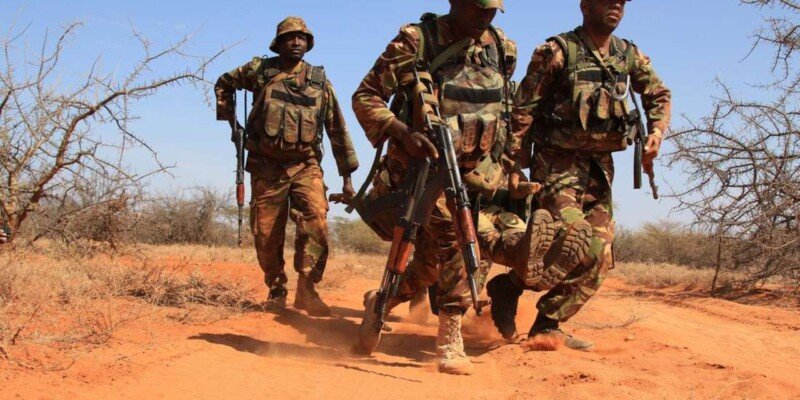
The operation involves police officers, specialized counterterrorism units, and other security agencies deployed to areas identified as high-risk. Authorities are conducting searches on roads, border areas, and locations suspected of harbouring armed group members. Several individuals have been arrested, though officials have not disclosed the number of detainees, their identities, or the evidence linking them to Al-Shabaab.
The operations follow a series of deadly incidents in Mandera and Garissa. On 9 October, the Officer Commanding Police Division (OCPD) of Hagadera, Assistant Superintendent Stephen Ekirapa, and his driver, Corporal David Rotich, were killed when their Toyota Land Cruiser struck an improvised explosive device (IED) along the Saretho–Dadaab main supply route. As reported in The Star, the vehicle was extensively damaged in the blast, which occurred at approximately 6 a.m. A follow-up operation was launched, but the attackers were not located. Security assessments warned of possible secondary devices and ambushes on responding officers.
A Pattern of Escalating Attacks
The Garissa attack was the latest in a series of deadly IED incidents targeting Kenyan security personnel along the border. On 28 July 2026, five officers from the elite Special Operations Group (SOG) and one National Police Reservist were killed when their vehicle struck an IED in the El-Raamo area of Kutulo, Mandera County. The device had reportedly been planted days earlier, with militants lying in wait to ambush the patrol. A fierce gunfight ensued following the explosion.
According to data from the Armed Conflict Location and Event Data Project (ACLED), at least 25 political violence events involving Al-Shabaab were recorded in Mandera, Garissa, Wajir, and Lamu counties during June and July 2026. These included remote explosions, armed clashes, and two defused explosives.
ACLED analysts attribute the surge in attacks partly to intensified military operations against Al-Shabaab in Somalia’s Jubaland State. At least 50 offensives by Jubaland security forces and the Somali Danab unit in Afmadow district during June and July reportedly pushed Al-Shabaab fighters out of their usual territory. To avoid being wiped out, commanders and foreign fighters have fled toward the porous Kenyan border, turning northeastern Kenya into a secondary battleground.
The group uses remote strongholds in Lower Juba, such as the Lag-Badanna area in Badhaadhe district, to assemble fighters, store heavy weaponry, and plan operations. From these bases, units move through border towns like Kolbiyow and slip into the dense cover of Kenya’s Boni Forest, which serves as a natural hideout for launching roadside attacks and raids on security posts.
Impact on Civilians and State Authority
The attacks have had severe consequences for civilians and government services in the affected areas. In January 2026, a local official and a teacher were killed in Garissa as part of what appears to be a deliberate strategy targeting government employees. Al-Shabaab has also been accused of abducting civilians; in August 2026, five herders were abducted near the Kenya-Somalia border before being released following negotiations by local elders.
The violence has disrupted education, health services, and administration in border communities, forcing some government workers to flee. Transportation and bilateral trade have also been affected by road closures and security restrictions.
The longstanding threat has also impacted Kenya’s border policy. Kenya closed its border with Somalia in 2011 following Al-Shabaab attacks, and plans to reopen it in 2026 were met with renewed security concerns. President William Ruto announced in February 2026 that two crossings would reopen in April, citing years of security assessments and a planned heavy deployment of security forces. However, the persistence of cross-border attacks underscores the difficulty of securing the frontier.
Kenya’s Counterterrorism Campaign
Kenya has maintained military operations against Al-Shabaab since launching Operation Linda Nchi in October 2011, deploying troops into Somalia following a series of kidnappings of foreigners on Kenyan soil. The country has also contributed forces to the African Union mission in Somalia, now known as AUSSOM, which is mandated to transfer full security responsibilities to Somali forces by the end of 2029.
Despite years of operations, Al-Shabaab retains the ability to launch cross-border attacks. The group uses the porous border and shared ethnic ties between communities on both sides to blend in and move undetected. Kenyan security analyst Benedict Arwa has identified porous borders, the marginalization of northern Kenya, and socio-economic factors such as widespread poverty and unemployment as underlying drivers that allow the group to exploit existing vulnerabilities.
The Kenyan operations come as cross-border violence between Al-Shabaab and Kenyan forces continues to escalate. As reported in FTL Somalia’s coverage of recent clashes, heavy fighting has erupted along the Somalia-Kenya border in recent weeks, with both sides suffering casualties. Earlier this month, Al-Shabaab launched coordinated attacks on Kenyan security posts in Mandera, as detailed in FTL Somalia’s coverage of the Mandera attacks.
Critical Note
The launch of new operations in Mandera and Garissa reflects a familiar pattern in Kenya’s long campaign against Al-Shabaab: a deadly attack, followed by a security surge, followed by a period of relative quiet, and then another attack. The killing of a senior police commander and his driver on a main supply route demonstrates that the group retains the capacity to strike at the heart of Kenya’s security apparatus in the northeast.
ACLED’s analysis is particularly instructive. The surge in attacks is not simply a spillover of the conflict in Somalia. It is a consequence of the group’s strategic adaptation to military pressure. As Jubaland and Danab forces squeeze Al-Shabaab in southern Somalia, fighters are moving into Kenya, where the group has long maintained networks and where the border remains porous. This suggests that the problem is not just that Kenya is a target; it is that Kenya has become a rear base for a conflict whose center of gravity has shifted.
The Kenyan government’s response, focused on security operations and arrests, addresses the symptoms rather than the causes. As researchers cited in this article note, the group thrives in environments characterized by marginalization, poverty, and weak state presence. Northern Kenya’s long history of neglect by Nairobi has created the conditions in which Al-Shabaab can recruit, tax, and operate. Military operations alone will not change that.
The re-opening of the border, announced with fanfare earlier this year, now appears premature. If Al-Shabaab can strike at will along the Saretho-Dadaab road, the security conditions required for safe cross-border trade and movement do not exist. The government’s decision to proceed with the reopening despite these risks suggests that political considerations, including fulfilling promises to border communities, may be outweighing a clear-eyed assessment of the security situation.
For Kenya, the challenge is not merely to repel attacks but to restore the authority of the state in a region where it has long been contested. That requires not only security operations but sustained investment in governance, services, and economic opportunity. Without that, the cycle of violence will continue.
Share your story. FTL Somalia is continuing to investigate cross-border security and the impact of Al-Shabaab on communities in Kenya and Somalia. If you have information or insights to share, contact us at info@ftlsomalia.com. Your identity will be protected.