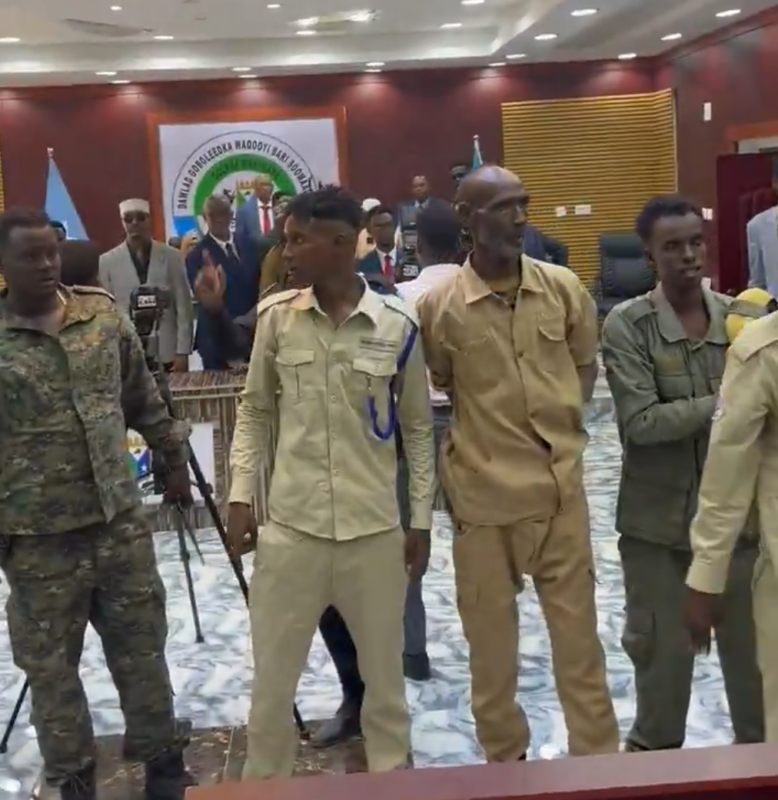
LAASCAANOOD, Physical confrontations broke out inside the North Eastern State parliament on Sunday, with lawmakers exchanging blows and shouting matches as a bitter power struggle between President Abdiqadir Ahmed Aw-Ali Firdhiye and his deputy, Abdirashid Yusuf Jibril Abwaan, spilled into the legislative chamber.
According to accounts circulating on social media, the confrontation centered on two competing lists submitted by the rival leaders to replace five MPs from Sanaag who had defected to Somaliland. The deputy’s faction reportedly lost the procedural battle, with his supporters forcibly removed from the chamber. Police were deployed to restore order.
These specific details of Sunday’s brawl could not be independently verified. However, the underlying political rupture between Firdhiye and Abwaan is well documented.
A Rift Months in the Making
The dispute between the president and his deputy became publicly visible in early October, following Firdhiye’s return to Laascaanood after more than 50 days in Mogadishu. Vice President Abwaan was notably absent from the welcoming ceremony held at the airport, a snub that confirmed speculation of a deepening rift.
Reports at the time indicated the disagreement centered on the appointment of the commander of the Somali National Army’s 26th Division, a decision Abwaan was reportedly not consulted on. The dispute also involved broader questions about the distribution of executive powers, constitutional interpretation, and the mechanisms for consultation between the two offices.
The political divide extended into parliament, where lawmakers aligned themselves with either camp. Sessions were postponed repeatedly as the chamber remained split. The institutional strain was compounded by the mass resignation of five MPs in July, who described the administration as having become “something akin to or worse than an NGO that Firdhiye and Abwaan carry in their pockets.”
The Sanaag Defections and the Replacement Lists
The immediate trigger for Sunday’s confrontation appears linked to the vacancies created by the departure of several Sanaag MPs. Among those who left was Fahiima Yuusuf Abdullahi Quuje, a prominent figure in the 2023 resistance against Somaliland who announced her defection in July and renounced the cause of Somaliweyn.
Her departure was followed by four other lawmakers from Sanaag who also declared allegiance to Somaliland. The North Eastern State parliament voted to strip the four of their seats, with 57 lawmakers supporting the motion.
The question of who would fill those vacancies, and under whose authority the replacements would be selected, has now become the flashpoint for physical confrontation. The fluid nature of political allegiances in the region has been a recurring theme, as seen in the reported armed mobilisation in Buqdharkayn between clans aligned with different authorities.
A Parliament Under Strain
Sunday’s chaos is the most visible manifestation of a broader institutional crisis. The North Eastern State was established in 2025 after local forces ousted Somaliland’s administration from Laascaanood, and its parliament was seated through a clan power-sharing formula rather than direct elections. That formula has now become a source of instability, as competing executives vie for control over the allocation of seats.
The state has struggled to build institutions from the ground up. A five-day training programme for district commissioners concluded in September, aimed at strengthening local governance and administrative capacity. But such efforts address skills, not the fundamental political questions that now divide the executive.
Vice President Abwaan said in early October that he remained committed to the unity and existence of the North Eastern State, but did not directly address the allegations against him.
Critical Note
The images emerging from Laascaanood on Sunday, lawmakers trading blows over competing lists of parliamentary replacements, are not merely a breakdown of decorum. They are a symptom of an administration whose internal contradictions have outpaced its institutional capacity to resolve them.
The core issue is not who submitted which list, or which faction was ejected from the chamber. It is that the North Eastern State’s parliament was constructed on a clan allocation formula that made seats negotiable commodities rather than instruments of representation. When five MPs resigned, the question of who would replace them became a contest not over constituency interests but over executive control. The brawl was the predictable outcome of a system in which legislative seats are dispensed as patronage.
The claim, circulating on social media, that the parliament operates from a hotel owned by a local drug trafficking figure deserves independent investigation. If true, it would represent a further degradation of an institution that already struggles for legitimacy. If unverified, it nonetheless reflects the depth of public cynicism toward a body that has yet to demonstrate it can function as a legislature rather than an arena for factional combat.
The more immediate concern is whether the Firdhiye-Abwaan rift can be contained. Traditional elders from Sool and Sanaag attempted mediation earlier this month, reportedly without success. With the executive divided and the legislature now physically contested, the North Eastern State faces a test of whether its institutions can survive the ambitions of the men who lead them. The answer, on Sunday’s evidence, is not encouraging.
Share your story. FTL Somalia is continuing to follow political developments in the North Eastern State. If you have information about events in Laascaanood or insights to share, contact us at info@ftlsomalia.com. Your identity will be protected.
Recommended Reading On ftlsomalia.com
- Mass Resignation Rocks Northeastern State Parliament as Lawmakers Decry ‘NGO’ Governance
- Somaliland Welcomes Defection of North Eastern State MP Who Once Fought Against Hargeisa
- Armed Buildup Reported in Buqdharkayn as Two Clans Face Off
- North Eastern State Closes Five-Day Training for District Commissioners
- PM Hamse’s Las Anod Visit Draws Public Support and Somaliland Condemnation
- Somaliland Offers Peace Deal, Prisoner Exchange to Las Anod Administration