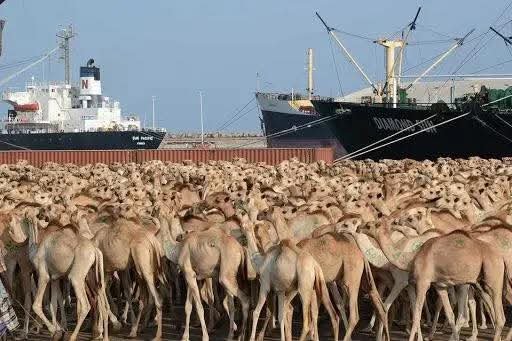
MOGADISHU — Livestock accounted for 75 percent of Somalia’s merchandise exports in the first quarter of 2026, contributing US$257.76 million of the US$344.91 million in total export receipts, according to the Central Bank of Somalia’s Quarterly Economic Review.
The figures confirm that Somalia’s export base remains overwhelmingly dependent on a single commodity, despite a 20 percent year-on-year increase in overall exports and notable growth in smaller categories. Livestock exports rose from US$244.30 million in the same quarter of 2025, driven by seasonal demand in Gulf markets ahead of Hajj.
During the quarter, Somalia exported 1,424,413 heads of livestock, comprising 1,293,931 sheep and goats, 71,921 cattle, and 58,561 camels.
Export Composition
Animal skins recorded the strongest growth among the smaller categories, rising to US$32.68 million from US$11.72 million a year earlier, and now accounting for 9 percent of total exports. Fishery exports also strengthened, increasing from US$1.83 million to US$15.18 million and accounting for 4 percent of total exports, as detailed in FTL Somalia’s reporting on the fisheries agreement with China.
Livestock products, primarily meat, remained broadly unchanged at US$9.02 million, or 3 percent of total exports. Forest products increased to US$5.54 million, accounting for 2 percent.
Crops and vegetable oil exports declined sharply to US$10.36 million, or 3 percent of total exports, from the elevated levels recorded in the second half of 2025. The category had reached US$85.15 million in the third quarter of 2025, reflecting the seasonal nature of Somalia’s crop exports.
The Fisheries Paradox
Somalia possesses the longest coastline in mainland Africa, stretching over 3,300 kilometres along the Gulf of Aden and the Indian Ocean. The country’s exclusive economic zone covers approximately 825,000 square kilometres, with some of the richest fishing grounds in the region.
Despite this potential, fisheries contributed just 4 percent of total export receipts in the first quarter. The sector has historically been constrained by inadequate cold-chain infrastructure, limited processing capacity, and the absence of direct market access. Foreign vessels, meanwhile, have exploited Somali waters through illegal, unreported and unregulated fishing, depriving the country of revenue and depleting stocks.
The July 2026 fisheries agreement with China, granting Somali seafood duty-free access to the Chinese market, has been presented as a potential turning point. The deal covers tuna, lobster and other marine products, and Somali officials have described it as “a major victory for fishermen, traders and all stakeholders in the fisheries sector”.
In August 2026, Somalia announced plans to begin exporting fish to China in September, following the implementation of the tariff-free agreement. Director General of the Ministry of Fisheries and Blue Economy, Abdi Dirshe, described the deal as a historic step aimed at boosting the blue economy, creating jobs, and attracting investment in cold storage and supply chain infrastructure. The start of exports opens one of the world’s largest seafood markets for Somalia, as the government works to transform the country’s coastal resources into an economic pillar alongside livestock and agriculture.
Diversification Remains Elusive
The concentration of Somalia’s export base has been a persistent feature of the economy for decades. Livestock has dominated exports since the 1980s, with Saudi Arabia, Oman and the United Arab Emirates serving as the primary markets. The trade is highly seasonal, shaped by Hajj demand, and remains vulnerable to import bans imposed by Gulf states over animal health concerns.
Agriculture, which once contributed a significant share of export earnings through bananas and other crops, has never recovered from the collapse of the sector in the early 1990s. The sesame and crop exports that recorded elevated levels in the second half of 2025 reflect seasonal production rather than a sustained recovery.
The country’s nascent oil and gas sector has generated considerable interest, with Türkiye conducting offshore seismic surveys and the first deep-sea drilling vessel arriving in April 2026, as reported in FTL Somalia’s coverage of the offshore drilling campaign. But commercial production, if it materialises, remains years away and would not affect the export composition in the near term.
Critical Note
Somalia’s continued reliance on livestock for three-quarters of its export earnings is a structural vulnerability that has persisted through every phase of the country’s post-1991 reconstruction. The 20 percent increase in total exports in the first quarter is welcome, but it is growth within the same narrow base, not diversification away from it.
The fisheries sector offers the most immediate opportunity for change. The China agreement provides market access that Somalia has long lacked, and the planned first shipment of fish to China in September 2026 demonstrates that the framework can be operationalised. But market access alone is not sufficient. The sector requires cold-chain infrastructure, quality control systems, and processing capacity to meet Chinese import standards at scale. Without those investments, the duty-free access will remain underutilised.
The broader challenge is that export diversification requires investment, and investment requires a stable and predictable policy environment. Somalia’s federal system creates overlapping authorities over trade and resources, and the recent dispute between Puntland and the federal government over resource concessions illustrates the complications that investors face. Without a clear and consistent framework for trade and investment, the structural dependence on livestock is unlikely to change, regardless of the opportunities that agreements like the China fisheries deal create.
Recommended Reading On ftlsomalia.com
- Somalia, China Sign Landmark Fisheries Agreement Granting Tariff-Free Access to Chinese Market
- Somalia to Begin Fish Exports to China in September Under Landmark Tariff-Free Deal
- Turkish Drillship to Begin Offshore Oil Operations in Somalia
- Somalia Eyes Expanded Economic and Investment Ties With China
- China Extends Zero-Tariff Trade to All 53 African Nations, Boosting Somali Export Prospects