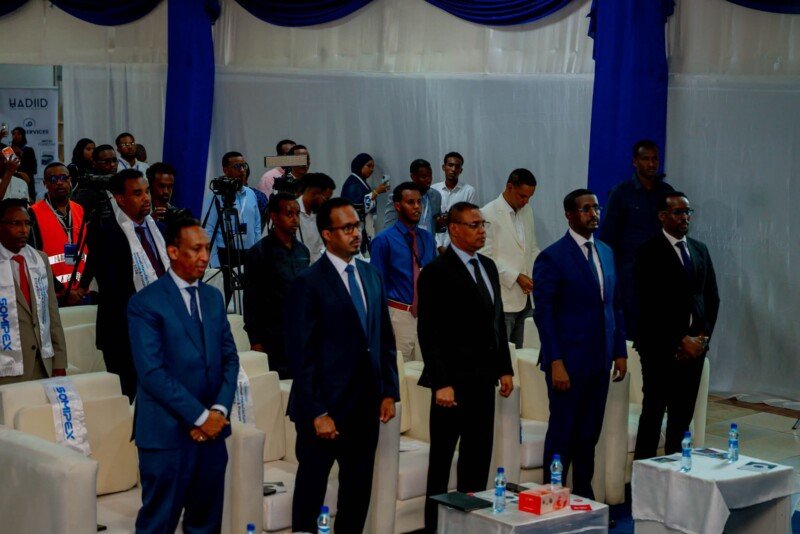
MOGADISHU — The Somalia International Manufacturing, Industry and Processing Exhibition (SOMIPEX) opened in Mogadishu on Tuesday, bringing together manufacturers, traders and investors to showcase domestic products and strengthen local industry.
The exhibition is designed to provide Somali companies and traders with a platform to present locally produced and processed goods to both domestic and international markets, and to highlight the capacity of Somalia’s manufacturing sector. It also focuses on encouraging domestic production, industrial investment and the creation of new markets for Somali-made goods.
A central feature of the event was the launch of the “Made in Somalia” label, a national mark intended to recognise and promote products manufactured or produced within the country. The label was unveiled during the exhibition, with officials emphasising its role in giving Somali products a distinct national identity.
A Push for Value Addition
Deputy Prime Minister Jibril Abdirashid, who spoke at the launch, said Somali products have historically been exported or marketed under the identity of other countries, arguing that the new mark would give locally produced goods clearer recognition.
“It is a major and historic achievement for our products to carry the words ‘Made in Somalia’,” he said, pointing to livestock exported to Oman, where it is fattened and later labelled as Omani, as an example of the value lost without a national brand.
The government said products seeking to carry the label will have to meet requirements established by the Ministry of Commerce and Industry intended to verify that the product is genuinely produced or manufactured in Somalia.
Economic Context
The initiative comes as Somalia seeks to increase domestic production and retain a greater share of consumer spending within the local economy. The Ministry of Commerce and Industry has said Somalia imported goods worth about US$9 billion in 2024, a figure that underscores the country’s reliance on foreign products.
Officials said 75 factories are currently operating in Somalia and producing goods on a regular basis [citation:3]. The government is also pursuing broader industrial development, including through the National Transformation Plan (NTP 2025-2029), which prioritises value addition and local manufacturing as drivers of job creation and economic growth.
In August 2026, Somalia ratified the African Continental Free Trade Area agreement, becoming the 50th member and opening access for Somali businesses to a continental market of nearly 1.4 billion people worth more than $3.4 trillion. The government says the ratification creates an opportunity to expand domestic production, attract industrial investment and position Somali-made products across Africa, as reported in FTL Somalia’s coverage of the zero-tariff trade expansion.
Critical Note
The launch of the “Made in Somalia” label and the opening of SOMIPEX reflect a genuine policy shift toward industrialisation and domestic production. For a country that has relied heavily on imports and raw commodity exports, building a national brand and promoting local manufacturing is a logical step toward economic diversification.
However, the practical impact of such initiatives depends on factors that a label alone cannot address. Somali manufacturers face significant structural constraints: limited access to affordable credit, unreliable electricity, poor road infrastructure and competition from cheaper imported goods. The 75 factories currently operating represent a small industrial base, and scaling production to meet domestic demand will require sustained investment in energy, logistics and workforce skills.
The “Made in Somalia” mark also raises questions about enforcement and quality assurance. For the label to gain credibility with consumers and international buyers, the verification process must be transparent and consistently applied. Without rigorous standards, the mark risks becoming a symbolic exercise rather than a meaningful signal of quality and origin.
For Somalia’s trade partners and international investors, SOMIPEX and the new label are signals of intent. The government has previously expressed interest in learning from China’s special economic zone model and has sought to attract foreign investment in manufacturing and processing. Whether those ambitions translate into concrete deals and production capacity will depend on whether the enabling environment, security, regulation and infrastructure, improves alongside the promotional efforts.