MOGADISHU, Uganda’s 64th Independence anniversary celebrations in Mogadishu concluded three days of intensive bilateral engagement between Somalia and Uganda, bringing together diplomacy, business, and regional cooperation under a shared agenda to advance trade, tourism, investment, and labour ties.
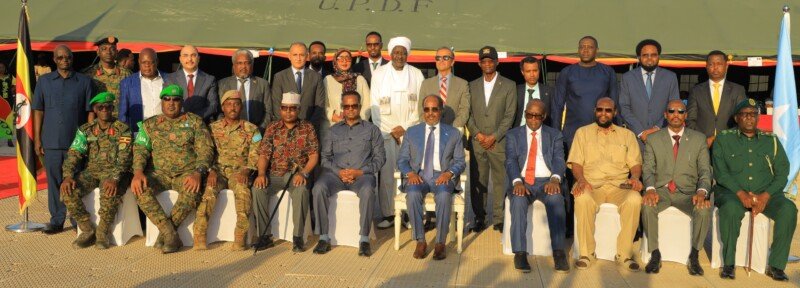
The celebrations, hosted at the Ugandan embassy in Mogadishu, were attended by President Hassan Sheikh Mohamud as chief guest. He congratulated his Ugandan counterpart, Yoweri Museveni, and the people of Uganda, reaffirming the longstanding friendship and partnership between the two nations.
President Mohamud paid tribute to the sacrifices of Ugandan troops who have served in Somalia since 2007, when Uganda became the first country to deploy forces under the African Union Mission in Somalia. He recalled President Museveni’s visit to Mogadishu in 1992, at a time of severe insecurity, describing it as an extraordinary demonstration of solidarity with the Somali people.
“We will work with you, and Somali institutions will work with you, and you will have what you have requested,” Mohamud told Ugandan business people at the event, pledging his government’s support for their interests.
Three Days of Economic Diplomacy
The independence celebrations capped a series of engagements that began with the mid-term review of the Uganda-Somalia Joint Permanent Commission and the first-ever Somali-Ugandan Business Forum. As reported in FTL Somalia’s coverage of the business forum, it was the first time Mogadishu had hosted a meeting of the commission, which was established in 2022.
More than 100 Ugandan delegates and 146 Somali representatives participated in the review, alongside an investment and business forum and a joint exhibition at the Airport Hotel, as reported in Dawan Africa’s coverage of the meetings. Discussions covered security, trade, investment, tourism, labour, aviation, and health cooperation.
A bilateral labour agreement was among the documents signed, aimed at regulating the employment of citizens from both countries and protecting workers’ rights. As reported in FTL Somalia’s coverage of the labour agreement, the accord establishes a framework for orderly recruitment, outlines employer responsibilities, standardizes contract procedures, and includes protections against abuse and unlawful exploitation. Uganda’s Minister of Gender, Labour and Social Development, Lt. Gen. (Rtd.) Henry Tumukunde, signed the agreement alongside Somalia’s Minister of Labour and Social Affairs, Prof. Salim Alio Ibro.
Trade Growth and Untapped Potential
The economic dimension of the relationship has grown significantly, though from a low base. Uganda’s exports to Somalia rose from $2.75 million in 2023 to $6.78 million in 2024, according to UN Comtrade data, as reported by The Independent Uganda. Tobacco products led the exports at $2.55 million, followed by aircraft and parts at $1.2 million, and wood products at $528,470.
Trade in the opposite direction remains minimal. Somalia exported goods worth $35,400 to Uganda in 2021, down from $671,000 in 2016.
“Our imports and exports between Uganda and Somalia have exponentially grown. However, we believe that our private sector can do better than the current statistics,” said Vincent Bagiire Waiswa, Uganda’s Permanent Secretary in the Ministry of Foreign Affairs.
Bagiire described Somalia as a potential trade bridge between Africa and the Gulf states, noting that Uganda is landlocked while Somalia has Africa’s longest coastline. He described Mogadishu as a prospective “New Dubai” within the East African Community.
The EAC Framework
Both countries are now members of the East African Community, which Somalia joined in 2024 as its eighth member state. The EAC’s Common Market Protocol provides for the free movement of goods, services, labour, and capital, offering a framework for deeper integration.
As reported in FTL Somalia’s coverage of Somalia’s EAC membership, the government views regional integration as a mechanism to create opportunities for Somali businesses operating across East Africa. The EAC represents a combined market of over 300 million people.
Direct air links have also improved. Uganda Airlines now flies to Mogadishu four times a week, providing the only nonstop connection between Entebbe and the Somali capital. Officials from both countries are pushing to conclude a Bilateral Air Services Agreement to formalize and expand aviation cooperation.
Critical Note
The three days of engagement in Mogadishu represent a deliberate effort by both governments to broaden a relationship that has historically been defined by security cooperation. Uganda has contributed troops to African Union missions in Somalia for nearly two decades, and President Mohamud’s tribute to their sacrifices was genuine and appropriate.
But the economic relationship remains modest. Bilateral trade of less than $7 million annually is negligible for two countries of Somalia’s and Uganda’s size. The Joint Permanent Investment and Business Council agreed in 2025 has not been operationalized. The air services agreement remains unsigned. The memoranda on customs, standards, and health are still drafts. A forum that produces a labour agreement and a communiqué is not the same as a forum that produces trade.
The deeper obstacle is not a lack of goodwill. It is the infrastructure and institutional gaps that make commercial exchange costly and unreliable. Uganda Airlines’ four weekly flights are a thin lifeline. Somalia’s ports and customs systems remain weak. And the security partnership that has defined the relationship for two decades is entering an uncertain phase, with the UN Security Council’s authorization for AUSSOM expiring at the end of 2026 and Uganda’s military leadership setting a withdrawal deadline of August 2027.
The celebrations in Mogadishu were a moment of friendship and shared purpose. Whether they mark the beginning of a genuine economic partnership, or simply another ceremonial chapter in a security-dominated relationship, will depend on whether the commitments made this week are implemented. The private sector, as Bagiire said, can do better. But it cannot do so without the conditions that allow it to operate.
Recommended Reading On ftlsomalia.com
- Somalia and Uganda Open Joint Commission Review as Business Forum Enters Second Day
- Somalia and Uganda Sign Bilateral Labour Agreement to Protect Workers’ Rights
- Somalia’s EAC Membership Is About Creating Opportunities for Somali Traders, Says Minister Beenebeene
- Uganda, Somalia to Seal New Trade and Investment Pacts at Kampala Summit
- Somalia’s Trade Gap Hits US$2.13 Billion as Imports Surge 16%