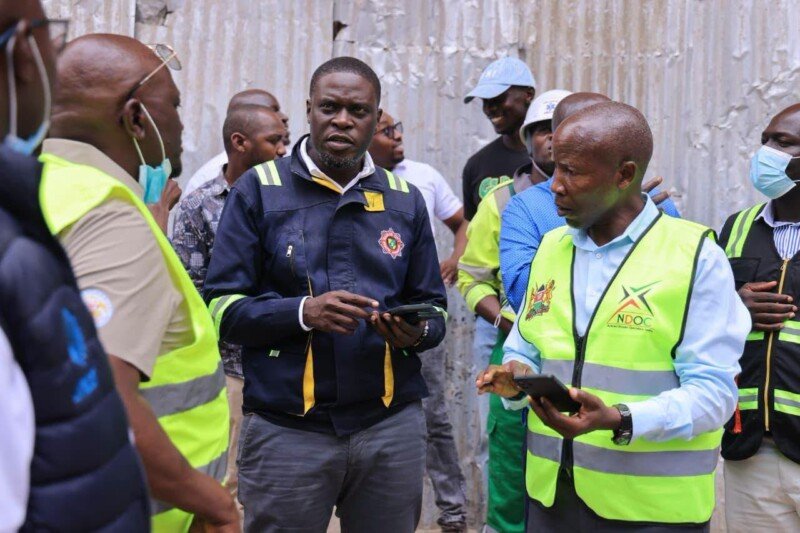
NAIROBI, Nairobi Governor Johnson Sakaja has publicly named the individuals and entities behind the 18-storey building that collapsed in Eastleigh on Friday, revealing that the project was constructed without the required approvals. The building, located on 9th Street, came down at approximately 1:00 p.m., striking at the heart of a district that serves as the economic lifeline for Kenya’s Somali community, as detailed in FTL Somalia’s initial coverage of the collapse.
Speaking at the scene, Sakaja disclosed that the property is owned by the estate of the late Wilson Mutia Musyoki. While a change-of-user application for the land was approved in 2024, a subsequent application to construct a 15-storey building with a basement was submitted by John Mutia Musyoki, who is listed as the developer on record. That application was never granted.
“We’ve looked at the documentation. They had applied in 2024 for a change of use. That was granted. Then an application was made through one John Mutia Musyoki, who is the developer on record. That application was to do 15 plus basements. The application was never granted, meaning there is no approval for this construction,” Sakaja stated.
The governor also named the professionals involved in the project’s documentation. The change of user was applied for through physical planner Nathan Mutunga Kiti, while the architect on record is Emmanuel Mwangi Maina. An engineering firm, Precise Civil Engineering Limited, was also named as having a role in the project. The National Construction Authority (NCA) separately listed 9th Street Plaza Limited as the developer and Stromax Holdings E.A Limited as the contractor, with Joseph Muturi Mugu as the structural engineer.
A System of Impunity and Weak Penalties
Sakaja used the tragedy to highlight the systemic failures in Nairobi’s construction enforcement. He revealed that more than 200 files related to construction violations are currently stuck at the Office of the Director of Public Prosecutions (DPP), allowing developers to continue building despite violations.
“Without prosecution, people continue to construct. We have to stop all of those developments and even bring down those that need to come down,” he stated.
The governor also pointed to the practice of developers dismissing qualified professionals after securing approvals. He called on professional bodies representing architects, engineers, and quantity surveyors to investigate and take disciplinary action against members who allow themselves to be used as a rubber stamp, or who fail to report when they are removed from a project.
He decried the weak penalties that allow developers to flout the law, noting that some violations attract fines as low as Sh5,000. “That does not deter anyone from continuing with an illegality,” he said, calling for county governments to be granted prosecutorial powers to enforce building regulations effectively.
Regarding the building’s occupancy, Sakaja confirmed that the ground floor housed shops that were operating without the mandatory occupation certificate. “Before anybody gets an occupation certificate, you’re not allowed to get into that property. At all. Even temporarily, that is not allowed,” he said.
Rescue Operations and the Human Cost
Rescue operations continued into the night, with Sakaja confirming that some people trapped inside the rubble had been communicating with rescue teams. “We are hoping that we shall clear in the quickest time possible the people who have been communicating from inside,” he said. The multi-agency operation involves the Kenya Defence Forces (KDF), the National Disaster Operations Centre, and the Kenya Red Cross, with sniffer dogs deployed to assist in the search.
According to Interior Cabinet Secretary Kipchumba Murkomen, 67 construction workers were on site at the time of the collapse. Sixty-six escaped uninjured, one was hospitalized, and seven people have been reported missing. Eleven shops in the basement and ground floor were occupied when the structure gave way.
Somalia’s Ambassador to Kenya, Jabril Ibrahim Abdulle, visited the scene and described the incident as a tragedy for the Somali community. He confirmed that lives had been lost and businesses destroyed, noting that the full extent of the damage to Somali-owned enterprises would only be known once rescue operations concluded.
What This Means for Somalia and Its Diaspora
For Somalia, the Eastleigh disaster is a direct economic and human blow. The neighbourhood is the primary destination for Somali nationals traveling to Kenya for medical treatment, business, and education. It is also a critical node in the informal financial networks that connect the diaspora to the homeland. The destruction of businesses and the loss of life in this specific location will be felt deeply in Mogadishu and across Somali communities worldwide.
Somali investors have injected over $1.5 billion into Nairobi’s economy over the last two decades, according to the Kenya National Chamber of Commerce and Industry, as reported in FTL Somalia’s coverage of Somali investment in Kenya. Eastleigh is the primary hub for much of that capital. The fact that this building was constructed without approval, and occupied illegally with the tacit tolerance of county authorities, highlights a system where regulatory oversight is weakest in the very areas where Somali enterprise is most concentrated.
The tragedy also underscores the vulnerability of Somali migrants and diaspora communities in Kenya. Many Somalis in Eastleigh operate in the informal economy, with limited access to formal insurance or legal recourse when disasters occur. The Kenyan government’s willingness to hold the developer and the county officials accountable will determine whether Eastleigh’s residents can trust that the buildings they live and work in are safe. As reported in FTL Somalia’s coverage of Somalia-Kenya security talks, the two governments have been actively strengthening cooperation on security, trade, and cross-border movement, making the treatment of the Somali diaspora in Kenya a matter of bilateral importance.
Critical Note
Governor Sakaja’s decision to name the developer, the estate, and the professionals on record is a significant escalation. It moves the discussion from vague accusations of “rogue developers or generalization” to specific individuals who must now answer for their roles. The fact that the application for the 15-storey structure was explicitly rejected, yet construction proceeded, is a direct challenge to the authority of the county government.
The governor’s admission that 200 files are stuck at the DPP is an admission that the system for holding developers accountable is not merely slow; it is broken. His call for prosecutorial powers to be returned to the county is a reasonable demand, but it is also a deflection. The county had the power to issue enforcement notices and stop construction. It did not. The building rose for months without approval, and the county’s inspectors did not stop it.
For the Somali community, this is a moment of grief and anger. Ambassador Abdulle’s visit to the scene was appropriate, but it must be followed by concrete action. The Eastleigh tragedy is a reminder that the Somali diaspora’s economic success in Kenya is built on foundations that are too often unsafe. Until the regulatory environment changes, the community will continue to bear the risks of a system that treats enforcement as optional.