
MOGADISHU, Somalia’s National Security Adviser, Ambassador Awes Hagi Yusuf Ahmed, has moved to clarify the nature of Uganda’s troop movements in Somalia, emphasizing that the personnel currently redeploying are primarily bilateral forces, not the Ugandan contingent operating under the African Union Support and Stabilization Mission in Somalia (AUSSOM).
In a statement issued on Tuesday, Ambassador Awes said the redeployment should not be misconstrued as a complete withdrawal of Ugandan military personnel from Somalia. “The Ugandan contingent serving under AUSSOM, however, remains in Somalia and continues to discharge its mandate alongside other contributing partner forces and the Somali National Army,” he stated.
The clarification comes after the Uganda People’s Defence Forces (UPDF) announced the drawdown of its bilaterally deployed troops. According to the UPDF, the roughly 2,000 personnel serving under the bilateral security agreement are leaving first, while the larger AUSSOM contingent of approximately 4,500 troops will be withdrawn in a phased process stretching to the end of 2027.
Tripartite Coordination Reaffirmed
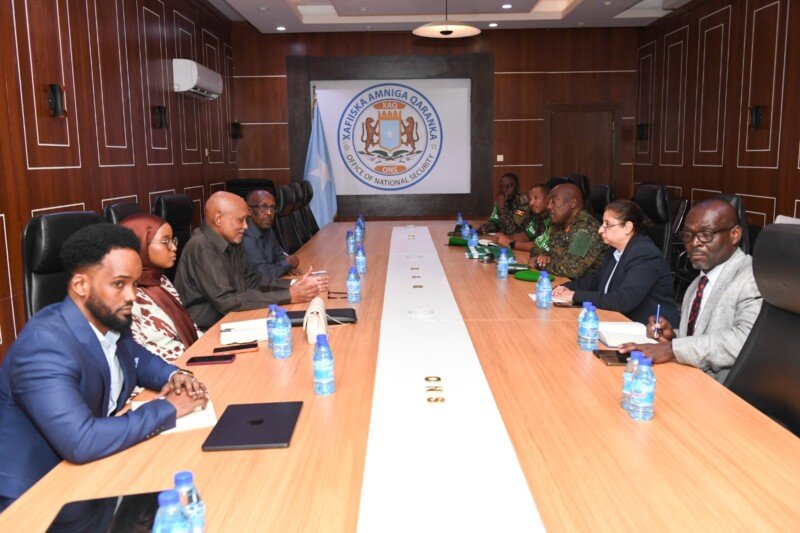
Ambassador Awes also chaired a Tripartite meeting on Tuesday involving the Federal Government of Somalia, AUSSOM, and the United Nations Support Office in Somalia (UNSOS). The meeting focused on strengthening the tripartite coordination mechanism as a platform for enhanced cooperation, strategic planning, and effective logistical support to AUSSOM and the Somali National Army.
The participants underscored the critical importance of sustained, predictable, and adequate international support in advancing Somalia’s security transition, consolidating the gains made through ongoing offensive operations, and strengthening the operational capacity of Somali security forces. The tripartite mechanism has become increasingly vital as AUSSOM faces severe funding constraints. As outlined in analysis of the unravelling security architecture, the United States’ decision to end funding for UNSOS threatens to pull the logistical foundation from under the mission, which provides transport, troop rotations, and medical support.
The coordination meeting builds on previous engagements between Somali and AUSSOM leadership to manage the transition. As reported after an earlier meeting at Villa Somalia, both sides have consistently acknowledged that the drawdown requires a carefully sequenced handover of security responsibilities to Somali forces.
A Necessary Distinction, But Questions Remain
The National Security Adviser’s statement is a necessary correction to a narrative that has gained traction in recent days. The Ugandan withdrawal is real, but it is not yet complete, and it does not mean that Uganda has abandoned the AUSSOM mission. The distinction between bilateral forces and the AU contingent is legally and operationally significant.
However, the clarification does not address the broader challenges facing the security transition. The AUSSOM contingent remains in Somalia, but its logistical backbone is being dismantled. UNSOS has begun preparing for liquidation. The mission’s funding is uncertain. And the Ugandan drawdown, even if limited to bilateral forces for now, signals that troop-contributing countries are reassessing their commitments.
Ambassador Awes’s meeting with AUSSOM and UNSOS is a recognition that coordination is essential. But coordination cannot substitute for resources. The tripartite mechanism can plan, but it cannot pay for fuel, rations, or troop rotations. The international support that the Ambassador describes as “critical” is precisely what is being withdrawn, a dynamic that echoes the recent conclusion of the UN political mission, which transferred mandates without the budgets to sustain them.
Critical Note
Ambassador Awes’s statement is a welcome clarification. It corrects a misperception that Uganda has left Somalia entirely and reminds the public that the AUSSOM contingent remains in place. The tripartite meeting is also a positive sign that the federal government, the AU mission, and the UN support office are coordinating on the transition.
But the clarification also highlights the precariousness of the situation. The Ugandan withdrawal of bilateral forces is the first concrete step in a drawdown that will eventually include the AUSSOM contingent. The UPDF has set an end-of-2027 deadline for its full exit. Other troop-contributing countries may follow. The financial foundation of the mission is eroding, and the tripartite mechanism cannot rebuild it alone.
The National Security Adviser is right to emphasize the importance of sustained international support. But the international community is not listening. The United States has ended its funding for UNSOS. The European Union has reduced its contribution. The African Union owes months of arrears to troop-contributing countries. The tripartite mechanism is meeting, but the money is not flowing. Until that changes, the coordination will be a conversation about how to manage a decline, not how to prevent it. As Somali forces prepare to take over vacated positions in areas like Lower Shabelle, the risk of a governance vacuum and local mobilisation grows deeper with every departing convoy.
Recommended Reading On ftlsomalia.com
- Uganda Begins Somalia Withdrawal as President Mohamud’s Plea for More Time Fails
- The First Domino: Uganda’s Withdrawal and the Unravelling of Somalia’s Security Architecture
- National Security Adviser and AUSSOM Chief Meet at Villa Somalia to Discuss Transition
- The UN Political Mission Ends: Somali Institutions Inherit the Mandate Without the Budget
- Governance Vacuum Fuels Clan Mobilisation in Lower Shabelle Following Al-Shabaab Withdrawal