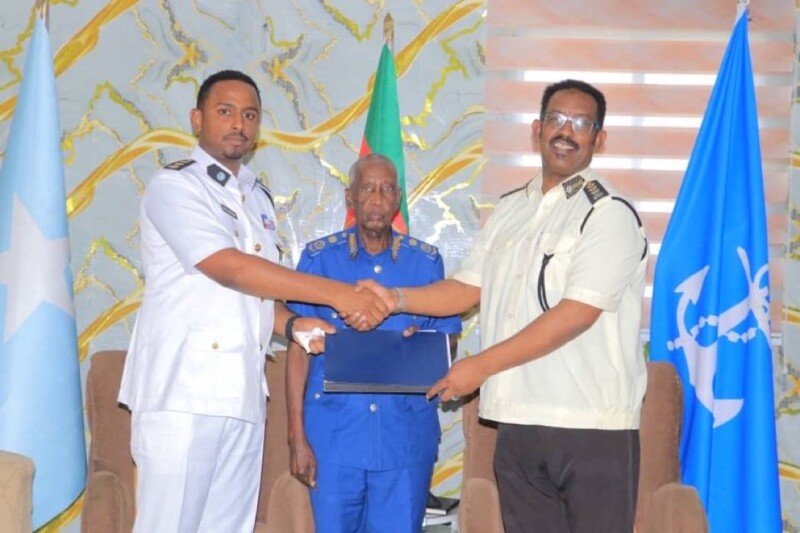
MOGADISHU, Colonel Mohamed Abdiqadir “Sharif” officially assumed command of the Somali Navy and Coast Guard today, taking over from outgoing Commander Brigadier General Abdiwahab Abdullahi Omar in a formal handover ceremony in Mogadishu.
The handover was presided over by Major General Mahmoud Sheikh Ali (Dable Baylood), Chairman of the Handover Committee, and attended by senior officers from the Somali National Army’s leadership and commands. The committee chairman praised the outgoing commander for his service and congratulated the incoming commander, wishing him success in his new responsibilities.
The change of command comes at a critical juncture for Somalia’s maritime security. The country is facing a resurgence of piracy off its northeastern coast, with at least 15 attacks reported since April, the highest number since 2013. The hijacking of the Iranian fishing vessel Azini on October 29, which maritime authorities warned could be used as a mothership for further attacks, is the most recent incident in a pattern that has exposed the gaps in Somalia’s coastal defense capabilities.
A Force Without the Means
The Somali Navy and Coast Guard are tasked with patrolling a coastline of over 3,000 kilometers, one of the longest in Africa, with a maritime exclusive economic zone covering roughly 825,000 square kilometers. The force has historically operated with limited vessels, equipment, and training, relying heavily on international partners for capacity building and maritime surveillance.
Türkiye has been a key partner in this effort, providing training and equipment to the Somali Navy, including the delivery of offshore patrol vessels in 2024. As Turkey deepens its military footprint in Somalia, the navy has become a focal point of the bilateral security relationship. But the force remains far from capable of independently securing Somalia’s waters, a reality underscored by the ongoing conversion of captured vessels into floating bases by pirate networks.
The new commander inherits a force that is expected to do more with less. International naval patrols that once kept piracy in check have been diverted to the Red Sea, and the African Union mission is drawing down. The human cost of this security vacuum has been severe, with more than 90 seafarers held captive at the peak of the crisis in August. Somalia’s maritime security is increasingly dependent on its own institutions, and those institutions are still being built.
The federal government has acknowledged that national resources alone cannot patrol the vast maritime domain and has called for international cooperation to address the surge. The new Navy chief will be expected to translate that call into operational reality, even as the resources available to him remain constrained.
Critical Note
The handover ceremony is a routine military transition, and it should be reported as such. But the timing is significant. The new commander takes over at a moment when Somali waters are more dangerous than they have been in a decade, and when the international support that once filled the gaps in Somalia’s maritime defense is receding.
The ceremony’s praise for the outgoing commander and congratulations for the incoming one are standard protocol. They do not address the central question: does the Somali Navy and Coast Guard have the resources, the vessels, and the intelligence capacity to fulfill its mandate? The answer, based on the record of the past six months, is no.
Colonel Sharif inherits a force that is expected to do more with less. The piracy resurgence is not his fault, but it will be his responsibility. Whether he can meet that responsibility depends less on his leadership than on whether the government and its international partners are prepared to invest in the maritime security capabilities that Somalia’s coastline demands.
Recommended Reading On ftlsomalia.com
- Iranian Fishing Vessel Hijacked Off Puntland as Piracy Resurges
- Somali Pirates Turn Hijacked Ship into Mothership as Piracy Surges in Puntland Waters
- Global Naval Shifts Fuel Somali Piracy Return as Dozens of Crew Members Held Hostage
- IMO Sounds Alarm as Somali Pirates Hold More Than 90 Seafarers Hostage
- Somalia Calls for International Cooperation as Piracy Surges Off Puntland Coast