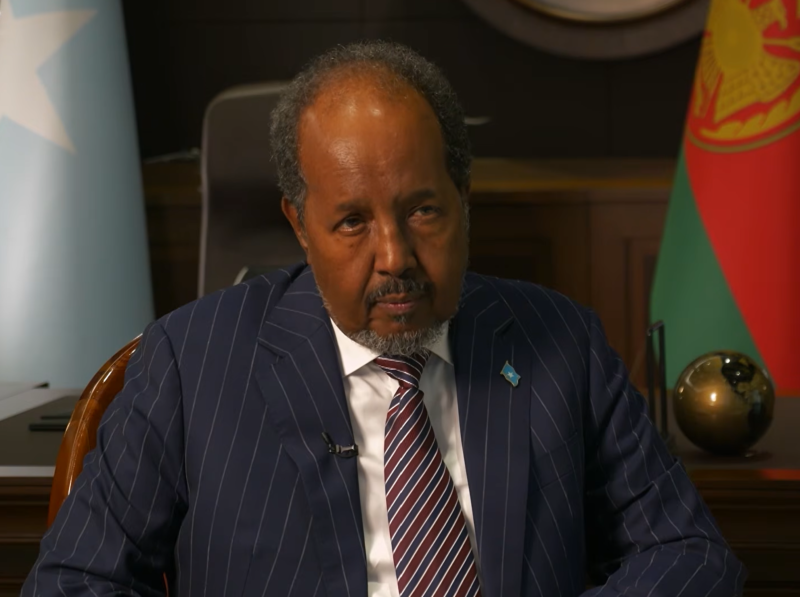
MOGADISHU, President Hassan Sheikh Mohamud has said his government will not permit foreign countries to establish military bases in Somalia for their own geopolitical purposes, drawing a clear line amid intensifying competition over the Red Sea and the Horn of Africa.
In an interview with Sky News, Mohamud said Somalia would not give any country the opportunity to set up bases inside the country to pursue its own interests. The remarks came in response to questions about the activities of countries including Russia, Israel, Türkiye, the United States, and Ethiopia in the region.
The President also addressed Somalia’s relationship with the United Arab Emirates, confirming that the defense and security agreements signed with Abu Dhabi had been cancelled. He said the UAE’s activities inside Somalia no longer rest on a valid legal agreement.
In the same interview, Mohamud was asked about Somaliland President Abdirahman Mohamed Abdullahi Irro’s recent visit to Washington. He downplayed its significance, saying that anyone can travel to the United States, obtain a visa, stay for a period of time and build friendships there. He said the US government has consistently respected Somalia’s unity and thanked Washington for that position.
The UAE Rupture and Its Legal Basis
The cancellation of the UAE agreements was first announced in January 2026, when the federal government annulled all agreements with Abu Dhabi, including those covering ports, security, and defense. Defense Minister Ahmed Moallim Fiqi said at the time that the decision was based on “reliable reports and evidence indicating practices linked to the United Arab Emirates that undermine the sovereignty of the Somali Republic, its national unity and political independence.”
The dispute centered in part on the UAE’s long-standing economic and security ties with Somaliland, including its involvement in the port of Berbera. Mogadishu objected to arrangements it considered to bypass the federal government. President Mohamud later said Somalia remained open to repairing relations with Abu Dhabi, noting that diplomatic channels had not been severed, but that the agreements themselves had been cancelled. DP World, the Emirati logistics giant that invested approximately $442 million in Berbera Port, confirmed that its operations there would continue under existing agreements, defying Mogadishu’s annulment.
The Israeli Dimension
The President’s remarks on foreign bases come amid heightened scrutiny of Israeli activities in the region. In a separate interview with Al Jazeera in early October, Mohamud said Israel planned to establish a naval base in Berbera and use the city’s airport, describing Israel’s recognition of Somaliland as an “existential threat” to Somalia’s unity. He said attempts to pull Somalia into the Middle East’s crises would not succeed.
Somaliland rejected Mohamud’s claims in a formal statement, asserting that Mogadishu has no authority over its foreign relations and defending its ties with Israel as “the sovereign decisions of two states.” As FTL Somalia reported, the statement did not address questions about the involvement of Israeli infrastructure companies with records of settlement construction in the occupied West Bank.
The President’s Sky News interview reinforced that position, framing the rejection of foreign proxy bases as a matter of national sovereignty.
The Regional Context
Somalia’s stance unfolds against a backdrop of escalating competition in the Red Sea and Horn of Africa. Türkiye maintains its largest overseas military base in Mogadishu and has deepened its economic and security footprint, including a hydrocarbon exploration agreement that critics have described as lopsided. The United States operates a base at Balidogle and has maintained security cooperation with Mogadishu, while the UAE has established facilities in Bosaso, Berbera, and previously in Kismayo.
Somaliland officials have said their diplomatic normalization with Israel was motivated in part by the need to counter Turkey’s military footprint in Somalia, with Hargeisa seeking Israeli air defense systems to offset Turkish drones and warplanes deployed in Mogadishu, as FTL Somalia reported.
The presence of multiple foreign military facilities in Somalia and its surroundings has made the question of basing rights a sensitive political issue. President Mohamud’s statement appears designed to assert federal authority over any future arrangements, and to signal that Somalia will not be used as a staging ground in conflicts it does not control.
Critical Note
President Mohamud’s statement is a clear assertion of sovereignty, but it sits uneasily with the reality of Somalia’s security dependency. The country hosts foreign forces under the AUSSOM mandate and bilateral agreements, and it relies on external partners for training, equipment, and logistics. The line between a “base” and a “training facility” or “logistics hub” is not always clear, and the government’s own security arrangements with Türkiye and the United States involve a permanent foreign military presence.
The rejection of proxy bases is therefore less a description of current reality than a declaration of intent about future arrangements. It is aimed at preventing Somalia from becoming a pawn in the rivalry between Israel, Türkiye, and the Gulf states, a rivalry that has already drawn Somaliland into its orbit through Israel’s recognition and the UAE’s port investments.
Whether the President can maintain that position will depend on his government’s ability to balance its security partnerships. Türkiye is Somalia’s most important military partner, and its presence is not likely to be described as a “proxy base.” The United States maintains its own facility. The UAE has been pushed out, at least formally. The question is whether other partners will accept the same terms, or whether Somalia’s need for security will eventually force it to accept arrangements it has publicly ruled out.
Recommended Reading On ftlsomalia.com
- Somali President Accuses Israel of Seeking Berbera Base to Target Iran
- Somaliland Accuses Mogadishu of Interference as Israel Companies Explore Infrastructure
- Hargeisa Wants Israel to Shield It From Turkish Drones and Warplanes
- DP World Confirms Berbera Port Operations Continue Despite UAE-Somalia Tensions
- Somaliland Leader Visits UAE Amid Somalia-Abu Dhabi Tensions