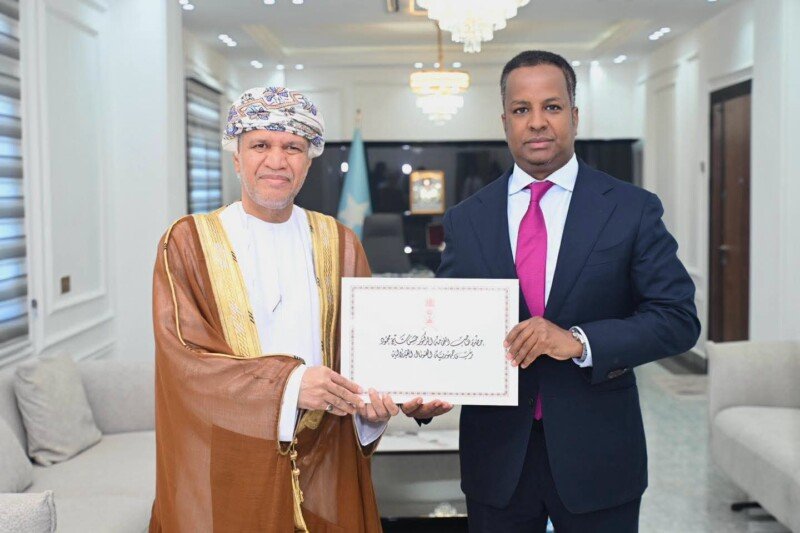
MOGADISHU, Foreign Minister Abdisalam Abdi Ali received a copy of the credentials of Oman’s new Ambassador to Somalia, Salim bin Habib Al-Umairi, on Saturday, marking a significant step in the restoration of diplomatic ties between Mogadishu and Muscat.
According to a statement from the Ministry of Foreign Affairs, Minister Abdisalam welcomed the new ambassador and pledged the ministry’s full support for his diplomatic duties. He also congratulated the ambassador on the reopening of Oman’s embassy in Mogadishu after 36 years of closure, describing the move as a clear demonstration of Oman’s strong confidence in Somalia.
The minister thanked the Omani government for its continued support for the sovereignty, unity, and territorial integrity of the Federal Republic of Somalia.
A Relationship Rebuilt on Mutual Respect
The reopening of Oman’s embassy is the culmination of a steady warming of relations that has accelerated over the past two years. In April 2026, Minister Abdisalam visited Muscat for high-level talks with Omani officials, including a meeting with Foreign Minister Sayyid Badr Albusaidi, who reaffirmed Oman’s firm position in support of Somalia’s unity, sovereignty, and territorial integrity, and its non-recognition of any entities outside the framework of the Somali state, as reported in Oman’s Foreign Ministry.
During that visit, the Somali delegation also engaged with the Oman Investment Authority to discuss opportunities in energy, infrastructure, logistics, food security, and information technology. The two sides explored ways to activate public-private partnerships and open new avenues for economic integration, as detailed in the Oman News Agency.
Economic cooperation has been a central pillar of the relationship. In December 2025, Somali business leaders held a strategic forum with Oman’s Minister of Commerce, Industry, and Investment Promotion, Qais Mohammed Al-Yousef, who noted that bilateral trade volume was around $20 million and “poised for significant growth.” Oman has also expressed interest in investing in Somalia’s Al-Ula Special Economic Zone, with the Omani Authority for Investment Promotion and Export Development offering technical expertise and training to zone management staff, as reported in FTL Somalia’s coverage of the Muscat talks.
What the Embassy Reopening Means
The closure of Oman’s embassy in Mogadishu for 36 years was a product of Somalia’s long civil war and the resulting collapse of diplomatic infrastructure in the capital. Its reopening signals that Muscat views the current federal government as a stable and reliable partner, and that it is prepared to invest diplomatic resources in the relationship.
For Somalia, the reopening is a diplomatic victory. It adds another Arab and Gulf state to the list of countries with a physical diplomatic presence in Mogadishu, reinforcing the federal government’s claim to be the legitimate and effective representative of the Somali state. It also provides a direct channel for consular services, trade facilitation, and people-to-people exchanges that had previously been handled through third countries.
The timing is also significant. It comes as Somalia navigates complex regional dynamics, including the Red Sea security crisis, the Ethiopia-Eritrea standoff, and the ongoing debate over Somaliland’s status. Oman’s explicit rejection of “any entities outside the framework of the Somali state” is a reaffirmation of the international consensus on Somalia’s territorial integrity, and a signal that Muscat will not follow the path of Israel.
Critical Note
The reopening of Oman’s embassy and the accreditation of a new ambassador are tangible diplomatic achievements, and the Somali government is right to celebrate them. A physical embassy in Mogadishu is more than a symbol. It is an operational platform for trade, investment, and political engagement that did not exist before.
But the relationship’s future will depend on whether the economic promises translate into action. The $20 million trade volume is modest for two countries with historic ties and geographic proximity. Oman’s interest in the Al-Ula Special Economic Zone is welcome, but expressions of interest are not investments. The embassy’s reopening creates the conditions for deeper engagement. It does not guarantee that the engagement will materialize.
For Somalia, the lesson of the past two years is that diplomatic momentum must be sustained. The visits, the agreements, and the reopening of embassies are necessary steps, but they are not ends in themselves. The test of the Oman relationship will be whether Omani investment arrives, whether trade grows, and whether the embassy becomes a hub of activity rather than a quiet diplomatic outpost. The credentials ceremony on Saturday was a beginning. The work starts now.