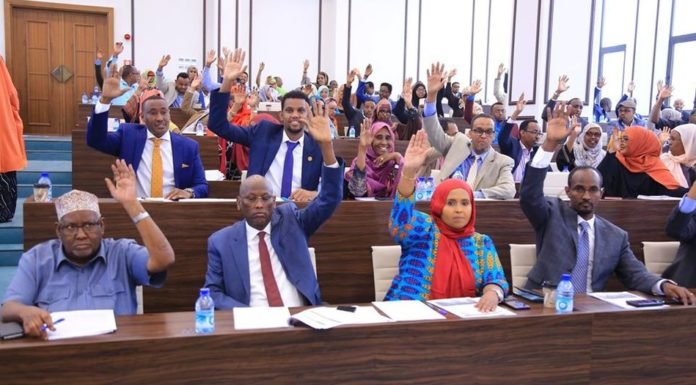
MOGADISHU — Somalia’s House of the People approved the International Judicial Cooperation Bill on Sunday in a vote of 130 in favour, nine against, and two abstentions, during the nineteenth sitting of the eighth parliamentary session.
The session was chaired by Second Deputy Speaker Abdullahi Omar Abshirow, who announced the result. The bill establishes the legal framework for Somalia’s judicial cooperation with foreign countries, including Mutual Legal Assistance, Extradition, and the Transfer of Sentenced Prisoners.
The approval follows the bill’s first reading in May 2025 and its second reading earlier in September 2026, when the Judiciary, Religious Sites, and Religious Affairs Committee presented its report and the House directed the committee to incorporate MPs’ views before returning the legislation for a third reading.
Central Bank Amendment Advances
The House also conducted the second reading of the bill amending the Central Bank of Somalia Law, Law No. 130 of 22 April 2012. MPs debated the provisions of the amendment and directed questions to officials from the Ministry of Justice and Constitutional Affairs and the Central Bank, who were present at the session.
The Central Bank amendment comes as Somalia’s financial sector undergoes significant reform. As reported in FTL Somalia’s coverage of the currency reform, the Central Bank is preparing to reintroduce the Somali shilling under a currency board arrangement, ending a 35-year period without new domestic banknotes. The Bank has also obtained ISO/IEC 27001:2022 certification for its Information Security Management System, granted operating licenses to four Takaful companies, and seen the National Payment System Law enacted in March 2026.
Türkiye Judicial Cooperation Agreements Distributed
At the conclusion of the session, MPs were distributed the second reading report of the agreements between Somalia and Türkiye concerning international judicial cooperation. As detailed in FTL Somalia’s coverage of the agreements, these include provisions on the transfer of sentenced persons and mutual legal assistance in criminal matters.
The agreements form part of the broader Somalia-Türkiye strategic partnership. In February 2026, Justice Minister Hassan Moalim Mohamud met with his Turkish counterpart to discuss strengthening cooperation between the judicial bodies of both nations. The two countries have also partnered on forensic investigation capacity, as reported in FTL Somalia’s coverage of the trilateral forensic initiative.
Critical Note
The passage of the International Judicial Cooperation Bill represents a necessary step in addressing a longstanding gap in Somalia’s legal architecture. As the case of Abdikariim Abdelahi Eidleh demonstrated, Somalia previously lacked the statutory framework to extradite criminal suspects to countries with which it had no treaty. FTL Somalia documented the legal roadblocks that initially prevented Eidleh’s transfer to the United States, before he was eventually handed over in July 2026 as reported in FTL Somalia’s coverage of his apprehension. The bill, once fully enacted, would provide a clearer legal basis for such cooperation in the future.
The Central Bank amendment is also significant given the institution’s expanding role in financial sector regulation. The Bank has been implementing reforms supported by the IMF and World Bank, including preparations for a new currency regime. The amendment may address governance, mandate, or operational provisions that need updating to reflect the Bank’s evolving responsibilities.
The distribution of the Türkiye judicial cooperation agreements reflects the deepening relationship between Mogadishu and Ankara. As Türkiye’s role in Somalia expands across security, economic, and institutional domains, the legal framework governing cooperation between the two countries becomes increasingly important. The agreements will now proceed to the next stage of the legislative process.
Recommended Reading On ftlsomalia.com
- Somali Parliament Holds First Reading of Child Rights Charter and International Judicial Cooperation Bill
- Parliament Passes Environmental Management Bill, Advances Central Bank Amendment and Judicial Cooperation Legislation
- Somalia Signs Justice Cooperation Agreement with Turkey
- Somalia, Turkey Boost Judicial Ties in Ministerial Meeting
- Gambia, Somalia Partner with Türkiye to Boost Forensic Investigation Capacity
- Legal and Diplomatic Roadblocks Emerge in Effort to Bring Somalia-Based Fraud Suspect to U.S. Trial