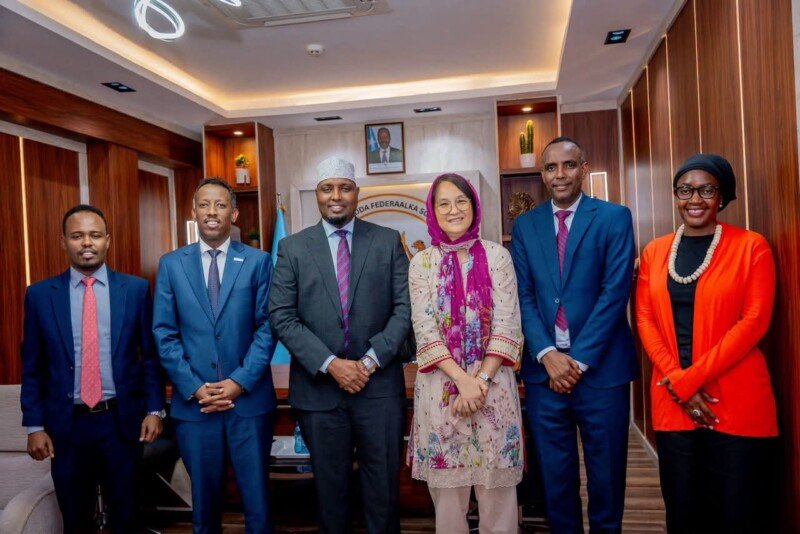
MOGADISHU — The Minister of Planning, Investment and Economic Development, Mohamed Abdirahman Sheikh Farah (Beenebeene), has received the Deputy Representative of the UN High Commissioner for Refugees (UNHCR) in Somalia and Acting Representative, Ms. Jing Song, at his office in Mogadishu.
The meeting focused on strengthening strategic cooperation between the Ministry and UNHCR, particularly in the areas of planning, coordination, monitoring, and evaluation of the agency’s programs to align with the priorities outlined in the National Transformation Plan (NTP) [citation:4][citation:5].
Both sides also discussed strengthening cooperation on data and evidence to support planning and decision-making based on accurate information. The Minister and the Acting Representative agreed to develop a new cooperation framework that clearly defines priority areas, coordination mechanisms, and the roles of both parties to enhance collaboration and support the implementation of national development priorities.
The meeting also addressed arrangements for a special event to commemorate the 75th anniversary of the 1951 Refugee Convention, which is planned to take place during the UN General Assembly (UNGA) session.
UNHCR’s Role in Somalia
UNHCR has been a key partner in Somalia’s humanitarian response, providing protection and assistance to refugees, asylum-seekers, and internally displaced persons. Somalia and UNHCR have previously held discussions on expanding support for internally displaced persons, focusing on aligning UNHCR programs with the National Transformation Plan.
The Ministry of Planning has previously held consultations with UNHCR on support for refugee returnees, focusing on durable solutions that enable returnees to rebuild their lives and contribute to the country’s development.
In a significant step toward durable solutions, Somalia and the UNHCR agreed to find long-term solutions for internally displaced persons during a high-level meeting in Mogadishu earlier this year. The agreement includes efforts to create conditions for voluntary return, local integration, or relocation, with the aim of ending the cycle of displacement.
Somalia has also approved the Refugees and Asylum Seekers Bill [citation:2], which establishes a legal framework for the rights and obligations of displaced people and provides a legal framework for handling foreigners who seek asylum in Somalia.
Somalia also launched a Refugee & Asylum Seeker ID Issuance Program aimed at providing identification documents to over 38,000 refugees and asylum seekers residing in the country, the majority from Ethiopia and Yemen.
The government has also pledged to enhance assistance for refugees and internally displaced persons, with the Minister of Interior, Federal Affairs and Reconciliation, Ali Yusuf Ali (Hosh), committing to upgrade humanitarian services and social protection nationwide during a working tour of the National Commission for Refugees and Internally Displaced Persons (NCRI) headquarters.
Critical Note
The meeting between the Planning Minister and the UNHCR Acting Representative reflects the government’s continued efforts to align humanitarian and development programs with national priorities. The focus on data-driven planning and coordination is a positive step toward ensuring that UNHCR’s programs contribute effectively to Somalia’s development objectives.
However, the scale of displacement in Somalia remains enormous, with over 3.3 million people internally displaced and nearly five million requiring humanitarian assistance. The government’s capacity to address these challenges is limited, and international support remains essential.
The planned commemoration of the 75th anniversary of the 1951 Refugee Convention provides an opportunity for Somalia to highlight its commitments to refugee protection and to mobilize support for durable solutions. Yet, the government must also address the root causes of displacement, including conflict, climate change, and poverty, to prevent new displacement and enable sustainable returns.