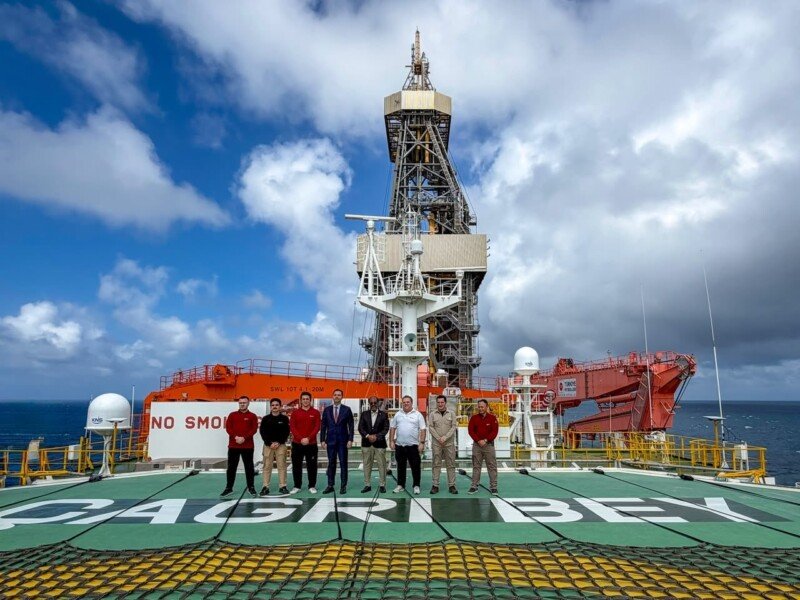
MOGADISHU — President Hassan Sheikh Mohamud visited the Çağrı Bey ultra-deepwater drillship this week, where he received a briefing from the vessel’s experts and officials on the progress of Somalia’s first offshore oil exploration operation.
According to a statement from Villa Somalia, the President inspected the vessel and was briefed on the preliminary findings and results achieved so far as part of efforts to assess Somalia’s offshore oil resources. The visit underscores the government’s focus on the ongoing exploration campaign and its potential to reshape the country’s economic future.
The Çağrı Bey and Curad-1 Well
The Çağrı Bey, operated by Turkey’s state-owned Turkish Petroleum Corporation (TPAO), arrived in Mogadishu in April 2026 after a 53-day voyage from Turkey’s Taşucu port, as reported in FTL Somalia’s coverage of the vessel’s arrival. The drillship is conducting Turkey’s first-ever overseas deep-sea drilling operation at the Curad-1 well, located approximately 372 kilometers off the Somali coast.
The well site was selected following months of seismic surveys conducted by the Turkish vessel Oruç Reis, which collected 3D seismic data across 4,464 square kilometers in three offshore blocks over 234 days, as detailed in FTL Somalia’s coverage of the seismic mission.
Drilling is planned to reach a total depth of approximately 7,500 meters, including about 3,500 meters of water depth and 4,000 meters below the seabed, making Curad-1 one of the deepest offshore wells globally. The name “Curad” means “first-born child” in Somali.
Progress Ahead of Schedule
The drilling operation has progressed ahead of schedule. As reported in FTL Somalia’s coverage of the drilling progress, the operation had reached a depth of around 3,000 meters by late August, with Somali Petroleum Authority Director General Abdulkadir Adan stating that completion by the end of September was possible ahead of the original October target.
The operation is supported by auxiliary vessels Altan, Korkut, and Sancar, with Turkish naval assets providing offshore security. As detailed in FTL Somalia’s coverage of the naval escort mission, TCG Gelibolu and TCG Göksu are engaged in a dual mission of protecting the drilling fleet and training Somali Navy and Coast Guard personnel.
Strategic Partnership Beyond Energy
The hydrocarbon exploration is part of a broader Turkey-Somalia partnership that has expanded significantly since President Recep Tayyip Erdoğan’s landmark 2011 visit to Mogadishu. The two countries signed an offshore oil and gas cooperation agreement in March 2024, followed by a Production Sharing Agreement in 2025 creating the legal and commercial structure to guide exploration activities.
At the April launch ceremony in Mogadishu, President Hassan Sheikh Mohamud said the drilling marked the start of “a new stage of shared progress” and stated that “natural resources are national wealth and will benefit all Somalis.” Turkish Energy Minister Alparslan Bayraktar described the operation as opening “a new era in Turkish oil and natural gas exploration.”
Somali Prime Minister Hamza Abdi Barre expressed optimism about the project’s potential, stating at the ceremony: “God willing, in a few months we will celebrate the first oil extraction.”
Governance and Transparency Concerns
Despite the optimism surrounding the drilling campaign, governance watchdogs have raised concerns about resource management. The Somalia Transparency Initiative has warned that while the arrival of the Çağrı Bey indicates tangible progress, severe risks stem from improper resource management, calling on federal authorities to maintain absolute transparency through the immediate public disclosure of oil contracts.
Opposition figures have also criticized the agreement. MP Abdirahman Abdishakur Warsame has characterized the oil exploration pact as “profoundly imbalanced,” warning that it might jeopardize Somalia’s national interests. Senator Professor Abdi Ismail Samatar has alleged that the defense and petroleum agreements between Türkiye and Somalia are “fraudulent” and have not been scrutinized or endorsed by the Somali Parliament.
Critical Note
President Mohamud’s visit to the Çağrı Bey is a symbolic moment that underscores the political weight his administration has attached to the offshore drilling campaign. The operation is the most tangible outcome of the Turkey-Somalia partnership and, if successful, could transform Somalia’s fiscal outlook.
However, the path from exploration to production is long and uncertain. No commercial discovery has been confirmed, and the results of the Curad-1 well will not be known until drilling and evaluation are complete. Even a discovery would require appraisal drilling, development planning, export infrastructure, and a transparent fiscal and regulatory framework before Somalia could realize any revenue.
The governance concerns raised by transparency watchdogs and opposition figures are particularly significant. Somalia’s history with natural resource management is limited, and the country faces well-documented challenges with corruption and institutional capacity. The “resource curse” that has afflicted other developing nations, where resource wealth leads to corruption, economic disparity, and political instability rather than prosperity, is a real risk if robust accountability mechanisms are not established before revenues begin to flow.
Recommended Reading On ftlsomalia.com
- Turkish Drillship Arrives in Mogadishu for Somalia’s First Offshore Oil Drilling
- Somali-Turkish Energy Partnership Reaches Milestone as Drilling Progresses Ahead of Schedule
- Turkey Completes 234-Day Seismic Mission in Somali Waters
- Turkish Navy Ships Train Somali Forces as Drilling Protection Mission Continues